Brief Report - (2025) Volume 9, Issue 3
Received: 01-May-2025, Manuscript No. fsb-26-189943;
Editor assigned: 05-May-2025, Pre QC No. P-189943;
Reviewed: 19-May-2025, QC No. Q-189943;
Revised: 22-May-2025, Manuscript No. R-189943;
Published:
29-May-2025
, DOI: 10.37421/2577-0543.2025.9.229
Citation: Mehta, Aarav. ”Lipid Systems For Enhanced Oral Drug Delivery.” J Formul Sci Bioavailab 09 (2025):229.
Copyright: © 2025 Mehta A. This is an open-access article distributed under the terms of the Creative Commons Attribution License, which permits unrestricted use, distribution and reproduction in any medium, provided the original author and source are credited.
Lipid-based drug delivery systems (LBDDS) are emerging as a transformative approach in oral drug administration, particularly addressing the challenges posed by drugs with poor solubility and permeability. These systems are designed to overcome biological barriers and improve the absorption of active pharmaceutical ingredients, thereby enhancing therapeutic efficacy. Recent advancements have focused on developing sophisticated lipidic formulations that can solubilize and protect drug molecules, leading to improved pharmacokinetic profiles. This has opened new avenues for delivering a wide range of therapeutic agents, including challenging small molecules and biologics. One of the significant areas of development within LBDDS involves nanostructured lipid carriers (NLCs) and solid lipid nanoparticles (SLNs). These nanocarriers offer a protective environment for drugs, shielding them from degradation in the gastrointestinal tract and facilitating their absorption through various mechanisms. The ability of these systems to maintain drug integrity and promote bioavailability makes them highly attractive for oral drug delivery applications [1].
NLCs, in particular, have demonstrated superiority over traditional SLNs by incorporating liquid lipids into their matrix. This innovation leads to a higher drug loading capacity and a reduced tendency for drug expulsion during storage, which are critical factors for long-term formulation stability and efficacy. The unique structure of NLCs also contributes to sustained drug release and enhanced oral bioavailability [2].
Further augmentation of oral absorption for poorly permeable drugs can be achieved through the incorporation of permeation enhancers within LBDDS. These enhancers work by transiently modifying the intestinal epithelium, specifically by reversibly disrupting tight junctions. This mechanism facilitates the paracellular transport of drugs, offering a synergistic approach to improve oral drug delivery and therapeutic outcomes [3].
Self-emulsifying drug delivery systems (SEDDS) represent another cornerstone of LBDDS technology. These systems are formulated to spontaneously form fine oil-in-water emulsions upon contact with gastrointestinal fluids. Their inherent ability to effectively solubilize lipophilic drugs and present them in a readily absorbable form significantly enhances oral bioavailability, especially for drugs that exhibit poor aqueous solubility [4].
Solid lipid nanoparticles (SLNs) continue to be explored as versatile carriers for oral drug delivery due to their biocompatibility and ability to encapsulate both hydrophilic and hydrophobic drugs. SLNs provide protection against enzymatic degradation and first-pass metabolism, which are common limitations for oral drug administration. Their potential to improve pharmacokinetic profiles is a key area of research [5].
Advanced lipidic formulations, including nanoemulsions and microemulsions, have also played a pivotal role in enhancing the oral absorption of lipophilic drugs. These systems offer a significantly increased surface area for absorption and effectively facilitate drug solubilization. This leads to improved bioavailability and the potential for reduced drug dosages, thereby minimizing side effects [6].
Hybrid nanoparticle systems, such as chitosan-lipid hybrid nanoparticles, present a synergistic approach to oral drug delivery. By combining the mucoadhesive properties of chitosan with the drug solubilizing and absorption-enhancing capabilities of lipids, these nanoparticles can improve drug residence time in the gastrointestinal tract and enhance cellular uptake, ultimately leading to higher bioavailability [7].
The development of targeted lipid-based nanocarriers, equipped with specific ligands, offers another strategy to improve oral drug bioavailability. These targeted systems can enhance drug interaction with intestinal epithelial cells and reduce clearance rates, ensuring more efficient delivery of the drug to its absorption site. This targeted approach is crucial for optimizing drug efficacy [8].
Ionic liquids are also emerging as innovative excipients in LBDDS. Their unique physicochemical properties, including tunable polarity and high drug solubility, make them valuable for improving the dissolution rate and oral bioavailability of poorly soluble drugs when integrated into lipid formulations. This represents a novel direction in drug delivery system design [9].
Lipid-based drug delivery systems (LBDDS) are revolutionizing oral drug administration by effectively tackling the inherent challenges of poor drug solubility and permeability. These advanced systems are engineered to protect active pharmaceutical ingredients from degradation within the gastrointestinal tract and facilitate their absorption across biological membranes, ultimately leading to enhanced therapeutic outcomes. The ongoing evolution of LBDDS encompasses a variety of sophisticated formulations designed to improve the bioavailability of a wide spectrum of drug molecules. The landscape of LBDDS has been significantly shaped by advancements in nanocarrier technologies, particularly nanostructured lipid carriers (NLCs) and solid lipid nanoparticles (SLNs). These nano-sized systems provide a protective matrix for encapsulated drugs, shielding them from harsh physiological conditions and promoting their entry into the systemic circulation. Their development represents a crucial step forward in overcoming the limitations of conventional oral drug delivery [1].
NLCs are a notable improvement over their predecessors, SLNs, owing to the strategic incorporation of liquid lipids. This modification not only increases the capacity for drug loading but also mitigates the issue of drug expulsion during storage, thereby ensuring formulation stability and consistent drug delivery. The distinct structural characteristics of NLCs enable sustained drug release and a notable enhancement in oral bioavailability [2].
To further bolster the oral absorption of drugs with poor permeability, the integration of permeation enhancers into lipid-based formulations has proven to be a highly effective strategy. These enhancers function by transiently and reversibly altering the intestinal epithelial barrier, specifically by loosening the tight junctions between cells. This mechanism facilitates paracellular drug transport, providing a complementary approach to enhance oral drug absorption [3].
Self-emulsifying drug delivery systems (SEDDS) are a foundational element within the broader category of LBDDS. These systems possess the remarkable ability to spontaneously form fine oil-in-water emulsions upon exposure to gastrointestinal fluids. Their capacity to solubilize lipophilic drugs and present them in a readily absorbable form is instrumental in significantly boosting oral bioavailability, particularly for drugs that are poorly soluble in water [4].
Solid lipid nanoparticles (SLNs) continue to be recognized for their versatility as carriers in oral drug delivery systems. Their inherent biocompatibility and ability to encapsulate both hydrophilic and hydrophobic drugs make them an attractive option for improving the pharmacokinetic profiles of various therapeutic agents. SLNs offer protection against enzymatic breakdown and first-pass metabolism [5].
More complex lipidic formulations, such as nanoemulsions and microemulsions, have demonstrated considerable success in improving the oral absorption of lipophilic drugs. These systems are characterized by a large surface area that promotes absorption and effectively solubilize drugs, leading to enhanced bioavailability and potentially lower required doses [6].
A synergistic approach to oral drug delivery is offered by chitosan-lipid hybrid nanoparticles. These systems leverage the mucoadhesive properties of chitosan to increase drug residence time in the gastrointestinal tract, while the lipid component aids in drug solubilization and absorption enhancement. This combination improves cellular uptake and leads to higher bioavailability [7].
Targeted lipid-based nanocarriers, functionalized with specific ligands, represent an advanced strategy for enhancing oral drug bioavailability. By directing these nanocarriers to interact more effectively with intestinal epithelial cells and reducing their systemic clearance, this approach ensures that a greater amount of drug reaches the site of absorption, thus improving therapeutic efficacy [8].
Ionic liquids are emerging as novel excipients in the formulation of lipid-based drug delivery systems. Their unique physicochemical attributes, such as adjustable polarity and a high capacity for drug solubility, make them particularly useful for improving the dissolution rate and oral bioavailability of poorly soluble drugs when incorporated into lipid matrices. This represents an innovative direction in drug delivery formulation [9].
Lipid-based drug delivery systems (LBDDS) are significantly improving oral drug administration by addressing poor solubility and permeability issues. Advanced formulations like nanostructured lipid carriers (NLCs) and solid lipid nanoparticles (SLNs) protect drugs from degradation and enhance absorption. NLCs offer superior drug loading and reduced expulsion compared to SLNs. The addition of permeation enhancers further boosts absorption by facilitating paracellular transport. Self-emulsifying drug delivery systems (SEDDS) effectively solubilize lipophilic drugs, while nanoemulsions and microemulsions increase absorption surface area. Hybrid systems like chitosan-lipid nanoparticles combine mucoadhesion with absorption enhancement. Targeted nanocarriers improve drug interaction with intestinal cells, and ionic liquids act as novel excipients to enhance dissolution and bioavailability. These innovations are crucial for the effective oral delivery of hydrophobic drugs.
None
None
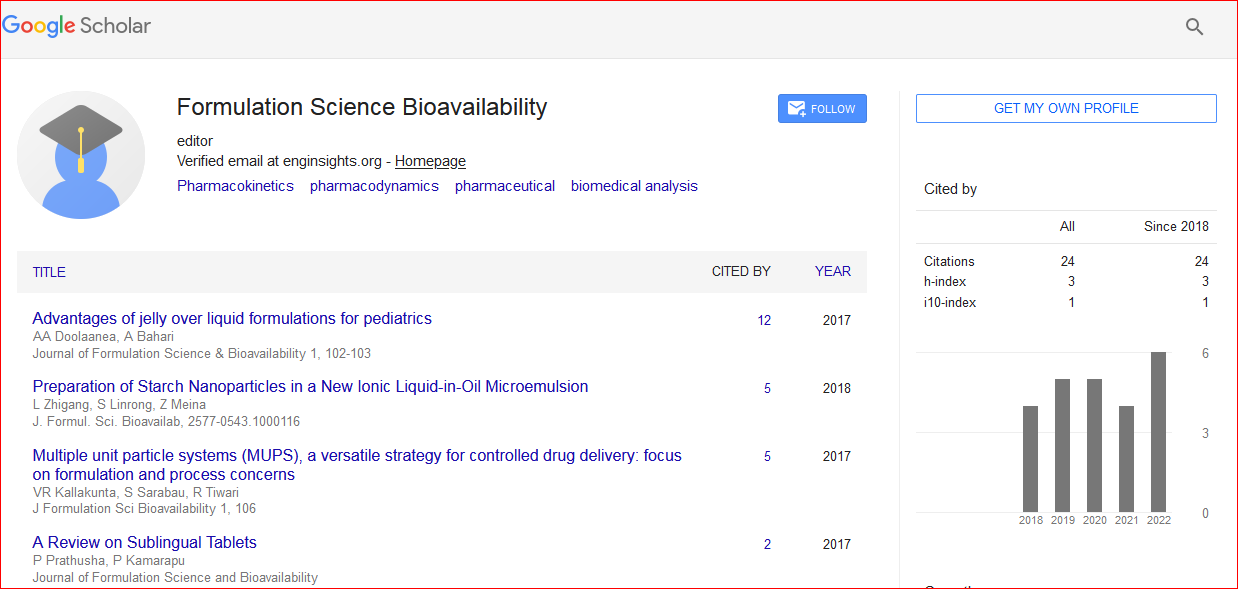
Journal of Formulation Science & Bioavailability received 23 citations as per Google Scholar report