Perspective - (2025) Volume 12, Issue 4
Received: 01-Aug-2025, Manuscript No. jreac-26-185841;
Editor assigned: 04-Aug-2025, Pre QC No. P-185841;
Reviewed: 18-Aug-2025, QC No. Q-185841;
Revised: 22-Aug-2025, Manuscript No. R-185841;
Published:
29-Aug-2025
, DOI: 10.37421/2380-2391.2025.12.442
Citation: Dijk, Marieke van. ”LC-MS/MS Analysis Of Antibiotic Residues In Wastewater.” J Environ Anal Chem 12 (2025):442.
Copyright: © 2025 Dijk v. Marieke This is an open-access article distributed under the terms of the Creative Commons Attribution License, which permits unrestricted use, distribution and reproduction in any medium, provided the original author and source are credited.
The pervasive presence of antibiotic residues in urban wastewater poses a significant environmental and public health challenge, necessitating the development of robust analytical methodologies for their detection and quantification. Research has increasingly focused on employing advanced techniques to monitor these contaminants effectively. One study details the development and validation of a liquid chromatography-tandem mass spectrometry (LC-MS/MS) method for the simultaneous determination of various antibiotic residues in urban wastewater, highlighting challenges with matrix effects and proposing optimized sample preparation techniques to mitigate these issues, identifying and quantifying classes such as fluoroquinolones, sulfonamides, and macrolides at environmentally relevant concentrations [1].
Another investigation delves into the occurrence and spatial distribution of macrolide antibiotics in wastewater treatment plant influents and effluents within a large urban setting, utilizing an advanced LC-MS/MS approach to quantify concentrations and discuss potential removal efficiencies, identifying specific macrolides as persistent pollutants and linking their presence to local pharmaceutical usage patterns [2].
Furthermore, a comprehensive analysis of fluoroquinolone antibiotics in raw and treated urban wastewater using high-resolution LC-MS/MS is presented, addressing challenges posed by complex matrices and proposing robust extraction and cleanup procedures, revealing the widespread presence of several fluoroquinolones with varying persistence levels [3].
A critical aspect of this research involves assessing the efficacy of LC-MS/MS in detecting and quantifying a broad spectrum of these compounds, providing a critical analytical tool for environmental agencies to monitor these critical antimicrobial agents. The need for optimized sample preparation strategies for the analysis of sulfonamide and trimethoprim residues in urban wastewater by LC-MS/MS is addressed, systematically evaluating different solid-phase extraction (SPE) sorbents and elution solvents to maximize analyte recovery and minimize matrix interference, with the validated method applied to real wastewater samples [4].
This study demonstrates the method's ability to detect these important antibiotics at low ng/L levels, contributing to a better understanding of the prevalence and behavior of these antimicrobial drugs in aquatic environments. The investigation into the presence of beta-lactam antibiotics in urban wastewater using a highly sensitive LC-MS/MS method is crucial, addressing challenges related to the instability of beta-lactams in aqueous matrices through rapid sample collection and processing, successfully identifying and quantifying several beta-lactam residues [5].
This work is vital for assessing the environmental risk associated with these critically important antibiotics and providing insights into their sources and degradation pathways within the wastewater system. A sensitive LC-MS/MS method for the multi-residue analysis of tetracyclines in urban wastewater has been developed, highlighting the importance of efficient sample enrichment and cleanup steps to overcome matrix complexities, with the validated method demonstrating excellent sensitivity and selectivity for detecting tetracycline antibiotics [6].
This provides crucial data on their occurrence and persistence in urban aquatic environments. The application of LC-MS/MS for the analysis of aminoglycoside antibiotics in urban wastewater is explored, addressing challenges associated with the polar nature of these compounds and developing a robust sample preparation protocol, enabling the detection of aminoglycosides at trace levels [7].
The findings are essential for monitoring the effectiveness of wastewater treatment processes in removing these antibiotics and contribute to a better understanding of their environmental presence and potential risks. The evaluation of LC-MS/MS for the simultaneous monitoring of lincosamides and streptogramins in urban wastewater is also a significant area of research, focusing on developing an efficient sample cleanup procedure to reduce matrix effects and improve analytical performance, providing valuable data on their occurrence and distribution [8].
This work supports efforts to assess the environmental impact of these antimicrobial agents. Finally, a comprehensive assessment of antibiotic residues, including cephalosporins, in urban wastewater using LC-MS/MS is presented, detailing the development of a sensitive and selective analytical method capable of handling the complex wastewater matrix, highlighting the need for continuous monitoring to mitigate potential environmental risks and the development of antibiotic resistance [9].
The study reveals the presence of several cephalosporin antibiotics, emphasizing the importance of such analytical approaches. The analysis of nitroimidazoles in urban wastewater employing LC-MS/MS presents distinct challenges and solutions, addressing sample preparation complexities and matrix effects inherent to wastewater samples, validating a method for accurate determination and providing essential data for environmental risk assessment [10].
This research underscores the importance of advanced analytical techniques for tracking pharmaceutical contaminants.
The critical need to monitor antibiotic residues in urban wastewater drives the advancement of sophisticated analytical techniques, with LC-MS/MS emerging as a primary tool. One foundational study presents a detailed development and validation of an LC-MS/MS method designed for the simultaneous determination of various antibiotic residues in urban wastewater samples, specifically addressing and overcoming the prevalent challenges posed by matrix effects through optimized sample preparation techniques, successfully quantifying common antibiotic classes like fluoroquinolones, sulfonamides, and macrolides at environmentally relevant concentrations [1].
This establishes a robust analytical framework for routine monitoring. In parallel, research investigates the occurrence and spatial distribution of macrolide antibiotics within urban wastewater treatment systems, employing an advanced LC-MS/MS approach to quantify macrolide concentrations in both influents and effluents and to assess their removal efficiencies during treatment processes, identifying persistent macrolides and correlating their presence with local pharmaceutical consumption patterns [2].
This provides crucial insights into the fate of these compounds. A significant contribution to the field is the comprehensive analysis of fluoroquinolone antibiotics in urban wastewater, which utilizes high-resolution LC-MS/MS to detect and quantify these residues in raw and treated samples, tackling the complexities of the wastewater matrix through the proposal of robust extraction and cleanup procedures, thereby revealing the widespread presence and varying persistence of several fluoroquinolones [3].
This analytical tool is invaluable for environmental monitoring. Further enhancing analytical capabilities, an optimized sample preparation strategy for the determination of sulfonamide and trimethoprim residues in urban wastewater by LC-MS/MS is detailed, involving a systematic evaluation of diverse solid-phase extraction (SPE) sorbents and elution solvents to maximize analyte recovery while minimizing matrix interference, with the validated method demonstrating efficacy in detecting these important antibiotics at low ng/L levels in real wastewater samples [4].
This contributes to a deeper understanding of their environmental behavior. The detection and quantification of beta-lactam antibiotics in urban wastewater using a highly sensitive LC-MS/MS method are addressed, specifically focusing on mitigating challenges arising from the inherent instability of these compounds in aqueous matrices through prompt sample collection and rapid processing, successfully identifying and quantifying various beta-lactam residues and shedding light on their sources and degradation pathways [5].
This is vital for environmental risk assessment. Moreover, a sensitive LC-MS/MS method for the multi-residue analysis of tetracyclines in urban wastewater has been developed, emphasizing the critical role of efficient sample enrichment and cleanup steps in overcoming matrix complexities and ensuring the validated method's excellent sensitivity and selectivity for detecting tetracycline antibiotics, thus providing essential data on their occurrence and persistence [6].
This supports environmental surveillance. The application of LC-MS/MS for analyzing aminoglycoside antibiotics in urban wastewater is also explored, tackling the inherent challenges presented by the polar nature of these compounds through the development of a robust sample preparation protocol, enabling the detection of aminoglycosides at trace levels and contributing to a better understanding of their environmental presence [7].
These findings are key for evaluating treatment efficacy. Another study focuses on the simultaneous determination of lincosamides and streptogramins in urban wastewater by LC-MS/MS, centering on the development of an effective sample cleanup procedure to minimize matrix effects and enhance analytical performance, with the validated method proving adept at quantifying these antibiotic classes and providing valuable distributional data [8].
This work aids in assessing their environmental impact. A comprehensive assessment of cephalosporin antibiotic residues in urban wastewater using LC-MS/MS is also a notable contribution, detailing the creation of a sensitive and selective analytical method capable of handling the complex wastewater matrix and identifying the presence of several cephalosporin antibiotics, underscoring the importance of continuous monitoring for risk mitigation [9].
This highlights the need for ongoing surveillance. Finally, the challenges and solutions associated with the analysis of nitroimidazoles in urban wastewater employing LC-MS/MS are investigated, addressing critical sample preparation complexities and matrix effects, validating a method for accurate determination and offering essential data for environmental risk assessment and management strategies [10].
This work emphasizes the significance of advanced analytical techniques.
This collection of research focuses on the development and application of liquid chromatography-tandem mass spectrometry (LC-MS/MS) for the analysis of various antibiotic residues in urban wastewater. Studies detail methods for detecting and quantifying specific classes of antibiotics including fluoroquinolones, sulfonamides, macrolides, beta-lactams, tetracyclines, aminoglycosides, lincosamides, streptogramins, cephalosporins, and nitroimidazoles. Key challenges addressed include matrix effects, sample preparation optimization, and analyte instability. The research highlights the widespread presence of these antibiotic residues in urban aquatic environments, underscoring the need for continuous monitoring to assess environmental risks, understand their fate, and inform public health strategies. The validated LC-MS/MS methods provide crucial data for environmental agencies and contribute to a better understanding of antimicrobial pollution.
None
None
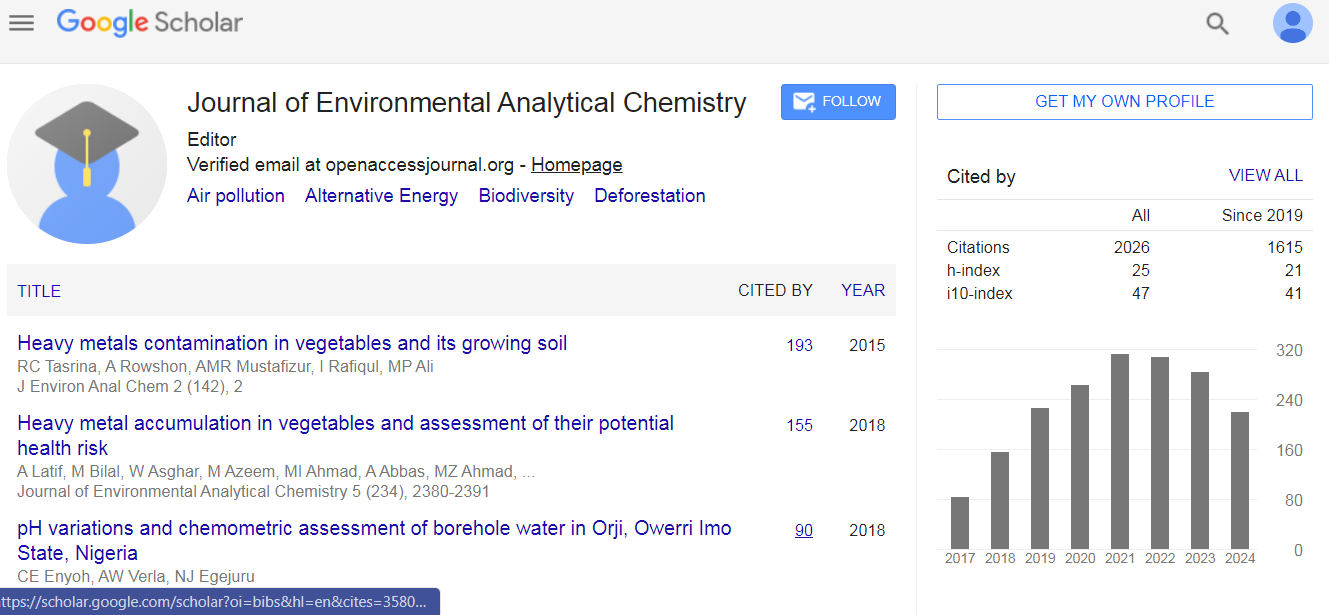
Journal of Environmental Analytical Chemistry received 1781 citations as per Google Scholar report