Brief Report - (2025) Volume 11, Issue 2
Received: 31-Mar-2025, Manuscript No. aso-25-166071;
Editor assigned: 02-Apr-2025, Pre QC No. P-166071;
Reviewed: 16-Apr-2025, QC No. Q-166071;
Revised: 24-Apr-2025, Manuscript No. R-166071;
Published:
30-Apr-2025
, DOI: 10.37421/2471-2671.2025.10.157
Citation: Nuria, Caricol. “KRAS and BRAF Mutations as Prognostic Indicators in Colorectal Cancer.” Arch Surg Oncol 10 (2025): 157.
Copyright: © 2025 Nuria C. This is an open-access article distributed under the terms of the Creative Commons Attribution License, which permits unrestricted use, distribution and reproduction in any medium, provided the original author and source are credited.
Colorectal cancer represents one of the most common malignancies worldwide and is a leading cause of cancer-related morbidity and mortality. Despite advances in screening, diagnosis, and treatment, patient outcomes vary widely due to the heterogeneous nature of the disease. This heterogeneity is largely driven by underlying genetic and molecular alterations that influence tumor behavior, progression, and response to therapy. Among these genetic changes, mutations in the KRAS and BRAF genes have gained significant attention as critical prognostic indicators. Understanding the role of these mutations in colorectal cancer not only enhances prognostication but also informs therapeutic decision-making and guides the development of targeted treatment strategies.
KRAS and BRAF are components of the mitogen-activated protein kinase signaling pathway, a key regulator of cell proliferation, differentiation, and survival [1]. Mutations in these genes can lead to constitutive activation of the signaling cascade, promoting oncogenesis and tumor progression. KRAS mutations are among the most common genetic alterations in colorectal cancer, occurring in approximately thirty to forty percent of cases, while BRAF mutations are less frequent but often associated with a distinct clinical and pathological profile. Both mutations have been extensively studied for their impact on prognosis and therapeutic responsiveness, with findings suggesting that their presence correlates with more aggressive tumor behavior and poorer clinical outcomes [2].
The prognostic significance of KRAS mutations in colorectal cancer has been demonstrated in multiple studies. Patients harboring KRAS mutations often exhibit resistance to certain targeted therapies, particularly those directed against the epidermal growth factor receptor. This resistance results in reduced treatment efficacy and has direct implications for patient survival. Additionally, KRAS-mutated tumors tend to display features associated with worse prognosis, such as advanced stage at diagnosis, increased likelihood of metastasis, and decreased overall survival rates. The specific mutation subtype within KRAS may further influence the degree of aggressiveness and clinical outcomes, highlighting the need for detailed molecular characterization in the clinical setting [3]. Similarly, BRAF mutations, most notably the V600E variant, are recognized as markers of poor prognosis in colorectal cancer. Although less common than KRAS mutations, BRAF-mutated tumors are frequently associated with a higher grade of malignancy, rapid disease progression, and a greater propensity for metastasis, particularly to the peritoneum and distant lymph nodes. Patients with BRAF-mutant colorectal cancer often have a lower median survival compared to those without these mutations. Furthermore, these tumors exhibit distinct pathological features, including a tendency toward right-sided colon localization and association with microsatellite instability. The presence of BRAF mutations may also influence the tumor microenvironment and immune response, factors that can impact therapeutic outcomes [4].
The clinical utility of assessing KRAS and BRAF mutation status extends beyond prognosis to guide treatment selection. The presence of KRAS mutations precludes the use of certain monoclonal antibodies targeting the epidermal growth factor receptor, thereby preventing ineffective treatment and sparing patients unnecessary toxicity. On the other hand, BRAF mutations have spurred the development of targeted inhibitors that specifically address the aberrant signaling caused by these alterations. Despite these advances, the overall prognosis for patients with BRAF-mutant colorectal cancer remains poor, underscoring the need for novel therapeutic approaches and combination strategies to overcome resistance mechanisms [5].
Google Scholar Cross Ref Indexed at
Google Scholar Cross Ref Indexed at
Google Scholar Cross Ref Indexed at
Google Scholar Cross Ref Indexed at
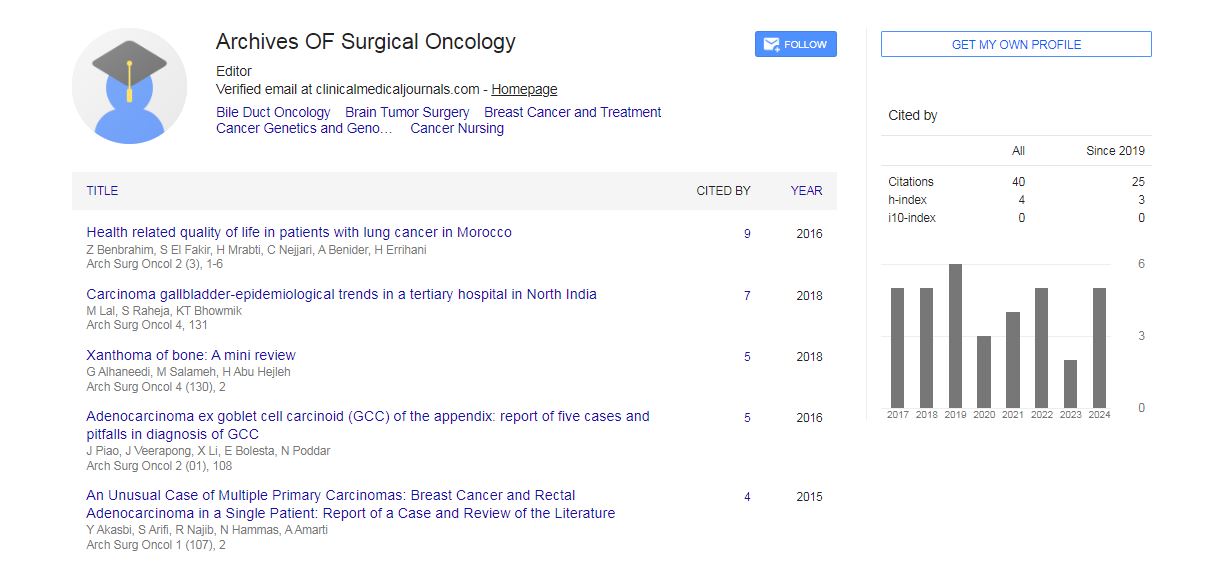
Archives of Surgical Oncology received 37 citations as per Google Scholar report