Opinion - (2025) Volume 15, Issue 5
Received: 30-Sep-2025, Manuscript No. jmcj-25-176922;
Editor assigned: 02-Oct-2025, Pre QC No. P-176922;
Reviewed: 14-Oct-2025, QC No. Q-176922;
Revised: 21-Oct-2025, Manuscript No. R-176922;
Published:
28-Oct-2025
, DOI: 10.37421/2165-7912.2025.15.645
Citation: Conti, Leonardo P.. ”Journalism Ethics: Digital Challenges and Rebuilding Trust.” J Mass Communicat Journalism 15(2025):645.
Copyright: © 2025 Conti P. Leonardo This is an open-access article distributed under the terms of the Creative Commons Attribution License, which permits unrestricted use,
distribution and reproduction in any medium, provided the original author and source are credited.
Journalism today faces a complex array of ethical challenges, continuously shaped by evolving media landscapes and societal expectations. Understanding these dilemmas is essential for maintaining public trust and ensuring responsible reporting. Central to these concerns are the intricate source-journalist relationships. Comparative studies, such as those in Sweden and the United States, demonstrate how cultural and professional norms profoundly influence how journalists manage sources, covering aspects like confidentiality, trust, and potential conflicts of interest. These studies identify both universal ethical quandaries and specific contextual differences that define ethical standards in daily reporting[1].
The pervasive issue of misinformation represents a significant challenge for contemporary journalism. Cross-national studies reveal how journalists perceive and address ethical hurdles when reporting on false content. Journalists often struggle to balance truthfulness, objectivity, and public interest amidst the rapid spread of inaccurate information. The evidence points to a critical need for clearer ethical guidelines and robust professional training, equipping journalists to effectively combat misinformation and uphold public trust[2].
Automated journalism introduces new ethical frontiers, particularly with Artificial Intelligence (AI) in news production. Research explores perceptions from both journalists and readers, highlighting concerns regarding transparency, accountability, and the potential impact on journalistic values such as objectivity and human judgment. There's a pressing need to develop clear ethical frameworks and guidelines to ensure the responsible implementation of AI technologies in news creation[3].
The relationship between trust and ethics in journalism is continually evolving, especially in the digital age. This article explores how technological advancements and changing media consumption patterns affect public confidence in news. Experts advocate for renewed focus on core ethical principles like accuracy, transparency, and accountability to rebuild and sustain trust in a fragmented media landscape[4].
Reporting on sensitive topics, specifically trauma and mental health issues, demands particular ethical attention. Review articles underscore the delicate balance between informing the public and avoiding re-traumatization or stigmatization. The emphasis here is on sensitivity, accurate portrayal, and careful language, advocating for specific ethical guidelines to ensure responsible and compassionate coverage in this critical area[5].
Ethical frameworks are also vital for fostering diversity and inclusion within journalism. Comparative studies examine how different news organizations and cultural contexts approach issues of representation, equity, and fairness in reporting. These advocate for strong ethical guidelines that move beyond mere tokenism, promoting genuine inclusivity in newsroom practices and content to serve diverse audiences better and bolster journalistic credibility[6].
The digital environment presents distinct ethical dilemmas. Qualitative research uncovers challenges tied to speed, verifying user-generated content, privacy in online spaces, and the blurring lines between personal and professional conduct on social platforms. Findings emphasize the need for updated ethical codes and continuous professional development to equip journalists for the complexities of digital news production[7].
International reporting, particularly on migration and refugee issues, introduces further ethical complexities. Studies of European journalists highlight the need to navigate sensitive topics like human dignity, stereotypes, and impartiality amidst political pressures and humanitarian concerns. This underscores the critical need for ethical reflection and training to ensure responsible, empathetic coverage, avoiding xenophobia and promoting public understanding[8].
Citizen journalism in conflict zones brings its own unique and pressing ethical challenges. Systematic reviews pinpoint significant dilemmas concerning accuracy, verification, source safety, and the potential for manipulation or propaganda. The consensus points to an urgent requirement for clear ethical guidelines and training for citizen Journalists, alongside robust support mechanisms, to uphold responsible reporting practices in highly volatile environments[9].
Ultimately, media organizations face an ethical imperative to actively rebuild public trust in journalism. Research identifies key areas where ethical failures have eroded public confidence, including bias, lack of transparency, and inadequate accountability. To address this, authors propose concrete strategies: rigorous adherence to professional standards, fostering an ethical newsroom culture, and engaging more openly with the public to restore journalism's credibility and essential societal role[10].
Journalism navigates a constantly shifting ethical landscape, shaped by societal demands and technological advancements. One primary area of concern involves the integrity of source-journalist relationships, where cultural and professional norms significantly impact how confidential information is handled, how trust is built, and how potential conflicts of interest are managed. Studies comparing practices in countries like Sweden and the United States reveal both universal ethical dilemmas and specific contextual differences influencing journalistic standards daily[1]. This points to the need for nuanced understanding rather than a one-size-fits-all approach to media ethics.
The digital age, while offering unprecedented reach, brings its own set of challenges. Misinformation, for instance, has become a pervasive issue. Journalists globally wrestle with the ethical tightrope of balancing truthfulness, objectivity, and public interest while false narratives spread rapidly. This situation underscores a critical need for clearer ethical guidelines and comprehensive professional training to equip journalists in combating misinformation effectively and responsibly, thereby preserving public confidence[2]. Similarly, the evolving relationship between trust and ethics in journalism, particularly in this digital era, has been a significant focal point. Technological shifts and changing consumption patterns directly impact public faith in news. Experts emphasize that a renewed commitment to core ethical principles such as accuracy, transparency, and accountability is paramount for rebuilding and sustaining trust in our increasingly fragmented media ecosystem[4].
The integration of Artificial Intelligence (AI) into news production, termed automated journalism, introduces complex ethical considerations. Research examines perceptions from both journalists and readers, highlighting concerns about transparency in AI operations, accountability for its outputs, and its potential effects on foundational journalistic values like human judgment and objectivity. There is a clear call for robust ethical frameworks and guidelines to ensure AI is implemented responsibly in newsrooms[3]. Furthermore, the specific ethical dilemmas arising in the digital environment extend beyond AI to include challenges related to the speed of information dissemination, the intricate verification of user-generated content, maintaining privacy in online spaces, and the blurring lines between professional and personal conduct on social media platforms. Updated ethical codes and continuous professional development are seen as essential for journalists operating in this complex digital space[7].
Beyond general practice, specialized reporting areas also present unique ethical imperatives. Covering trauma and mental health issues, for example, requires a delicate balance. It is about informing the public responsibly without re-traumatizing or stigmatizing individuals. Emphasis is placed on sensitivity, accurate portrayal, and careful language, with a strong advocacy for specific ethical guidelines to ensure compassionate and responsible coverage[5]. In a similar vein, reporting on migration and refugee issues, particularly from a European perspective, involves significant ethical hurdles. Journalists must navigate sensitive themes like human dignity, avoid reinforcing stereotypes, and uphold impartiality amidst political pressures and humanitarian concerns. This highlights the vital need for ethical reflection and specialized training to prevent xenophobia and promote deeper public understanding[8].
Moreover, fostering diversity and inclusion within journalism itself is an ethical imperative. Comparative studies explore how different news organizations and cultural contexts approach representation, equity, and fairness in their reporting. The consensus favors ethical guidelines that transcend token gestures, promoting genuine inclusivity in both newsroom practices and content to better serve diverse audiences and reinforce journalistic credibility[6].
Lastly, citizen journalism in conflict zones introduces profound ethical challenges, ranging from ensuring accuracy and verification to protecting the safety of sources and preventing manipulation or propaganda. This situation demands urgent ethical guidelines and training for citizen Journalists, coupled with strong support mechanisms, to uphold responsible reporting in volatile settings[9]. Ultimately, media organizations face an urgent task to rebuild public trust. Identified ethical failures, including bias, lack of transparency, and insufficient accountability, have eroded confidence. Strategies proposed include rigorous adherence to professional standards, cultivating an ethical newsroom culture, and engaging openly with the public to restore journalism's vital credibility and societal function[10].
Journalism ethics face diverse challenges across various domains. Studies highlight the complex dynamics of source-journalist relationships, influenced by cultural norms and trust[1]. The rise of misinformation demands clear ethical guidelines and training for journalists to balance truth, objectivity, and public interest[2]. Automated journalism presents concerns about transparency, accountability, and the impact on human judgment, necessitating new ethical frameworks for Artificial Intelligence (AI) in news[3]. The digital age continuously reshapes trust in media, emphasizing the need for accuracy, transparency, and accountability to rebuild public confidence[4]. Reporting on sensitive topics like trauma and mental health requires careful ethical consideration to avoid re-traumatization and stigmatization, advocating for specific guidelines and sensitive language[5]. Diversity and inclusion are critical, with ethical frameworks promoting genuine representation in newsrooms and content to enhance credibility[6]. The digital environment brings unique dilemmas related to speed, user-generated content verification, privacy, and social media conduct, requiring updated ethical codes[7]. Reporting on migration and refugees, particularly in Europe, involves navigating human dignity and impartiality amidst political pressures, stressing the need for empathetic training[8]. Citizen journalism in conflict zones also presents challenges regarding accuracy, source safety, and manipulation, requiring urgent ethical support[9]. Overall, rebuilding public trust in journalism is paramount, calling for rigorous professional standards, ethical newsroom cultures, and open public engagement to address issues like bias and transparency[10].
None
None
Maria K, Torbjörn O, Helle SØ. "The ethics of source-journalist relationships: A comparative study of journalistic practices in Sweden and the United States.".Journalism Studies 21 (2020):1195-1212.
Indexed at, Google Scholar, Crossref
Edson CTJ, Rich L, Maria A. "Journalists' perceptions of ethical challenges in reporting misinformation: A cross-national study.".Journalism Practice 14 (2020):969-985.
Indexed at, Google Scholar, Crossref
Mária L, Frédéric Z, Miklós F. "Ethical dilemmas of automated journalism: Perceptions of journalists and readers.".Journalism 22 (2021):994-1011.
Indexed at, Google Scholar, Crossref
Thomas H, Folker H, Afonso dA. "Trust and ethics in journalism: Challenges in the digital age.".Journalism Studies 20 (2019):1-17.
Indexed at, Google Scholar, Crossref
Rebecca L, Kylie G, Kerry B. "Ethical reporting of trauma and mental health in journalism: A review.".Journal of Health Communication 27 (2022):388-397.
Indexed at, Google Scholar, Crossref
Jeremy J, Edson CTJ, Rich L. "Ethical frameworks for diversity and inclusion in journalism: A comparative study.".Journalism Practice 16 (2022):1032-1049.
Indexed at, Google Scholar, Crossref
Helle SØ, Maria K, Torbjörn O. "Digital journalism ethics: A qualitative study of journalists' dilemmas.".Journalism Practice 16 (2022):747-763.
Indexed at, Google Scholar, Crossref
Liza C, Ruth W, Anna T. "Ethical challenges in reporting on migration and refugees: A study of European journalism.".Journalism Studies 21 (2020):110-127.
Indexed at, Google Scholar, Crossref
Naomi S, Rana H, Khalid A. "Ethical challenges of citizen journalism in conflict zones: A systematic review.".Journalism Practice 17 (2023):512-530.
Indexed at, Google Scholar, Crossref
Jesper S, Patrik L, Pernilla A. "Rebuilding trust in journalism: Ethical imperatives for media organizations.".Journalism Studies 23 (2022):663-680.
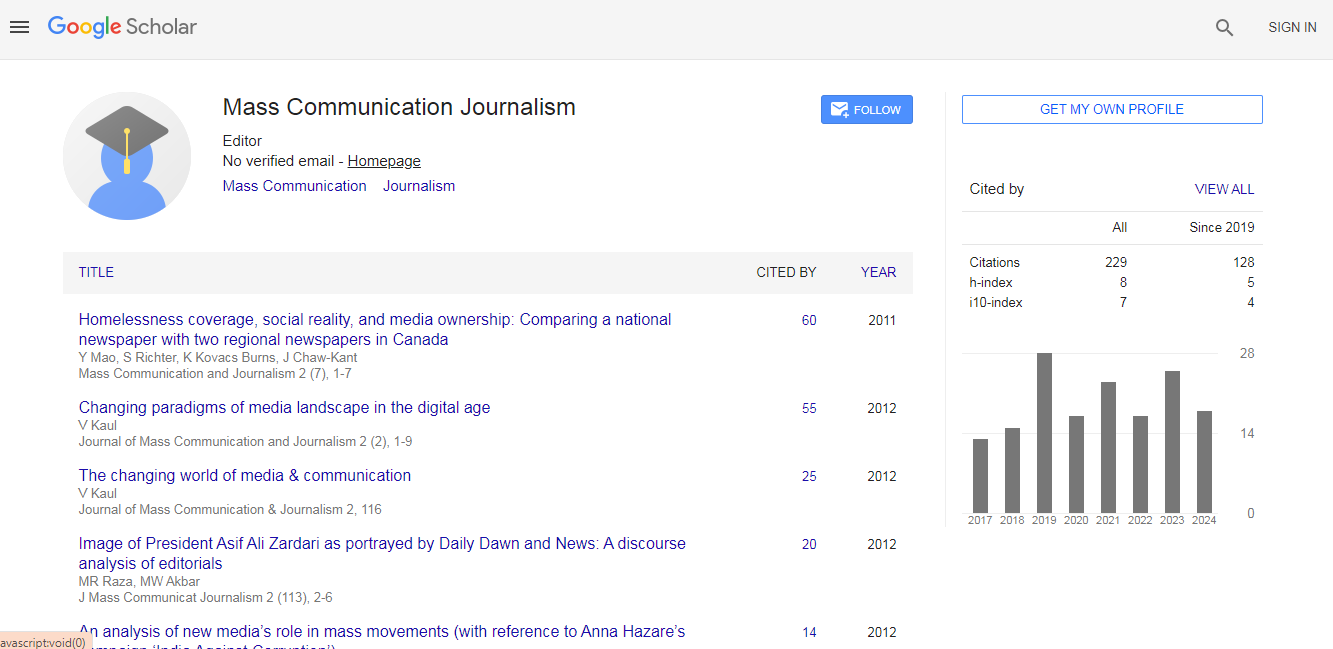
Journal of Mass Communication & Journalism received 205 citations as per Google Scholar report