Short Communication - (2025) Volume 16, Issue 6
Received: 01-Dec-2025, Manuscript No. csj-26-183495;
Editor assigned: 03-Dec-2025, Pre QC No. P-183495;
Reviewed: 17-Dec-2025, QC No. Q-183495;
Revised: 22-Dec-2025, Manuscript No. R-183495;
Published:
29-Dec-2025
, DOI: 10.37421/2160-3494.2025.16.493
Citation: Mwangi,Daniel ”Interdisciplinary Chemistry: Driving Global Challenges.” Chem Sci J 16 (2025):493.
Copyright: © 2025 Mwangi D. This is an open-access article distributed under the terms of the Creative Commons Attribution License, which permits unrestricted use, distribution and reproduction in any medium, provided the original author and source are credited.
The chemical sciences are experiencing a period of unprecedented innovation, fueled by the integration of diverse disciplines and cutting-edge methodologies. This interdisciplinary approach is leading to breakthroughs that address some of society's most pressing challenges, from sustainable energy to advanced healthcare and environmental protection. Computational chemistry, materials science, and synthetic biology are converging to drive this progress, enabling researchers to design novel catalysts, develop advanced functional materials, and gain deeper molecular-level insights into complex biological processes. This synergy is paramount for tackling global issues and fostering societal impact. One significant area of advancement lies in the design and application of advanced materials for catalytic purposes. Hierarchical porous materials, for instance, are being engineered to exhibit enhanced catalytic activity and selectivity, leading to more efficient chemical transformations crucial for industrial applications. The understanding of structure-property relationships, facilitated by advanced characterization techniques, is key to this development [2].
Furthermore, the application of artificial intelligence, specifically machine learning, is revolutionizing drug discovery and the optimization of synthetic routes. By analyzing vast datasets, computational models can now predict promising drug candidates and design efficient synthesis pathways, significantly reducing experimental workloads and accelerating the timeline from concept to viable pharmaceutical [3].
In parallel, the fusion of chemistry and biology is yielding remarkable advancements in regenerative medicine. Synthetic chemists are actively creating bio-inspired materials that mimic native tissue environments, promoting cell adhesion, proliferation, and differentiation. These biomimetic scaffolds hold immense potential for tissue repair and regeneration, offering new therapeutic avenues [4].
Sustainable chemical production is another critical focus, with electrocatalysis emerging as a powerful tool. Innovations in electrode materials and reactor designs are facilitating efficient redox reactions, thereby minimizing waste and energy consumption in the synthesis of valuable chemicals and fuels. This approach aligns with the growing demand for environmentally friendly industrial processes [5].
Understanding complex chemical reactions at their most fundamental level is being propelled by the integration of single-molecule spectroscopy and computational modeling. This powerful combination allows for the visualization and detailed comprehension of individual molecular events, which is indispensable for designing more efficient and precisely controlled chemical processes [6].
The development of smart materials, capable of responding to various chemical and physical stimuli, is opening new frontiers in sensing and actuation. Tailored molecular design is enabling the creation of materials that can dynamically alter their properties, leading to sophisticated diagnostic tools and responsive systems with diverse applications [7].
The convergence of synthetic chemistry and nanotechnology is facilitating the creation of sophisticated nanoscale devices for precise applications such as targeted drug delivery and advanced medical imaging. The design of functional nanoparticles with specific biological interactions is enhancing therapeutic efficacy and diagnostic accuracy, marking a significant leap in nanomedicine [8].
Finally, the principles of flow chemistry are being harnessed to develop greener and more efficient synthetic processes. Utilizing continuous flow reactors allows for superior control over reaction parameters, enhanced safety, and reduced waste generation compared to conventional batch methods, promoting a more sustainable approach to chemical synthesis [9].
This transformative era in chemistry is characterized by an interdisciplinary ethos, where the boundaries between traditional fields are blurring. The collaborative efforts across computational chemistry, materials science, synthetic biology, nanotechnology, and engineering are not only advancing fundamental scientific understanding but also paving the way for tangible solutions to global challenges. The ability to design at the molecular and nanoscale, predict outcomes through advanced modeling, and implement sustainable processes underscores the profound impact of these integrated approaches. As researchers continue to bridge disciplinary gaps, the potential for groundbreaking discoveries and their translation into societal benefits remains immense, driving innovation in areas critical to human well-being and planetary health.
The integration of diverse chemical disciplines is a cornerstone of modern scientific advancement, driving innovation across multiple sectors. Computational chemistry, materials science, and synthetic biology, for example, are working in concert to pioneer novel catalysts, sophisticated functional materials, and a deeper molecular understanding of biological systems. This interdisciplinary synergy is instrumental in addressing grand challenges related to energy, health, and environmental sustainability, marking a significant shift towards holistic problem-solving [1].
Within the realm of catalysis and materials science, a synergistic approach has led to the design of hierarchical porous materials. These materials are engineered to possess a finely tuned structure that significantly enhances their catalytic activity and selectivity. The insights gained from advanced characterization techniques are crucial in elucidating the intricate structure-property relationships, thereby enabling the development of more efficient chemical transformations that are directly relevant to industrial processes and sustainable manufacturing [2].
The application of machine learning in chemical research is accelerating the pace of discovery, particularly in the fields of pharmaceuticals and synthetic chemistry. By leveraging large datasets of chemical reactions and biological activity, computational models can accurately predict potential drug candidates and optimize synthetic routes. This intelligent approach reduces the need for extensive experimental work, saving valuable time and resources in the development of new medicines and chemical products [3].
The convergence of chemistry and biology is yielding remarkable advancements in the field of regenerative medicine. Synthetic chemists are now adept at designing biomimetic scaffolds that closely mimic the natural extracellular matrix of tissues. These advanced scaffolds are engineered to promote crucial cellular processes such as adhesion, proliferation, and differentiation, thereby facilitating tissue repair and regeneration and offering new hope for patients with debilitating injuries or diseases [4].
Advancements in electrochemical synthesis are paving the way for more sustainable and environmentally friendly chemical production methods. By utilizing innovative electrode materials and sophisticated reactor designs, researchers can facilitate efficient redox reactions. This not only reduces waste generation but also minimizes energy consumption, making the synthesis of valuable chemicals and fuels more eco-conscious and economically viable, aligning with global sustainability goals [5].
The ability to unravel complex reaction mechanisms is being profoundly enhanced by the combined power of single-molecule spectroscopy and computational chemistry. These complementary techniques allow scientists to visualize and understand chemical processes at the most fundamental level, observing individual molecular events as they occur. This detailed mechanistic insight is critical for the rational design of more efficient, controlled, and predictable chemical processes [6].
The development of smart materials that exhibit responsiveness to external chemical or physical stimuli is expanding the capabilities of sensing and actuation technologies. Through precise molecular design, researchers are creating materials whose properties can be dynamically altered in response to specific triggers. This leads to the development of advanced diagnostic tools and sophisticated responsive systems with a wide range of applications in various technological fields [7].
The fusion of synthetic chemistry and nanotechnology has opened new avenues for creating highly specialized nanoscale devices. These devices are being developed for targeted drug delivery systems and advanced medical imaging techniques. By designing functional nanoparticles that can specifically interact with biological targets, researchers are improving the efficacy of therapies and enhancing the precision of diagnostic procedures, marking a significant step forward in nanomedicine [8].
The adoption of flow chemistry principles is revolutionizing the way chemical reactions are conducted, leading to greener and more efficient synthetic processes. By performing reactions in continuous flow reactors, chemists gain superior control over critical reaction parameters such as temperature, pressure, and mixing. This enhanced control improves safety, reduces waste generation, and often leads to higher yields compared to traditional batch methods, promoting a more sustainable chemical industry [9].
The critical interface between chemical engineering and environmental science is crucial for developing effective remediation technologies. Novel chemical approaches are being designed to remove pollutants from both water and air. This involves the strategic design of highly efficient sorbent materials and the development of advanced catalytic processes specifically tailored for environmental cleanup and pollution control, addressing pressing environmental concerns [10].
These diverse research efforts collectively highlight the dynamic and interdisciplinary nature of modern chemistry. The ability to manipulate matter at the molecular and nanoscale, coupled with advanced computational tools and sustainable methodologies, is transforming scientific discovery and its application. The ongoing exploration at the frontiers of chemical sciences promises continued innovation and impactful solutions for societal needs.
This collection of research underscores the transformative power of interdisciplinary approaches in chemistry. Innovations span across computational chemistry, materials science, synthetic biology, nanotechnology, and machine learning, driving progress in catalysis, drug discovery, regenerative medicine, sustainable synthesis, and environmental remediation. Key advancements include the design of hierarchical porous materials for catalysis, AI-driven drug development, bio-inspired materials for tissue repair, electrocatalysis for greener production, and nanoscale devices for targeted therapies. The integration of advanced spectroscopic techniques and computational modeling offers unprecedented insights into reaction mechanisms. Furthermore, responsive materials for sensing and flow chemistry for efficient synthesis are highlighted. These developments collectively address critical global challenges in energy, health, and environmental sustainability, showcasing the broad impact of modern chemical sciences.
None
None
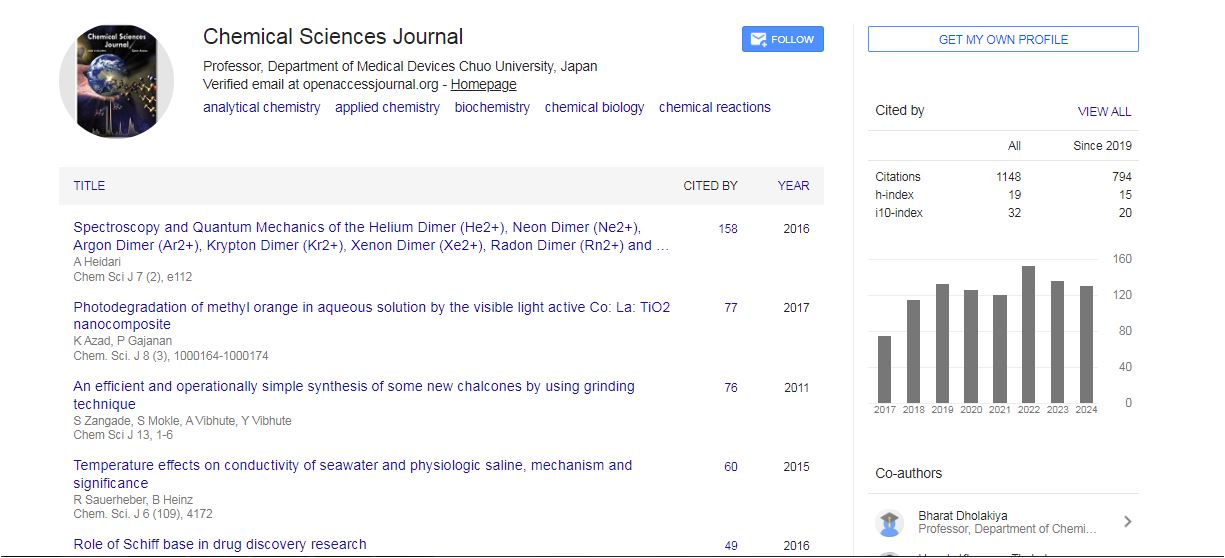
Chemical Sciences Journal received 912 citations as per Google Scholar report