Brief Report - (2025) Volume 13, Issue 6
Received: 01-Dec-2025, Manuscript No. JGPR-26-190236;
Editor assigned: 03-Dec-2025, Pre QC No. P-190236;
Reviewed: 17-Dec-2025, QC No. Q-190236;
Revised: 22-Dec-2025, Manuscript No. R-190236;
Published:
29-Dec-2025
, DOI: 10.37421/2329-9126.2025.13.646
Citation: Haddad, Leila. ”Integrating Women’s Health into Primary Care for Better Outcomes.” J Gen Pract 13 (2025):646.
Copyright: © 2025 Haddad L. This is an open-access article distributed under the terms of the Creative Commons Attribution License, which permits unrestricted use, distribution and reproduction in any medium, provided the original author and source are credited.
The integration of comprehensive women's health management into primary care settings is a critical imperative, advocating for a patient-centered and proactive approach across the lifespan. This framework emphasizes the necessity of early detection, timely interventions, and continuous support for women, seamlessly blending preventive care with the management of chronic conditions. The collaborative efforts of interdisciplinary teams, augmented by technological advancements, are paramount to elevating the accessibility and quality of care for women within general practice [1].
Primary care physicians are tasked with addressing the unique health needs of women, which necessitates a robust focus on preventive services. This includes essential screenings for various cancers, comprehensive reproductive health services, and effective strategies for chronic disease management. The implementation of these services by primary care providers is directly linked to improved health outcomes and a reduction in existing health disparities, with particular attention paid to mental health and lifestyle factors [2].
Current evidence-based guidelines provide a foundational framework for managing common women's health conditions within the primary care setting. A significant emphasis is placed on the early identification of gynecological cancers, the provision of effective contraception counseling, and the appropriate management of menopausal symptoms. To ensure comprehensive and equitable care, there is a strong call for enhanced training and the allocation of necessary resources for primary care providers [3].
The crucial role of integrating mental health screening and support into routine women's health visits within primary care cannot be overstated. Given the high prevalence of mental health conditions among women, primary care settings are uniquely positioned for early identification and timely referral. Key areas of focus include screening for depression, anxiety, and perinatal mental health issues, recognizing their profound impact on overall well-being [4].
Evaluations of team-based care models demonstrate their effectiveness in enhancing women's health outcomes within primary care. Collaboration among physicians, nurses, and allied health professionals is shown to significantly improve patient satisfaction, treatment adherence, and overall health status. These models are particularly beneficial for providing multifaceted care, encompassing both chronic conditions and essential preventive services [5].
Addressing the complexities of providing culturally sensitive care for women from diverse backgrounds in primary care is a significant challenge and opportunity. Cultivating cultural humility, employing effective communication strategies, and a deep understanding of the social determinants of health are essential for improving access to care and achieving equitable outcomes for all women [6].
The implementation of digital health tools and telemedicine holds substantial promise for improving women's health management in primary care. Benefits include enhanced accessibility, patient engagement, and continuity of care through remote monitoring, online consultations, and patient portals, especially for underserved populations [7].
Primary care plays a pivotal role in supporting young women through critical health transitions, from adolescence to adulthood. This involves addressing their specific needs, including reproductive health, mental well-being, and the management of chronic conditions. Building strong patient-provider relationships and navigating unique developmental challenges are key to effective care [8].
Understanding the patient perspective is vital for optimizing women's health services in primary care. Identifying facilitators and barriers to accessing care reveals the importance of improved communication, adequate appointment durations, and consistent continuity of care to meet women's expectations and enhance their satisfaction with services received [9].
Providing a practical guide for primary care providers on implementing quality improvement initiatives in women's health is essential. This guide encompasses critical areas such as reproductive health screening, sexually transmitted infection prevention, and the management of common gynecological conditions, offering actionable strategies to elevate the quality and equity of delivered care [10].
The fundamental concept underpinning advancements in women's health within primary care revolves around a comprehensive, patient-centered strategy designed to enhance health management across all life stages. This approach champions proactive screening, the implementation of timely interventions, and sustained support systems. Critically, it advocates for the seamless integration of preventive care with the ongoing management of chronic conditions, recognizing the interconnectedness of various health aspects. Furthermore, the significance of interdisciplinary collaboration and the strategic utilization of technology are highlighted as crucial enablers for improving both access to and the overall quality of care provided to women in general practice settings [1].
Central to the provision of effective primary care for women is a deliberate focus on preventive services, encompassing a broad spectrum of needs. This includes targeted cancer screenings, robust reproductive health services, and tailored chronic disease management plans. The paper elaborates on practical strategies that primary care physicians can adopt to effectively implement these services, thereby contributing to better health outcomes and mitigating disparities. An important consideration also involves addressing the prevalent issues of mental health and the impact of lifestyle choices on women's well-being [2].
A thorough review of current evidence-based guidelines is presented, offering a roadmap for the management of common women's health conditions within the primary care framework. Key areas of focus include the early detection of gynecological cancers, the critical aspect of providing effective contraception counseling, and the management of symptoms associated with menopause. The authors strongly advocate for increased investment in enhanced training programs and the provision of adequate resources to empower primary care providers in delivering comprehensive and equitable care [3].
The imperative of integrating mental health screening and support into the fabric of routine women's health visits in primary care is underscored. Recognizing the disproportionately high prevalence of mental health conditions among women, primary care serves as a vital entry point for early identification and appropriate referral pathways. Specific attention is given to screening for depression, anxiety disorders, and conditions related to perinatal mental health, acknowledging their significant impact on women's lives [4].
Examining the effectiveness of team-based care models reveals their substantial contribution to improving women's health outcomes within primary care environments. The synergistic collaboration among physicians, nurses, and other allied health professionals is demonstrated to enhance patient satisfaction, foster greater adherence to treatment regimens, and positively influence overall health status. These models are particularly adept at providing multifaceted care for both chronic conditions and essential preventive services [5].
Addressing the nuanced challenges and opportunities inherent in delivering culturally sensitive care to women from diverse backgrounds within primary care settings is a paramount concern. The development of cultural humility, the adoption of effective communication strategies, and a profound understanding of the social determinants of health are identified as essential components for improving healthcare access and outcomes for all women, irrespective of their background [6].
The potential of leveraging digital health tools and telemedicine to significantly enhance women's health management within primary care is explored. The benefits of implementing remote monitoring, facilitating online consultations, and utilizing patient portals are discussed in terms of their capacity to improve accessibility, bolster patient engagement, and ensure greater continuity of care, with particular advantages for underserved populations [7].
This article focuses on the crucial transitionary period from adolescence to adulthood, examining how primary care can effectively support the evolving health needs of young women. This includes addressing reproductive health concerns, mental well-being, and the management of any chronic conditions they may have. Emphasis is placed on cultivating strong and trusting patient-provider relationships and adeptly navigating the unique developmental challenges characteristic of this age group [8].
The research presented investigates the patient perspective concerning women's health services offered in primary care, identifying key factors that either facilitate or hinder access to care. The findings underscore the critical need for enhanced communication channels, the provision of longer appointment slots, and a greater emphasis on continuity of care to effectively meet women's expectations and significantly improve their overall satisfaction with the services received [9].
This article serves as a practical guide for primary care providers, offering actionable advice on the implementation of quality improvement initiatives specifically tailored for women's health. It comprehensively covers essential areas such as reproductive health screening, the prevention of sexually transmitted infections, and the management of common gynecological conditions, thereby providing strategies to enhance both the quality and the equity of the care delivered [10].
This collection of research highlights the critical importance of integrating comprehensive women's health services into primary care settings. Key themes include a patient-centered approach, the necessity of preventive services like screenings and reproductive health, and the effective management of chronic and mental health conditions. The articles emphasize the role of interdisciplinary collaboration, the utilization of digital health tools, and culturally sensitive care to improve access and outcomes. Furthermore, the importance of understanding patient experiences and supporting young women through health transitions is addressed, alongside practical guidance for quality improvement initiatives in women's health. The overarching goal is to enhance the quality, accessibility, and equity of care provided to women within primary care.
None
None
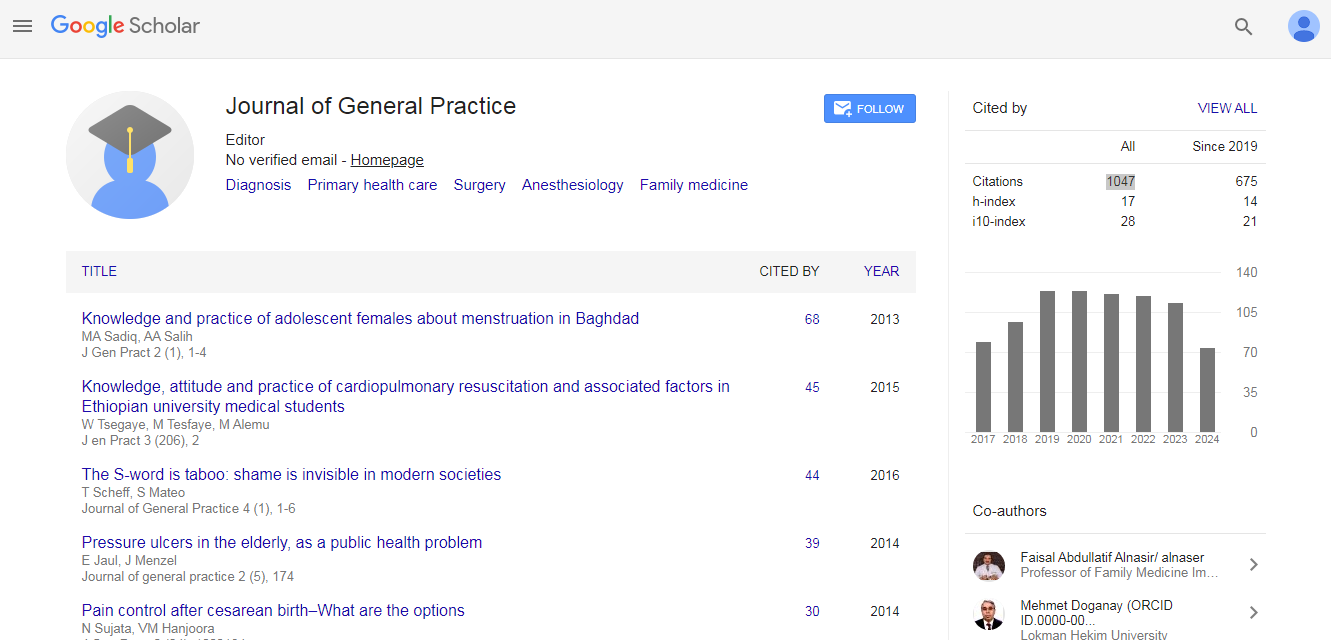
Journal of General Practice received 1047 citations as per Google Scholar report