Brief Report - (2025) Volume 16, Issue 3
Received: 02-Jun-2025, Manuscript No. jvst-26-188005;
Editor assigned: 04-Jun-2025, Pre QC No. P-188005;
Reviewed: 18-Jun-2025, QC No. Q-188005;
Revised: 23-Jun-2025, Manuscript No. R-188005;
Published:
30-Jun-2025
, DOI: 10.37421/2157-7579.2025.16.296
Citation: Ionescu, Andrei. ”Integrated Diagnostics For Companion
Animal Infectious Diseases.” J Vet Sci Techno 16 (2025):296.
Copyright: © 2025 Ionescu A. This is an open-access article distributed under the terms of the Creative Commons Attribution License, which permits unrestricted use,
distribution and reproduction in any medium, provided the original author and source are credited.
The accurate and timely diagnosis of infectious diseases in companion animals is of paramount importance for effective treatment strategies, comprehensive disease control measures, and the safeguarding of public health. This foundational aspect of veterinary medicine necessitates a multifaceted approach, integrating various diagnostic modalities to achieve precise identification of causative agents [1].
The landscape of veterinary diagnostics has been significantly transformed by the advent and widespread application of molecular diagnostic methods. Among these, polymerase chain reaction (PCR) has emerged as a revolutionary tool, offering unparalleled sensitivity, specificity, and speed in detecting a broad spectrum of infectious agents affecting our animal companions [2].
Complementing molecular techniques, serological assays have long been a cornerstone in the diagnostic arsenal, providing critical insights into an animal's immune response by detecting specific antibodies or antigens. These assays are instrumental in identifying exposure to or active infection by various pathogens, offering a valuable perspective on disease status [3].
For bacterial infections, microbiological culture and sensitivity testing remain indispensable. This process allows for the isolation and identification of specific bacterial pathogens and crucially guides the selection of appropriate antimicrobial therapies, thereby optimizing treatment outcomes and mitigating the development of resistance [4].
Diagnostic imaging modalities, encompassing radiography, ultrasonography, and computed tomography (CT), play a significant role in the evaluation of infectious diseases. These non-invasive techniques enable the visualization of lesions, organ involvement, and pathological changes indicative of infection, thereby aiding in differential diagnoses and treatment planning [5].
Companion animals are not immune to the threat posed by emerging infectious diseases, which present unique diagnostic challenges. The rapid identification and epidemiological surveillance of novel or re-emerging pathogens are critical for effective control and the development of timely interventions [6].
Fungal infections represent another significant category of diseases in companion animals, requiring specialized diagnostic approaches. Differentiating fungal etiologies from bacterial or viral infections often involves a combination of clinical observation, imaging, and targeted laboratory techniques such as cytology and culture [7].
Parasitic infections, both internal and external, are highly prevalent in companion animals and can often present with clinical signs that mimic other infectious diseases. A thorough understanding of diagnostic methods, including microscopic examination and serological testing, is essential for their accurate identification [8].
In the contemporary veterinary clinical setting, point-of-care diagnostic tests (POCTs) have gained prominence due to their ability to provide rapid results. These tests facilitate immediate treatment decisions and are particularly valuable for commonly encountered infectious conditions in companion animals [9].
Ultimately, the most effective and comprehensive diagnosis of infectious diseases in companion animals is achieved through the judicious integration of a diverse range of diagnostic modalities. This multidisciplinary approach, from initial clinical assessment to advanced laboratory and imaging techniques, ensures efficient and accurate diagnostic pathways [10].
The diagnosis of infectious diseases in companion animals is a critical undertaking, influencing treatment efficacy, disease containment, and overall public health. A comprehensive diagnostic strategy is essential, combining clinical signs with advanced laboratory techniques such as serology, PCR, and culture, alongside sophisticated imaging modalities. Early pathogen identification and understanding transmission routes are key to preventing severe disease and the spread of zoonotic infections [1].
Molecular diagnostics, particularly polymerase chain reaction (PCR), have dramatically advanced the detection of infectious agents in veterinary medicine. The high sensitivity, specificity, and rapidity of PCR are invaluable for identifying bacterial, viral, and protozoal pathogens that affect dogs and cats. Proper execution hinges on meticulous sample preparation, appropriate primer selection, and accurate interpretation of results [2].
Serological assays continue to be a fundamental tool for diagnosing infectious diseases by detecting the presence of antibodies or antigens, indicative of exposure or active infection. Various serological techniques, including ELISA and immunofluorescence, are employed to identify pathogens like Bartonella, Anaplasma, and Ehrlichia in companion animals. Careful consideration of the infection stage and potential for cross-reactivity is crucial for accurate interpretation [3].
Microbiological culture and sensitivity testing remain vital for isolating and identifying bacterial pathogens, thereby guiding antimicrobial therapy. The success of these tests relies heavily on appropriate sample collection, transport, and incubation conditions. Understanding bacterial resistance mechanisms and interpreting sensitivity results is paramount for successful treatment of bacterial infections [4].
Diagnostic imaging, including radiography, ultrasonography, and CT scans, offers crucial insights into infectious diseases by revealing pathological lesions and organ involvement. These modalities can detect evidence of pneumonia, pleuritis, abscesses, and organ damage caused by infectious agents, significantly aiding in differential diagnoses and treatment planning for companion animals [5].
Emerging infectious diseases present ongoing diagnostic hurdles in companion animal populations. Challenges associated with novel or re-emerging pathogens necessitate rapid identification, robust epidemiological surveillance, and the continuous development of innovative diagnostic tools to manage these threats effectively [6].
Fungal infections in companion animals require specific diagnostic considerations to distinguish them from other infectious etiologies. Clinical presentation, diagnostic imaging findings, and laboratory techniques such as cytology, histopathology, and fungal culture are employed to diagnose common fungal diseases like dermatophytosis, blastomycosis, and cryptococcosis [7].
Parasitic infections, encompassing both endoparasites and ectoparasites, are common in companion animals and can manifest with signs that mimic other infectious diseases. Diagnostic methods include fecal examinations, blood smear analysis, skin scrapings, and serological tests for identifying parasites such as Giardia, Toxoplasma, and Demodex [8].
Point-of-care diagnostic tests (POCTs) are increasingly utilized in veterinary practice for their capacity to yield rapid results, enabling prompt therapeutic decisions for infectious diseases in companion animals. Commercially available rapid antigen tests and immunochromatographic assays for conditions like canine parvovirus and feline leukemia virus are examples of their utility [9].
The comprehensive diagnosis of infectious diseases in companion animals is best achieved through the integration of multiple diagnostic modalities. A stepwise approach, where initial findings inform subsequent testing, ensures efficient and cost-effective diagnostic pathways, from basic clinical examination to advanced molecular techniques and imaging [10].
Diagnosing infectious diseases in companion animals is vital for effective treatment, disease control, and public health. A comprehensive approach involves integrating clinical signs with laboratory techniques like serology, PCR, and culture, alongside advanced imaging. Molecular diagnostics, particularly PCR, offer rapid and sensitive pathogen detection. Serological assays help identify exposure or active infections. Microbiological culture and sensitivity testing are crucial for bacterial infections and guiding antibiotic therapy. Imaging modalities visualize lesions and organ involvement, aiding in diagnosis. Emerging diseases require rapid identification and surveillance. Fungal and parasitic infections necessitate specific diagnostic approaches. Point-of-care tests provide quick results for immediate treatment decisions. Ultimately, a multidisciplinary approach combining various diagnostic tools ensures accurate and efficient diagnosis, leading to better animal health outcomes.
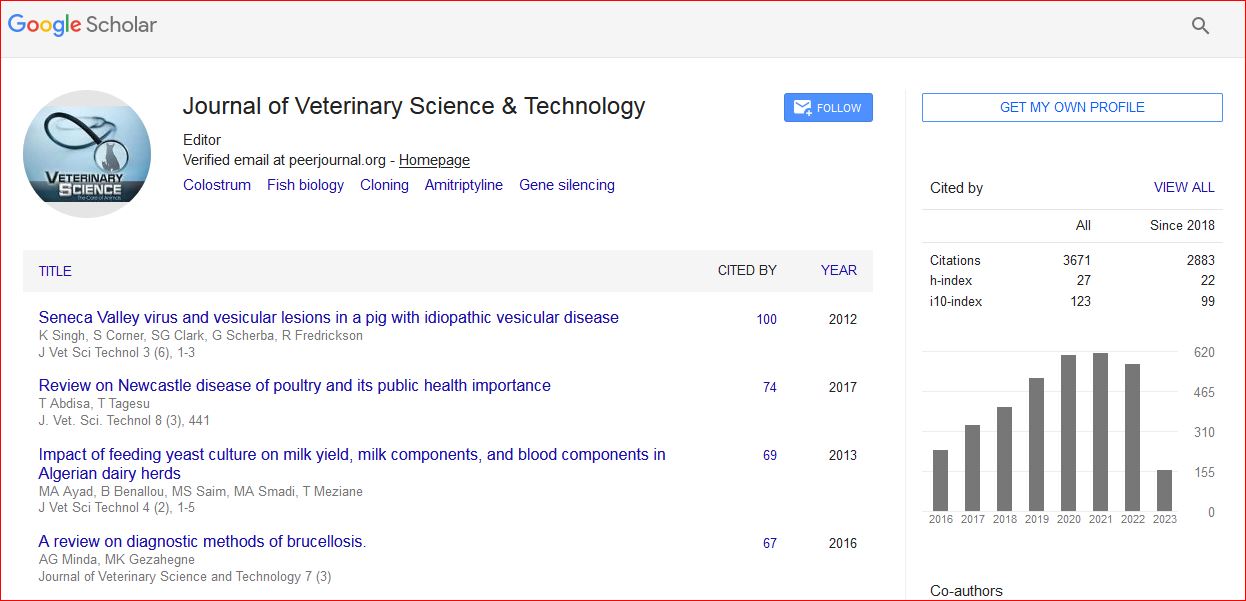
Veterinary Science & Technology received 4472 citations as per Google Scholar report