Brief Report - (2025) Volume 16, Issue 3
Received: 01-Apr-2025, Manuscript No. .hycr-25-172516;
Editor assigned: 03-Apr-2025, Pre QC No. P-172516;
Reviewed: 17-Apr-2025, QC No. Q-172516;
Revised: 22-Apr-2025, Manuscript No. R-172516;
Published:
29-May-2025
, DOI: 10.37421/2157-7587.2025.16.577
Citation: O’Connell, Liam. ”Integrated Approaches for Global Water Security.” Hydrol Current Res 16(2025):577.
Copyright: © 2025 O’Connell L. This is an open-access article distributed under the terms of the Creative Commons Attribution License, which permits unrestricted use,
distribution and reproduction in any medium, provided the original author and source are credited.
This review offers a comprehensive look at microplastic contamination in global drinking water. It details their presence, potential human health implications, and various strategies developed to mitigate their impact. The study highlights the widespread nature of this problem and the urgent need for effective solutions.[1] This systematic review explores the worldwide issue of freshwater scarcity and its profound impacts on human health. It consolidates evidence showing how limited access to clean water leads to various health crises, stressing the urgency of addressing water resource management for global well-being.[2] This article reviews advanced oxidation processes (AOPs) for effectively removing emerging contaminants from water and wastewater. It discusses recent breakthroughs, current implementation challenges, and future directions for these crucial water treatment technologies, emphasizing their potential to safeguard water quality.[3] This bibliometric analysis provides an overview of research trends in sustainable water management within agriculture. It identifies key themes, influential authors, and emerging areas of study, offering insights into the evolution and future trajectory of water-saving practices in farming.[4] This review focuses on emerging contaminants found in water and wastewater, covering detection methods, prevalence in environmental systems, and various removal technologies. It highlights the challenges these pollutants pose to water quality and ongoing efforts to develop effective remediation strategies.[5] This comprehensive review examines advanced membrane technologies used in desalination, outlining their current efficacy and future potential. It addresses ongoing developments, challenges, and prospects for improving water production efficiency and sustainability through innovative membrane solutions.[6] This systematic review explores the interconnectedness of water, energy, and food systems through the Water-Energy-Food (WEF) nexus framework. It evaluates various approaches for achieving sustainable development by managing these critical resources synergistically, highlighting the importance of integrated policy-making.[7] This global synthesis identifies and analyzes the primary factors contributing to the decline of freshwater biodiversity. It highlights the complex interplay of habitat destruction, pollution, climate change, and invasive species, emphasizing the urgent need for integrated conservation efforts to protect these vital ecosystems.[8] This review delves into smart urban water management strategies, examining current implementations, existing challenges, and future prospects. It highlights how integrating digital technologies and data analytics can lead to more efficient, resilient, and sustainable water systems in urban environments.[9] This review explores the increasing importance of water reuse as a strategy for sustainable development. It examines the technical, economic, and social challenges associated with water recycling, alongside the significant opportunities it presents for conserving freshwater resources and enhancing water security.[10]
Global water systems face severe challenges due to widespread contamination, which significantly jeopardizes environmental health and human well-being. A critical review examines microplastic contamination in global drinking water, detailing their pervasive presence, potential human health implications, and mitigation strategies. This research highlights the widespread nature of this problem and the urgent necessity for effective, sustainable solutions [1]. Furthermore, emerging contaminants in water and wastewater pose unique remediation challenges. Advanced oxidation processes (AOPs) are thoroughly reviewed as a crucial technology for removing these pollutants. The discussion covers recent breakthroughs, implementation challenges, and future directions, emphasizing their vital role in safeguarding water quality [3]. A broader analytical review also focuses on emerging contaminants, covering detection methods, widespread occurrence, and removal technologies, detailing ongoing efforts to develop more effective remediation strategies [5].
Beyond contamination, the world is profoundly grappling with severe freshwater scarcity and its far-reaching ecological and humanitarian ramifications. A systematic review explores the critical worldwide issue of freshwater scarcity, outlining its profound impacts on human health. This review consolidates extensive evidence demonstrating how limited access to clean water directly leads to various severe health crises globally. It stresses the fundamental importance of addressing comprehensive water resource management for ensuring global well-being and stability [2]. This resource issue is further compounded by a global synthesis identifying the primary factors contributing to the alarming decline of freshwater biodiversity. The study highlights the complex interplay of habitat destruction, widespread pollution, climate change, and invasive species, emphasizing the urgent need for integrated conservation efforts to protect these vital and irreplaceable freshwater ecosystems [8].
Achieving sustainable water management requires a multifaceted approach, leveraging technological advancements across diverse sectors. A comprehensive bibliometric analysis provides an insightful overview of research trends in sustainable water management within the agricultural sector. This analysis identifies key thematic areas, influential authors, and emerging study areas, offering invaluable insights into the evolution and projected future trajectory of water-saving practices essential for modern farming [4]. In a distinct yet equally vital domain, advanced membrane technologies are rigorously examined for their applications in desalination processes. A comprehensive review outlines their current efficacy and substantial future potential, addressing developments, challenges, and prospects for improving water production efficiency and enhancing overall sustainability through innovative membrane solutions [6]. Furthermore, water reuse is progressively recognized as a fundamental strategy for achieving global sustainable development objectives. A detailed review explores its increasing significance, examining the complex technical, economic, and social challenges associated with water recycling, alongside the significant opportunities it presents for conserving freshwater resources and profoundly enhancing overall water security [10].
Addressing these complex and interconnected global water challenges often necessitates the adoption of highly integrated and intelligent management approaches. A systematic review explores the intricate nature of water, energy, and food systems through the robust Water-Energy-Food (WEF) nexus framework. It evaluates comprehensive approaches designed for achieving sustainable development by managing these critical resources synergistically. This review highlights the undeniable importance of integrated, holistic policy-making to ensure long-term resource security and environmental balance [7]. Complementing these systemic views, smart urban water management strategies are comprehensively reviewed, examining both current successful implementations and persistent challenges, while also casting an eye towards future prospects. This highlights how integrating advanced digital technologies and sophisticated data analytics can lead to more efficient, resilient, and sustainable water systems within complex urban environments, crucial for modern city planning and urban resilience [9].
The diverse challenges impacting global water resources are a central theme across recent research. Contamination, stemming from microplastics in drinking water to a broad spectrum of emerging contaminants in water and wastewater, poses significant health and environmental risks. Coupled with these issues is the pressing concern of global freshwater scarcity, which directly impacts human health and contributes to the alarming decline of freshwater biodiversity due to factors like habitat destruction and climate change. To counteract these problems, innovative solutions are being developed and refined. These include advanced oxidation processes for contaminant removal, sophisticated membrane technologies for desalination, and the increasing adoption of water reuse strategies for sustainable development. Beyond technological fixes, there's a strong emphasis on holistic management, as seen in the exploration of sustainable water management in agriculture and the Water-Energy-Food (WEF) nexus framework, which promotes integrated resource policies. Further progress is evident in smart urban water management, leveraging digital technologies for more efficient and resilient urban water systems. This collective body of work underscores the critical need for multifaceted, integrated approaches to ensure water security and environmental health globally.
None
None
Indexed at, Google Scholar, Crossref
Indexed at, Google Scholar, Crossref
Indexed at, Google Scholar, Crossref
Indexed at, Google Scholar, Crossref
Indexed at, Google Scholar, Crossref
Indexed at, Google Scholar, Crossref
Indexed at, Google Scholar, Crossref
Indexed at, Google Scholar, Crossref
Indexed at, Google Scholar, Crossref
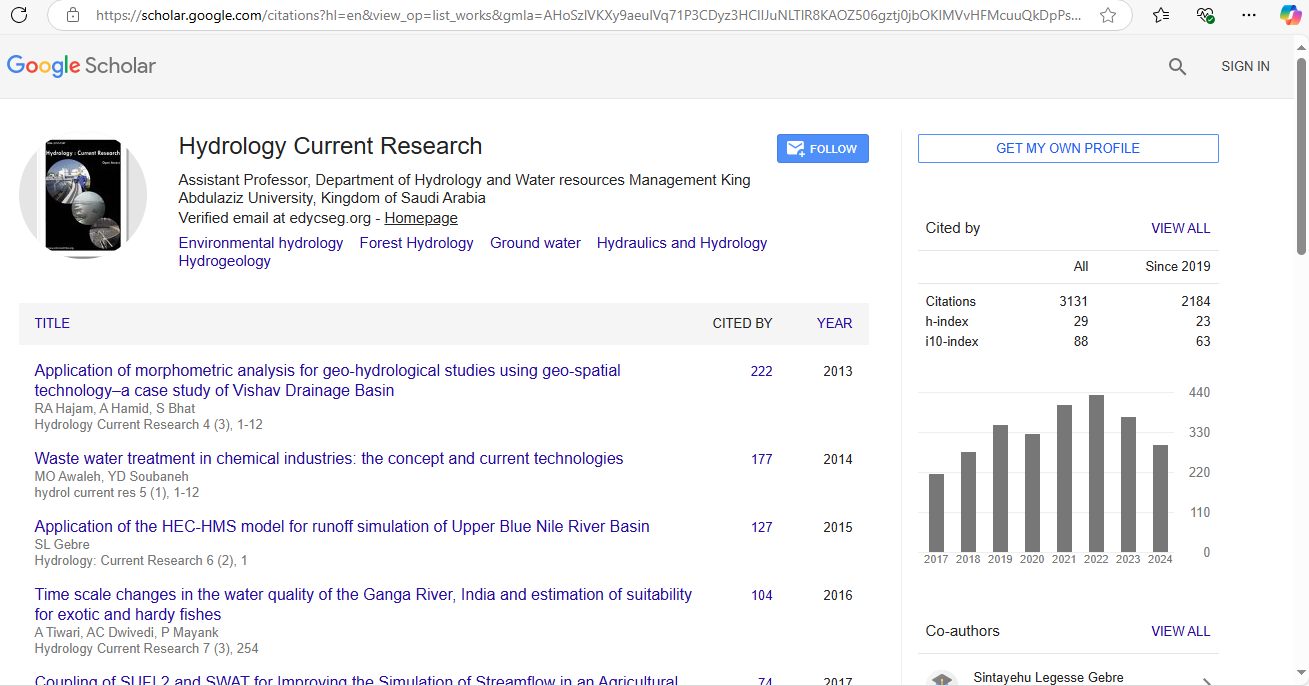
Hydrology: Current Research received 2843 citations as per Google Scholar report