Perspective - (2025) Volume 10, Issue 2
Received: 01-Apr-2025, Manuscript No. arwm-26-182708;
Editor assigned: 03-Apr-2025, Pre QC No. P-182708;
Reviewed: 17-Apr-2025, QC No. Q-182708;
Revised: 22-Apr-2025, Manuscript No. R-182708;
Published:
29-Apr-2025
Citation: Rao, Nandini. ”Bio-Recycling: Turning Waste Into Resources.” Advances in Recycling & Waste Management 10 (2025):398.
Copyright: © 2025 Rao N. This is an open-access article distributed under the terms of the Creative Commons Attribution License, which permits unrestricted use, distribution and reproduction in any medium, provided the original author and source are credited.
The sustainable management of organic waste has emerged as a critical global challenge, necessitating innovative and eco-friendly solutions. Bio-recycling and biodegradation processes offer a promising pathway forward, transforming waste materials into valuable resources and mitigating their environmental impact [1].
These biological approaches leverage natural processes to break down organic matter, yielding products such as compost, biogas, and biofuels, thereby reducing reliance on traditional landfilling and its associated ecological burdens [1].
The effectiveness of these bio-recycling strategies is intrinsically linked to the intricate roles played by microbial communities. Specialized microorganisms, including a diverse array of bacteria and fungi, are fundamental to the efficient degradation of various organic wastes. Understanding their metabolic capabilities and the environmental conditions that foster their activity is paramount for optimizing waste conversion processes [2].
Beyond the inherent microbial activity, enzyme-assisted biodegradation presents a targeted and accelerated method for breaking down recalcitrant organic compounds. The strategic deployment of specific enzymes, such as cellulases and laccases, can significantly enhance the efficiency of waste breakdown, making it a key area of research for improving bio-recycling efficacy [3].
For the successful implementation and scaling of these biological processes, robust bioreactor technologies are indispensable. Aerobic and anaerobic digesters, vermicomposting systems, and composting piles are designed to create optimized conditions for microbial activity, facilitating efficient waste conversion and the production of valuable end products [4].
A significant output of organic waste bio-recycling is the generation of renewable energy through biofuels. Technologies like anaerobic digestion are widely employed to convert waste into biogas, a methane-rich energy source, with ongoing advancements focusing on improving yield and quality from diverse waste streams [5].
Composting remains a foundational practice in organic waste bio-recycling, yielding nutrient-rich compost essential for soil amendment and agricultural applications. Continuous research aims to enhance composting efficiency through optimized management of aeration, moisture, and the strategic use of microbial inoculants [6].
The diverse nature of organic waste streams, ranging from agricultural residues to food waste and sewage sludge, necessitates tailored bio-recycling strategies. Developing specific microbial consortia and process conditions is crucial for maximizing resource recovery and minimizing environmental impact from these varied sources [7].
To ensure the genuine sustainability of bio-recycling and biodegradation processes, comprehensive life cycle assessment (LCA) is vital. LCAs provide a framework for evaluating environmental and economic performance, identifying areas for improvement, and guiding the development of more eco-efficient and cost-effective solutions [8].
Furthermore, the integration of bio-recycling with other waste management technologies, such as mechanical sorting and incineration, can unlock synergistic benefits. Such integrated systems aim to maximize resource recovery and energy generation, leading to more holistic and effective waste management strategies [9].
Ultimately, the widespread adoption of bio-recycling and biodegradation technologies is heavily influenced by supportive policies and economic incentives. Government support, carbon pricing mechanisms, and the development of markets for bio-based products are crucial drivers for innovation and investment in sustainable organic waste management, thereby fostering a circular economy [10].
The field of bio-recycling and biodegradation of organic waste is gaining significant traction due to its potential to address pressing environmental concerns. These biological processes are instrumental in converting waste materials into valuable resources like compost, biogas, and biofuels. This not only reduces the burden on landfills but also contributes to the reduction of greenhouse gas emissions, aligning with principles of a circular economy where waste is viewed as a feedstock for new products and energy [1].
At the heart of efficient organic waste biodegradation lies the critical role of microbial communities. Research efforts are concentrated on identifying and characterizing specialized microorganisms, including bacteria and fungi, that possess the capability to break down complex organic matter. A deep understanding of their metabolic pathways and the optimization of environmental factors such as temperature, pH, and nutrient availability are key to enhancing degradation rates and maximizing product yields in various bio-recycling applications [2].
Enzyme-assisted biodegradation offers a more targeted approach to accelerate the breakdown of challenging organic compounds present in waste. This involves the identification and application of specific enzymes like cellulases, laccases, and lipases to deconstruct complex polymers. Significant research is dedicated to engineering these enzymes to improve their stability and activity under diverse waste conditions, thereby enhancing the overall efficiency of bio-recycling processes [3].
The scalability of bio-recycling processes hinges on the development and optimization of bioreactor technologies. This includes a range of systems such as aerobic and anaerobic digesters, vermicomposting systems, and composting piles. The focus of research is on refining reactor designs to ensure efficient mixing, aeration, temperature control, and leachate management, thereby creating optimal environments for microbial activity and waste conversion, leading to high-quality compost and biogas production [4].
Biofuel production from organic waste represents a significant avenue for renewable energy generation. Anaerobic digestion is a well-established technology for converting waste into biogas, which is rich in methane. Ongoing advancements are being made in pre-treatment methods and co-digestion strategies aimed at improving both the yield and quality of biogas derived from a variety of waste streams [5].
Composting remains a fundamental and widely practiced method for bio-recycling organic waste, resulting in the production of nutrient-rich compost suitable for soil amendment. Current research is focused on improving the efficiency of composting through precise control of aeration, moisture levels, and the introduction of microbial inoculants. These efforts aim to accelerate decomposition, reduce odors, and ensure the production of high-quality, pathogen-free compost [6].
The biodegradation of specific types of organic waste, such as agricultural residues, food waste, and sewage sludge, presents distinct challenges and opportunities. Tailored bio-recycling strategies, involving carefully selected microbial consortia and precisely optimized process conditions, are being developed to maximize resource recovery and minimize the environmental footprint associated with these diverse waste sources [7].
To comprehensively evaluate the environmental and economic viability of bio-recycling and biodegradation processes, Life Cycle Assessment (LCA) plays a crucial role. LCAs allow for the comparison of different waste management options, the identification of environmental hotspots within a process, and provide guidance for the development of more eco-efficient and economically sound bio-recycling solutions [8].
An integrated approach to waste management, combining bio-recycling with other technologies like mechanical sorting and incineration, can yield synergistic benefits. This integrated strategy aims to achieve maximum resource recovery, enhanced energy generation, and significant waste minimization, leading to the establishment of more comprehensive and sustainable waste management systems [9].
Finally, the widespread adoption and success of bio-recycling and biodegradation technologies are significantly influenced by supportive policy frameworks and effective economic incentives. Government funding, carbon pricing initiatives, and the establishment of robust markets for bio-based products are essential for driving innovation and investment in sustainable organic waste management, thereby fostering the transition towards a circular economy [10].
Bio-recycling and biodegradation of organic waste offer sustainable solutions by transforming waste into valuable resources like compost, biogas, and biofuels. These processes reduce landfill burden and greenhouse gas emissions, aligning with circular economy principles. Key to their success are optimized microbial consortia, enhanced enzyme activity, and efficient bioreactor designs. Microbial communities play a vital role in degrading organic matter, while enzyme-assisted methods accelerate the breakdown of recalcitrant compounds. Bioreactor technologies are crucial for scaling up these processes, with ongoing research focusing on improvements in aerobic and anaerobic digestion, vermicomposting, and composting. Valorization into biofuels, particularly biogas through anaerobic digestion, is a significant aspect, with advancements in pre-treatment and co-digestion. Life Cycle Assessment (LCA) is essential for evaluating the environmental and economic sustainability of these technologies. Integration with other waste management strategies and supportive policies and economic incentives are critical for widespread adoption and the development of a circular economy.
None
None
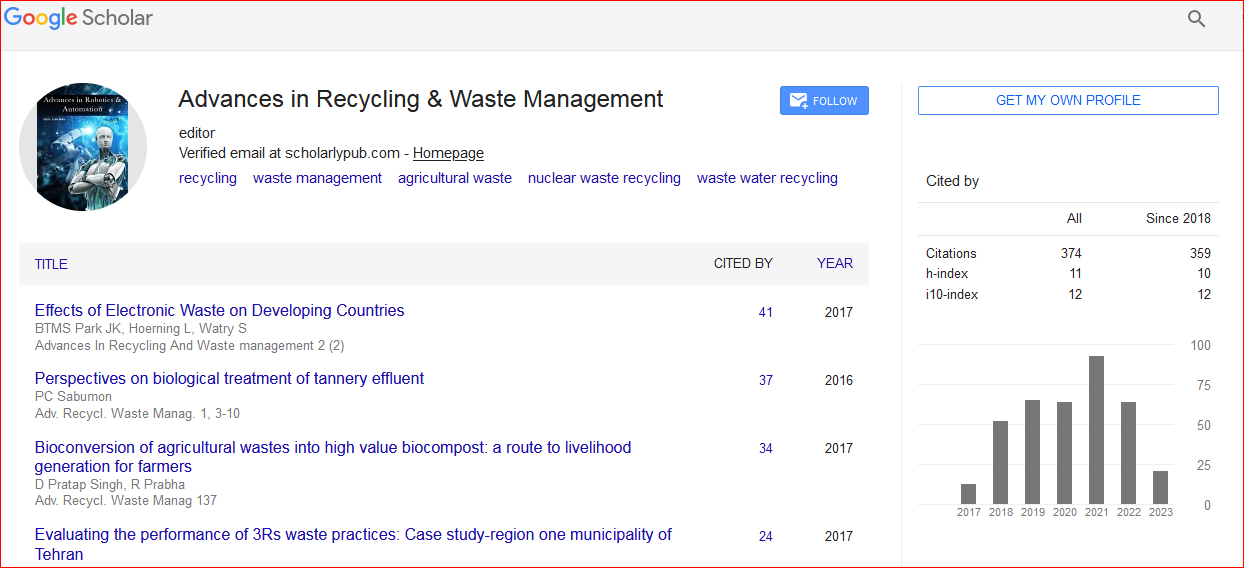
Advances in Recycling & Waste Management received 438 citations as per Google Scholar report