Short Communication - (2025) Volume 16, Issue 6
Received: 01-Dec-2025, Manuscript No. jvst-26-188141;
Editor assigned: 03-Dec-2025, Pre QC No. P-188141;
Reviewed: 17-Dec-2025, QC No. Q-188141;
Revised: 22-Dec-2025, Manuscript No. R-188141;
Published:
29-Dec-2025
, DOI: 10.37421/2157-7579.2025.16.333
Citation: Al-Khalifa, Noor. ”Innovations Revolutionizing Veterinary
Medicine for Animal Welfare.” J Vet Sci Techno 16 (2025):333.
Copyright: © 2025 Al-Khalifa N. This is an open-access article distributed under the terms of the Creative Commons Attribution License, which permits unrestricted use,
distribution and reproduction in any medium, provided the original author and source are credited.
The field of veterinary medicine is undergoing a significant technological transformation, with innovations driving advancements in diagnostics, therapeutics, and overall animal health management. Molecular techniques, such as PCR and sequencing, are revolutionizing the rapid and accurate diagnosis of infectious diseases, aiding in outbreak investigations and surveillance efforts. The integration of bioinformatics and artificial intelligence promises further enhancement in data analysis and predictive modeling for veterinary epidemiology [1].
Concurrently, gene editing technologies like CRISPR-Cas are emerging as powerful tools with the potential to develop disease-resistant livestock and create valuable animal models for human disease research, although ethical considerations are paramount for their implementation [2].
The application of nanotechnology is also expanding within veterinary medicine, offering novel approaches for targeted drug delivery, improved drug bioavailability, and early disease detection through nanosensors, thereby enhancing animal health management strategies [3].
Furthermore, the integration of artificial intelligence and machine learning is revolutionizing veterinary diagnostic imaging. These algorithms are improving the accuracy and efficiency of interpreting various imaging modalities, leading to automated lesion detection, precise disease classification, and better prediction of treatment outcomes [4].
In the realm of disease prevention, advancements in veterinary vaccinology, particularly in subunit and DNA vaccines, are leading to the development of safer and more effective platforms against animal pathogens, with ongoing research focused on next-generation vaccines for emerging diseases [5].
Omics technologies, including genomics, transcriptomics, and proteomics, are providing unprecedented insights into animal health. These high-throughput approaches are crucial for identifying genetic predispositions, discovering biomarkers for early diagnosis, and elucidating complex disease mechanisms, especially when combined with sophisticated bioinformatics analysis [6].
Precision livestock farming represents another significant technological frontier, utilizing sensor-based monitoring and data analytics to optimize animal welfare, productivity, and health. These technologies enable proactive disease prevention and personalized care in agricultural settings [7].
Regenerative medicine is also making strides in veterinary practice, with stem cell therapy and tissue engineering showing promise for treating injuries and degenerative diseases, offering potential benefits for musculoskeletal disorders, wound healing, and organ regeneration [8].
The development of wearable sensor technology is enhancing continuous monitoring of physiological parameters in animals. This data facilitates the early detection of health issues, behavioral changes, and stress, thereby improving animal welfare and disease management [9].
Finally, technological innovations in veterinary biosecurity and surveillance are critical for controlling infectious diseases in animal populations. Digital tools, data integration, and rapid testing methods are vital for preventing zoonotic disease transmission and ensuring food safety [10].
The landscape of veterinary diagnostics is being reshaped by molecular techniques that enable swift and precise identification of infectious agents. Techniques such as PCR and sequencing, alongside bioinformatics and AI, are enhancing our ability to monitor and control diseases in animal populations. This advancement is crucial for epidemiological studies and for responding effectively to disease outbreaks [1].
Gene editing technology, notably CRISPR-Cas, presents groundbreaking possibilities for veterinary medicine. Its potential lies in engineering livestock for enhanced disease resistance and in creating sophisticated animal models for research, although careful consideration of ethical implications and practical challenges is essential for its widespread adoption [2].
Nanotechnology is offering novel solutions for veterinary medicine, particularly in drug delivery and diagnostics. Nanoparticles are being utilized for targeted drug delivery, improving treatment efficacy and reducing adverse effects, while nanosensors hold promise for early disease detection and continuous health monitoring [3].
The field of veterinary diagnostic imaging is being significantly enhanced by artificial intelligence and machine learning. These technologies are improving the interpretation of radiographic, ultrasound, and CT scans, leading to more accurate diagnoses through automated lesion detection and classification, ultimately guiding treatment decisions [4].
Advancements in veterinary vaccinology are focusing on developing next-generation vaccines, including subunit and DNA vaccines. These innovative platforms aim to provide improved safety and efficacy against a range of animal pathogens, addressing challenges posed by emerging diseases and the need for robust disease prevention strategies [5].
The application of omics technologies such as genomics, transcriptomics, and proteomics is providing a deeper understanding of animal health and disease. By analyzing biological data at a molecular level, these approaches help identify disease predispositions, discover diagnostic biomarkers, and unravel complex disease mechanisms, thereby informing targeted interventions [6].
Precision livestock farming is leveraging technological integration to optimize animal production and welfare. Through sensor networks and advanced data analytics, these systems facilitate proactive disease prevention, personalized animal care, and improved resource management in agricultural settings [7].
Regenerative medicine holds considerable promise for veterinary therapeutics. The use of stem cells and tissue engineering techniques is being explored for the treatment of injuries and degenerative conditions in animals, offering potential for enhanced healing and recovery [8].
Wearable sensor technology is emerging as a valuable tool for real-time animal health monitoring. These devices continuously track vital physiological and behavioral data, enabling early detection of health anomalies and facilitating timely intervention to maintain animal well-being [9].
Innovations in veterinary biosecurity and surveillance are paramount for global animal health security. Digital platforms, integrated data systems, and rapid diagnostic tools are being employed to enhance the control of infectious diseases, mitigate the risk of zoonotic transmissions, and ensure the safety of food products [10].
This compilation highlights the significant technological advancements transforming veterinary medicine. Innovations in molecular diagnostics, gene editing, nanotechnology, artificial intelligence in imaging, and next-generation vaccinology are enhancing disease detection, prevention, and treatment. Omics technologies and precision livestock farming offer deeper insights into animal health and optimize production. Regenerative medicine and wearable sensors provide new therapeutic and monitoring capabilities, while advanced biosecurity measures are crucial for disease control and food safety. These integrated technological approaches are collectively advancing animal welfare, productivity, and public health.
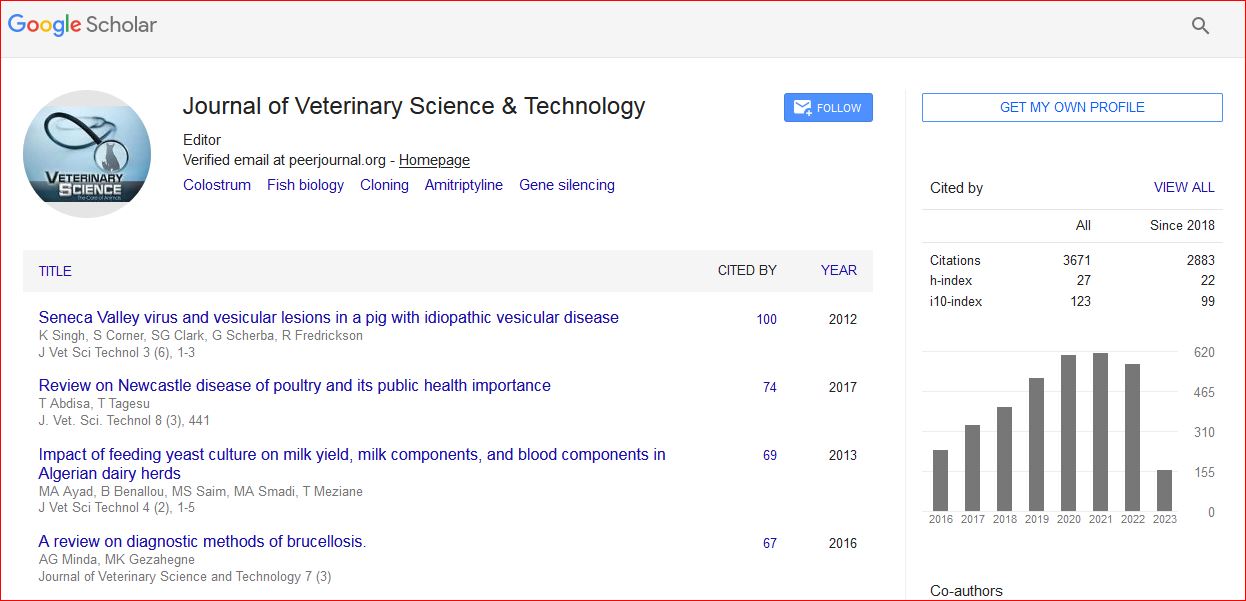
Veterinary Science & Technology received 4472 citations as per Google Scholar report