Perspective - (2025) Volume 10, Issue 5
Received: 01-Oct-2025, Manuscript No. jidm-26-188099;
Editor assigned: 04-Oct-2025, Pre QC No. P-188099;
Reviewed: 18-Oct-2025, QC No. Q-188099;
Revised: 22-Oct-2025, Manuscript No. R-188099;
Published:
29-Oct-2025
, DOI: 10.37421/2576-1420.2025.10.427
Citation: Keller, Reto. ”Infectious Disease Management: Low-
Resource Settings, Critical Challenges.” J Infect Dis Med 10 (2025):427.
Copyright: © 2025 Keller R. This is an open-access article distributed under the terms of the Creative Commons Attribution License, which permits unrestricted use, distribution
and reproduction in any medium, provided the original author and source are credited.
Infectious diseases continue to pose a significant global health challenge, particularly in regions with limited resources. These settings often face a confluence of factors that exacerbate disease burden, including inadequate healthcare infrastructure, limited access to diagnostics and treatment, and socio-economic vulnerabilities. Addressing these multifaceted challenges requires a comprehensive and integrated approach that considers the unique contexts of low-resource environments. The critical role of diagnostics cannot be overstated, as accurate and timely identification of pathogens is fundamental to effective disease management and control [1].
Furthermore, the dynamic interplay between environmental changes and disease patterns presents an escalating threat. Climate change, with its attendant shifts in weather patterns and environmental degradation, directly influences the epidemiology of infectious diseases, often leading to increased prevalence of vector-borne and waterborne illnesses in vulnerable regions [2].
This necessitates a proactive stance, integrating climate adaptation strategies with robust public health surveillance and control mechanisms to mitigate emerging risks. The diagnostic gap remains a pervasive obstacle in many low-income countries, leading to delayed or incorrect treatment decisions. Improving laboratory infrastructure, enhancing the skills of healthcare workers, and leveraging point-of-care diagnostics are crucial steps towards bridging this gap and ensuring early detection and effective management of infectious diseases [3].
Ensuring equitable access to essential medicines for infectious diseases is another paramount concern. Challenges related to affordability, fragile supply chains, and inadequate storage facilities often hinder the availability of life-saving treatments for those who need them most. Global partnerships and innovative financing models are vital to overcome these barriers and reach vulnerable populations [4].
The resilience of healthcare systems in low-resource settings is frequently tested by infectious disease outbreaks and pandemics. Vulnerabilities such as insufficient staffing, limited intensive care capacity, and weak infection control measures can significantly impede response efforts. Strengthening primary healthcare, investing in workforce training, and developing comprehensive emergency preparedness plans are essential for building robust systems [5].
Neglected tropical diseases (NTDs) continue to impose a substantial burden on populations in low-resource regions. These often chronic and debilitating conditions face significant challenges in surveillance, diagnosis, and treatment. Integrated control programs, active community participation, and sustained funding are imperative to effectively address the persistent impact of NTDs and improve the lives of affected individuals [6].
Community health workers (CHWs) play an indispensable role in combating infectious diseases, particularly in remote and underserved areas. They serve as a critical link in healthcare access, providing essential services, health education, and early symptom detection. Adequate training, ongoing support, and seamless integration of CHWs into formal health systems are vital for maximizing their impact [7].
Antimicrobial resistance (AMR) represents a growing and insidious threat to infectious disease management, especially in resource-limited settings. Challenges associated with inappropriate antibiotic use, limited availability of newer drugs, and weak surveillance systems for AMR demand urgent attention. Strengthening stewardship programs, enhancing diagnostic capabilities, and fostering global collaboration are key to combating this escalating crisis [8].
Effective vaccination programs are cornerstones of infectious disease prevention, yet their implementation in geographically dispersed and low-income communities presents unique hurdles. Issues such as maintaining the cold chain, addressing vaccine hesitancy, and reaching marginalized populations require tailored strategies, including robust communication campaigns and the utilization of mobile vaccination units [9].
Finally, the intricate relationship between poverty, malnutrition, and infectious disease susceptibility cannot be ignored. Poor nutritional status compromises immune function, rendering individuals more vulnerable to infections and leading to poorer treatment outcomes. Integrated interventions that simultaneously address nutrition and infectious disease control are essential for breaking this vicious cycle and improving overall health [10].
The challenges faced by low-resource settings in managing infectious diseases are deeply intertwined with systemic issues of healthcare infrastructure, access to essential medical resources, and the broader socio-economic environment. Addressing these complex problems requires a multifaceted strategy that encompasses diagnostics, treatment, and public health systems. The critical role of diagnostics in infectious disease control is highlighted, emphasizing how limitations in diagnostic capacity can lead to delayed or inaccurate treatment, ultimately worsening patient outcomes [1].
Environmental factors, particularly climate change, are increasingly recognized as significant drivers of infectious disease dynamics. Shifting weather patterns and environmental degradation contribute to the spread of diseases such as those transmitted by vectors and contaminated water, placing an immense strain on already limited public health services in many regions. This underscores the need for integrated approaches that combine climate adaptation with infectious disease surveillance [2].
The significant gap in diagnostic capabilities within low-income countries is a critical bottleneck. The challenges of accessing and implementing accurate diagnostic tools directly impact the timeliness and efficacy of treatment. Proposed solutions include enhancing laboratory infrastructure, training healthcare professionals, and adopting point-of-care diagnostics to improve early detection and management strategies [3].
Equitable access to essential medicines for infectious diseases remains a persistent challenge in low-resource settings. Issues such as affordability, disruptions in supply chains, and inadequate storage facilities contribute to treatment gaps. The authors advocate for global collaborations and innovative financial mechanisms to ensure that life-saving treatments reach populations in need [4].
The resilience of healthcare systems in low-resource environments is crucial when confronting outbreaks and pandemics. Identifying vulnerabilities such as insufficient staffing, limited critical care capacity, and poor infection control measures is the first step towards strengthening these systems. Investments in primary healthcare, health workforce development, and robust emergency preparedness are proposed as key strategies [5].
Neglected tropical diseases (NTDs) continue to represent a substantial public health burden in low-resource regions. The difficulties in surveillance, diagnosis, and treatment of these often chronic conditions necessitate integrated control programs, active community involvement, and sustained financial support to effectively manage their persistent impact [6].
Community health workers (CHWs) are indispensable in extending healthcare services to remote and underserved populations, playing a vital role in infectious disease control. They bridge healthcare access gaps by delivering essential services, health education, and early symptom detection. The importance of providing adequate training, support, and integration into formal health systems for CHWs is emphasized [7].
Antimicrobial resistance (AMR) poses a growing threat to the effective management of infectious diseases, particularly in contexts with limited resources. Challenges include the inappropriate use of antibiotics, the scarcity of newer drugs, and weak surveillance systems for AMR. Strengthening antimicrobial stewardship, improving diagnostic tools, and enhancing global cooperation are essential to address this crisis [8].
The implementation of vaccination programs for infectious diseases in low-resource settings faces considerable obstacles, including difficulties in maintaining the cold chain, vaccine hesitancy, and challenges in reaching marginalized communities. Tailored communication strategies and mobile vaccination units are identified as important tools for overcoming these barriers [9].
The intrinsic link between poverty, malnutrition, and susceptibility to infectious diseases is a critical consideration in low-resource settings. Malnutrition weakens the immune system, increasing vulnerability to infections and leading to poorer health outcomes. The authors advocate for integrated interventions that address both nutritional status and infectious disease control to break this detrimental cycle [10].
This collection of articles addresses the critical challenges of infectious disease management in low-resource settings. Key themes include the vital role of diagnostics, treatment accessibility, and healthcare infrastructure limitations. The impact of climate change on disease patterns and the persistent burden of neglected tropical diseases are examined. Strategies for strengthening healthcare system resilience, empowering community health workers, and combating antimicrobial resistance are proposed. Furthermore, the difficulties in implementing vaccination programs and the interconnectedness of poverty, malnutrition, and infectious disease susceptibility are highlighted. The overarching message emphasizes the need for integrated, context-appropriate interventions and global collaboration to improve health outcomes in these vulnerable regions.
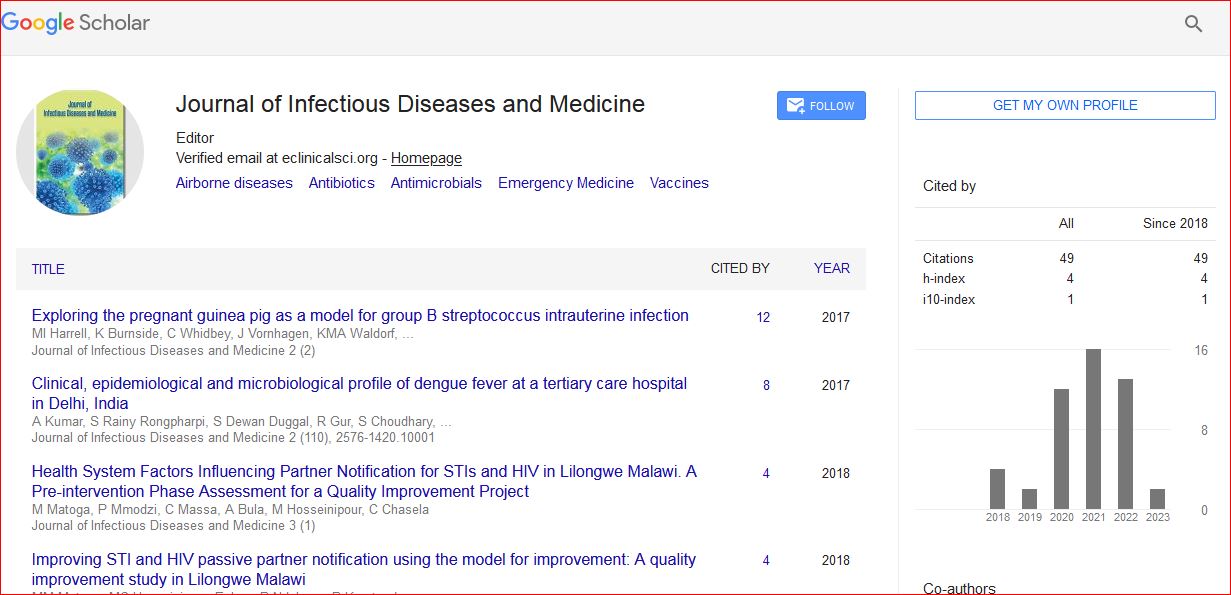
Journal of Infectious Diseases and Medicine received 1059 citations as per Google Scholar report