Opinion - (2025) Volume 14, Issue 2
Received: 02-Jun-2025, Manuscript No. ara-25-175567;
Editor assigned: 04-Jun-2025, Pre QC No. P-175567;
Reviewed: 18-Jun-2025, QC No. Q-175567;
Revised: 23-Jun-2025, Manuscript No. R-175567;
Published:
30-Jun-2025
, DOI: 10.37421/2168-9695.2025.14.325
Citation: Sakamoto, Haruto. ”Industry 4.0: AI, Worker Safety, Cybersecurity.” Adv Robot Autom 14 (2025):325.
Copyright: © 2025 Sakamoto H. This is an open-access article distributed under the terms of the Creative Commons Attribution License, which permits unrestricted use, distribution and reproduction in any medium, provided the original author and source are credited.
The rapid evolution of Industry 4.0 marks a significant paradigm shift in manufacturing and industrial operations, bringing unprecedented levels of automation, digitalization, and interconnectedness. This transformation, while promising enhanced efficiency and productivity, also introduces a complex array of challenges and opportunities across various domains, from worker safety to cybersecurity and supply chain management. Understanding these multifaceted impacts is crucial for navigating the contemporary industrial landscape effectively. The advent of Industry 4.0 significantly transforms industrial environments, particularly by introducing new ergonomic risks and concerns related to musculoskeletal disorders. These challenges stem from increased automation and intensified human-robot interaction within industrial settings, demanding proactive ergonomic design to safeguard workers in these evolving automated workplaces. Preventing such disorders requires careful consideration of human capabilities and limitations in the design of future work systems [1].
The integration of Artificial Intelligence (AI), human factors, and ergonomics is pivotal in modern manufacturing environments. This integration reveals how AI can significantly enhance industrial automation processes, concurrently ensuring optimal human performance, safety, and overall well-being within complex hybrid human-AI systems. Such systems aim to create symbiotic relationships where humans and AI collaborate efficiently and safely [2].
One critical application of Artificial Intelligence is in predictive maintenance, which substantially improves industrial safety. AI-driven predictive models are adept at anticipating equipment failures, thereby reducing human exposure to hazardous conditions and optimizing maintenance schedules across automated industrial setups. This proactive approach minimizes downtime and prevents potential accidents by identifying issues before they escalate [3].
The embrace of Industry 4.0 technologies, while advancing automation, also brings escalating cybersecurity threats to industrial control systems. Understanding common vulnerabilities and developing effective countermeasures becomes essential to establish robust security frameworks in automated industrial environments. The increasing connectivity of operational technology (OT) systems to IT networks creates new attack vectors that demand vigilant protection [4].
Industry 4.0 profoundly affects the health and safety of industrial workers, presenting both new risks stemming from pervasive automation and digitalization, as well as opportunities for enhanced safety via intelligent systems. This necessitates a balanced, considered approach to integrating new technologies. Balancing the benefits of automation with potential new hazards is a central theme in ensuring worker welfare in this era [5].
The principles of Artificial Intelligence and robotic systems applied to automation, even when studied in contexts like smart hospitals, are broadly applicable across various industrial sectors. Intelligent automation consistently enhances efficiency, precision, and task execution, reflecting significant advancements in all areas leveraging smart technologies. The core functionalities of AI in optimizing processes and managing complex tasks transcend specific application environments [6].
Industry 4.0 technologies, including advanced automation and cyber-physical systems, are fundamentally transforming supply chain management. These automated advancements lead to improved efficiency, transparency, and resilience throughout industrial logistics and production networks. Real-time data and interconnected systems allow for more agile and responsive supply chains, capable of adapting to market changes more effectively [7].
Digital transformation for Industry 4.0 exposes industrial automation and control systems to heightened cybersecurity risks. There is an urgent, undeniable need for robust defense mechanisms to effectively protect critical industrial infrastructure from increasingly sophisticated cyber threats. Protecting these systems is paramount to national security and economic stability, highlighting the severity of these vulnerabilities [8].
Artificial Intelligence holds substantial potential for improving occupational safety and health in industrial settings influenced by Industry 4.0. It can assist in hazard prediction and risk mitigation, though its deployment also brings new safety and ethical considerations to automated industrial environments. Addressing these ethical implications, such as data privacy and algorithmic bias, is crucial for responsible AI implementation [9].
Augmented Reality (AR) presents a powerful tool for improving human-robot collaboration and operator training within advanced manufacturing contexts. AR solutions focus on providing intuitive interfaces, real-time guidance, and enhanced safety, which are all crucial elements for the efficient integration of automation into industrial operations. This technology bridges the gap between the digital and physical worlds, making complex tasks more accessible and safer for human operators [10].
This collection of research underscores the critical ongoing efforts to understand, mitigate, and leverage the vast potential of Industry 4.0 and related technologies. From protecting human workers and their data to optimizing complex logistical systems, the future of industry relies on strategic, interdisciplinary approaches to innovation and risk management.
The landscape of modern industry is undergoing profound changes driven by the principles of Industry 4.0, characterized by advanced automation, digitalization, and intelligent systems. This transformation deeply impacts the core aspects of manufacturing and industrial operations, reshaping everything from worker safety to logistical efficiency and cybersecurity. Examining these shifts reveals a complex interplay of emerging risks and innovative solutions.
A primary concern arising from Industry 4.0's expansion is its impact on worker health and safety. Increased automation and intensified human-robot interaction introduce significant ergonomic risks, contributing to musculoskeletal disorders in industrial settings. This highlights an urgent need for proactive ergonomic design strategies to protect workers in these evolving automated environments [1]. Beyond specific ergonomic issues, Industry 4.0 broadly affects the health and safety of industrial workers by presenting both new risks associated with digitalization and automation, and unique opportunities for enhancing safety through intelligent systems. A balanced, thoughtful approach to integrating these technologies is therefore essential to safeguard the workforce [5].
Artificial Intelligence (AI) and related advanced technologies are central to both mitigating risks and driving efficiencies. The integration of AI, human factors, and ergonomics within manufacturing environments is crucial for optimizing industrial automation processes. This integration ensures not only operational efficiency but also the optimal human performance, safety, and well-being in hybrid human-AI systems where collaboration is key [2]. Furthermore, AI plays a pivotal role in improving overall occupational safety and health. Its potential lies in advanced hazard prediction and robust risk mitigation, though implementing AI in automated industrial settings also introduces novel safety and ethical considerations that must be carefully managed [9]. To bridge the gap between human operators and advanced machinery, Augmented Reality (AR) proves invaluable. AR enhances human-robot collaboration and operator training in advanced manufacturing by providing intuitive interfaces, real-time guidance, and significantly improved safety, which are all critical for efficient automation integration [10].
Beyond human-centric applications, AI's capabilities extend to critical operational areas like maintenance and overall system efficiency. Artificial Intelligence finds a significant application in predictive maintenance, which is a powerful tool for improving industrial safety. AI-driven predictive models can accurately anticipate equipment failures, thereby substantially reducing human exposure to potential hazards and optimizing maintenance schedules across automated industrial setups [3]. The broader principles derived from the application of AI and robotic systems for automation, even from studies focused on sectors like smart hospitals, are broadly applicable. These studies demonstrate how intelligent automation consistently enhances efficiency, precision, and task execution, offering valuable insights for industrial sectors leveraging similar smart technologies [6].
However, the increasing interconnectedness and digitalization inherent in Industry 4.0 expose industrial operations to heightened vulnerabilities. Cybersecurity threats to industrial control systems are escalating as industries adopt these advanced technologies. Identifying common vulnerabilities and implementing robust countermeasures are fundamental steps to ensure secure automated industrial environments [4]. This concern is further amplified when considering industrial automation and control systems (IACS) undergoing digital transformation for Industry 4.0. The urgent need for strong defense mechanisms to protect critical industrial infrastructure from sophisticated cyber threats cannot be overstated, as disruptions could have far-reaching consequences [8].
Finally, Industry 4.0 technologies, encompassing advanced automation and sophisticated cyber-physical systems, are fundamentally reshaping supply chain management. These automated advancements lead to notable improvements in efficiency, transparency, and resilience across various industrial logistics and production networks. The ability to monitor, analyze, and optimize supply chain processes in real-time empowers businesses to respond more dynamically to market demands and unforeseen disruptions [7]. Together, these advancements and challenges paint a picture of an industrial future that is highly integrated, intelligent, and critically dependent on both technological innovation and comprehensive risk management.
Industry 4.0 brings significant transformations to industrial environments, deeply impacting automation, human-machine interaction, and overall operational safety. A key area of focus is ergonomics and worker well-being, as increased automation and human-robot interaction introduce new musculoskeletal disorder risks, underscoring the need for proactive ergonomic design. The broader effects of Industry 4.0 on workers' health and safety include identifying novel risks from digitalization while also recognizing opportunities for safety enhancements through intelligent systems. Artificial Intelligence (AI) plays a central role in this evolution. It enhances industrial automation and manufacturing by ensuring optimal human performance, safety, and well-being in hybrid human-AI systems. AI also proves critical for industrial safety applications through predictive maintenance, anticipating equipment failures and reducing human exposure to hazards. Beyond maintenance, AI's potential in occupational safety and health involves hazard prediction and risk mitigation, though it also introduces new ethical and safety considerations. Even applications of AI and robotic systems in diverse sectors, like hospitals, demonstrate principles of automation that apply to enhancing efficiency and precision in industrial settings. Augmented Reality (AR) further supports human-robot collaboration and operator training, providing intuitive interfaces and real-time guidance for safer industrial operations. However, the digitalization inherent in Industry 4.0 and advanced automation also brings substantial cybersecurity challenges. Industrial control systems (ICS) and industrial automation and control systems (IACS) face escalating threats and vulnerabilities, demanding robust countermeasures and defense mechanisms to protect critical infrastructure. The transformation extends to supply chain management, where Industry 4.0 technologies improve efficiency, transparency, and resilience across production networks. Overall, this data highlights a complex interplay of technological advancement, human integration, and risk management in the rapidly evolving industrial landscape.
None
None
Lorenzo I, Francesco R, Michele B. "Ergonomics and Work-Related Musculoskeletal Disorders in the Era of Industry 4.0: A Narrative Review".Int J Environ Res Public Health 20 (2023):2631.
Indexed at, Google Scholar, Crossref
Sara S, Omid M, Mostafa S. "Artificial Intelligence, Human Factors, and Ergonomics in Manufacturing: A Systematic Review".Sustainability 15 (2023):10077.
Indexed at, Google Scholar, Crossref
Marco B, Laura M, Simone B. "Predictive Maintenance with Artificial Intelligence for Industrial Safety Applications: A Systematic Review".Int J Environ Res Public Health 21 (2024):120.
Indexed at, Google Scholar, Crossref
Alberto F, Gabriele T, Simone B. "Cybersecurity in Industrial Control Systems: Threats, Vulnerabilities, and Countermeasures in the Context of Industry 4.0".Sustainability 15 (2023):8645.
Indexed at, Google Scholar, Crossref
Laura M, Anna RB, Pierfrancesco B. "Industry 4.0 and the Future of Work: A Systematic Review of Impacts on Workers' Health and Safety".Int J Environ Res Public Health 20 (2023):3614.
Indexed at, Google Scholar, Crossref
Abdulrahman SA, Abdulaziz SA, Abdullah OB. "Application of Artificial Intelligence and Robotic Systems in Smart Hospitals: A Review".Sensors 21 (2021):7922.
Indexed at, Google Scholar, Crossref
Chiara F, Alberto F, Gabriele T. "The Impact of Industry 4.0 on Supply Chain Management: A Systematic Literature Review".Sustainability 15 (2023):13693.
Indexed at, Google Scholar, Crossref
Anna D, Salvatore CD, Domenico F. "Digital Transformation and Cybersecurity Challenges in Industrial Automation and Control Systems in the Era of Industry 4.0".Int J Environ Res Public Health 19 (2022):15995.
Indexed at, Google Scholar, Crossref
Matteo B, Francesca B, Marco S. "Challenges and Opportunities of Artificial Intelligence in Occupational Safety and Health in the Fourth Industrial Revolution".Int J Environ Res Public Health 19 (2022):10984.
Indexed at, Google Scholar, Crossref
Konstantinos MG, Athanasios CK, Nikolaos FP. "The Role of Augmented Reality in Enhancing Human-Robot Collaboration and Operator Training in Advanced Manufacturing".Appl Sci 14 (2024):1709.
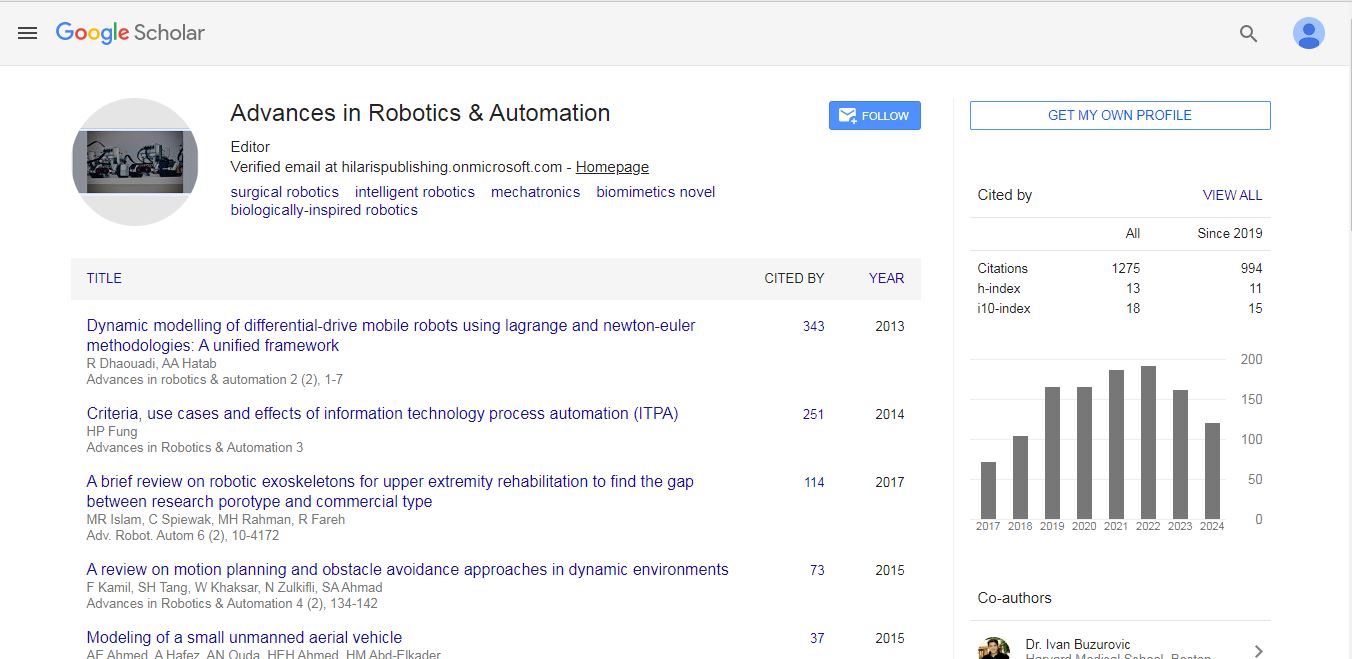
Advances in Robotics & Automation received 1275 citations as per Google Scholar report