Brief Report - (2025) Volume 14, Issue 3
Received: 01-May-2025, Manuscript No. iem-26-179775;
Editor assigned: 04-May-2025, Pre QC No. P-179775;
Reviewed: 14-May-2025, QC No. Q-179775;
Revised: 21-May-2025, Manuscript No. R-179775;
Published:
29-May-2025
, DOI: 10.37421/2169- 0316.2025.14.299
Citation: Lorenzo, Santiago. Industrial Process Efficiency: Data, Automation, and Optimization. J Ind Eng Manag 14 (2025):299.
Copyright: © 2025 Lorenzo S. This is an open-access article distributed under the terms of the Creative Commons Attribution License, which permits unrestricted use,
distribution and reproduction in any medium, provided the original author and source are credited.
The relentless pursuit of enhanced industrial process efficiency stands as a cornerstone of modern manufacturing and operations management. This pursuit is characterized by a multifaceted approach that integrates traditional methodologies with cutting-edge technological advancements. Lean manufacturing principles, for instance, continue to provide a robust framework for identifying and eliminating waste, thereby streamlining operations and improving resource utilization. Complementing these principles is the burgeoning role of data-driven decision-making, which leverages the vast amounts of information generated by industrial processes to inform strategic choices and drive continuous improvement [1].
The integration of advanced analytics and automation has become paramount in this endeavor, enabling businesses to pinpoint bottlenecks, minimize inefficiencies, and optimize the allocation of resources across the entire value chain [1].
A critical dimension of this optimization drive is the focus on energy efficiency, which not only contributes to cost savings but also to environmental sustainability. Optimizing manufacturing operations to minimize energy consumption without compromising output necessitates the adoption of smart energy management systems, the integration of renewable energy sources, and the implementation of energy-efficient technologies. Real-time energy monitoring and analysis play a crucial role in achieving these objectives and are increasingly being incorporated into the overall industrial process design [2].
In parallel, the evolution of supply chain management has been significantly influenced by digital transformation. The application of digital twins and simulation modeling offers a novel approach to optimizing complex supply chains. By creating virtual replicas of physical processes, organizations can effectively assess risks, plan for various scenarios, and identify potential inefficiencies before they manifest in real-world operations. This enhanced visibility and improved stakeholder coordination are vital for adapting to dynamic market demands and fostering resilience [3].
The strategic implementation of automation and robotics has emerged as a primary driver for increasing production efficiency and reducing operational costs. The integration of collaborative robots (cobots) and automated guided vehicles (AGVs) enhances flexibility, improves safety, and boosts throughput. A thorough return on investment (ROI) analysis for automation projects, coupled with workforce training, is essential for seamless integration and successful adoption of these technologies [4].
Beyond physical automation, advanced simulation techniques play a pivotal role in optimizing complex industrial processes. Tools such as discrete-event simulation and agent-based modeling allow for in-depth analysis of system performance, precise identification of bottlenecks, and thorough evaluation of different operational strategies. These modeling tools facilitate 'what-if' scenario analysis, leading to more informed decision-making and targeted process improvements, provided that accurate data is utilized [5].
The Internet of Things (IoT) has revolutionized real-time process monitoring and control in manufacturing. IoT sensors and connected devices provide continuous data streams, enabling immediate detection of anomalies and deviations from optimal performance. The benefits extend to predictive maintenance, improved quality control, and enhanced operational visibility, though cybersecurity remains a pertinent consideration for interconnected industrial systems [6].
Artificial intelligence (AI) and machine learning (ML) are increasingly instrumental in optimizing industrial processes. AI algorithms can analyze vast datasets to uncover intricate patterns, predict equipment failures, and optimize production schedules. Applications span intelligent quality inspection, demand forecasting, and adaptive control systems, collectively driving significant improvements in efficiency and reducing operational risks [7].
The overarching paradigm of Industry 4.0 provides a comprehensive framework for achieving maximum industrial process efficiency. The integration of cyber-physical systems, the Industrial Internet of Things (IIoT), and cloud computing fosters intelligent and interconnected manufacturing environments. These technologies facilitate real-time data analysis, autonomous decision-making, and flexible production systems, offering a roadmap for digital transformation [8].
While technological advancements are crucial, the human element remains a critical factor in process optimization. Understanding and improving human performance, ergonomics, and team collaboration are equally vital for achieving peak efficiency. Methods for reducing human error, enhancing worker well-being, and fostering a culture of continuous improvement are essential for realizing the full potential of industrial operations [9].
Finally, the application of Six Sigma methodologies offers a structured approach to achieving operational excellence and maximizing efficiency. The DMAIC (Define, Measure, Analyze, Improve, Control) framework is instrumental in identifying and eliminating defects and process variations. Successful Six Sigma projects demonstrably lead to improvements in quality, cost reduction, and customer satisfaction, underscoring the importance of data-driven problem-solving [10].
The field of industrial engineering and management is continuously evolving, with a strong emphasis on enhancing process efficiency through a blend of established methodologies and advanced technologies. Lean manufacturing principles, renowned for their effectiveness in waste reduction and value stream optimization, are now being augmented by sophisticated data analytics. This synergy allows for a more profound understanding of operational dynamics, enabling businesses to identify areas for improvement with greater precision. The integration of advanced analytics and automation is not merely about incremental gains but about a fundamental shift towards data-informed strategic planning, resource allocation, and bottleneck elimination, all contributing to a more holistic view of process optimization [1].
Energy efficiency represents another critical frontier in industrial operations. The drive to minimize energy consumption without impacting productivity has led to the development and adoption of smart energy management systems. These systems, coupled with the integration of renewable energy sources and energy-efficient technologies, are reshaping how manufacturing facilities operate. The ability to perform real-time energy monitoring and analysis provides actionable insights that can lead to substantial cost savings and a reduced environmental footprint, with frameworks being developed to embed energy efficiency into the very design of industrial processes [2].
The transformation of supply chains is being significantly influenced by digital twins and simulation modeling. These technologies enable the creation of virtual representations of complex logistical networks, allowing for the simulation of various scenarios and the proactive identification of potential disruptions or inefficiencies. This capability is invaluable for risk assessment, strategic planning, and ensuring the resilience of supply chains in the face of market volatility and unforeseen events. Enhanced visibility and improved coordination are key outcomes of this digital approach [3].
Automation and robotics are no longer futuristic concepts but integral components of modern manufacturing aimed at boosting productivity and lowering costs. The deployment of collaborative robots (cobots) and automated guided vehicles (AGVs) offers enhanced flexibility in production lines, improves workplace safety, and increases throughput. Strategic planning, including thorough ROI analysis and investment in workforce training, is crucial for the successful integration of these automated systems into existing operations [4].
Advanced simulation techniques provide powerful tools for dissecting and optimizing intricate industrial processes. Methodologies like discrete-event simulation and agent-based modeling are employed to analyze system performance under various conditions, identify critical bottlenecks, and test the efficacy of different operational strategies. These modeling tools empower decision-makers by allowing them to explore numerous 'what-if' scenarios, leading to more robust and effective process improvements, provided that the input data is accurate and representative [5].
The Internet of Things (IoT) is a key enabler of real-time process monitoring and control in industrial settings. By equipping processes with sensors and enabling device connectivity, IoT provides a continuous stream of data. This real-time data facilitates the rapid detection of anomalies, supports predictive maintenance, enhances quality control, and improves overall operational visibility. While offering significant advantages, the interconnected nature of IoT systems also raises important considerations regarding cybersecurity [6].
Artificial intelligence (AI) and machine learning (ML) are at the forefront of driving innovation in industrial process optimization. These technologies excel at analyzing large, complex datasets to identify subtle patterns, predict future events like equipment failures, and optimize dynamic processes such as production scheduling. Their applications are diverse, including intelligent quality inspection, accurate demand forecasting, and adaptive control systems, all contributing to substantial gains in efficiency and risk mitigation [7].
Industry 4.0 represents a paradigm shift towards intelligent, interconnected manufacturing. It advocates for the integration of cyber-physical systems, the Industrial Internet of Things (IIoT), and cloud computing to create smart factories. This integrated approach enables real-time data processing, facilitates autonomous decision-making, and allows for highly flexible and responsive production systems, providing a comprehensive strategy for achieving peak operational efficiency [8].
The importance of human factors in industrial process optimization cannot be overstated. While technology plays a vital role, the performance, well-being, and collaborative capabilities of the human workforce are equally critical. Strategies focused on minimizing human error, improving ergonomics, and fostering a strong team dynamic are essential for achieving sustainable efficiency gains. A balanced approach that integrates human strengths with technological capabilities is paramount [9].
Six Sigma methodologies offer a disciplined, data-driven approach to achieving operational excellence. The DMAIC framework provides a systematic way to define problems, measure performance, analyze root causes, implement improvements, and control processes to sustain gains. Through the application of Six Sigma, organizations can effectively reduce defects, minimize process variation, and achieve significant improvements in quality, cost, and customer satisfaction, highlighting the power of structured, data-informed problem-solving [10].
This collection of research explores various facets of industrial process efficiency. Key themes include the integration of lean manufacturing principles with data analytics and automation for waste reduction and resource optimization. Energy efficiency is addressed through smart management systems and renewable energy integration. Supply chain optimization benefits from digital twins and simulation modeling for enhanced visibility and resilience. Automation and robotics are highlighted for their role in increasing productivity and reducing costs . Advanced simulation techniques, such as discrete-event and agent-based modeling, are utilized for complex process analysis. The Internet of Things (IoT) enables real-time monitoring and control, supporting predictive maintenance and quality improvement. Artificial intelligence (AI) and machine learning (ML) are leveraged for pattern recognition, predictive capabilities, and process optimization. Industry 4.0 principles, involving cyber-physical systems and IIoT, are discussed as enablers of intelligent manufacturing. Human factors, including ergonomics and collaboration, are recognized as crucial for maximizing efficiency alongside technology. Finally, Six Sigma methodologies are presented as a framework for achieving operational excellence through defect reduction and process control.
None
None
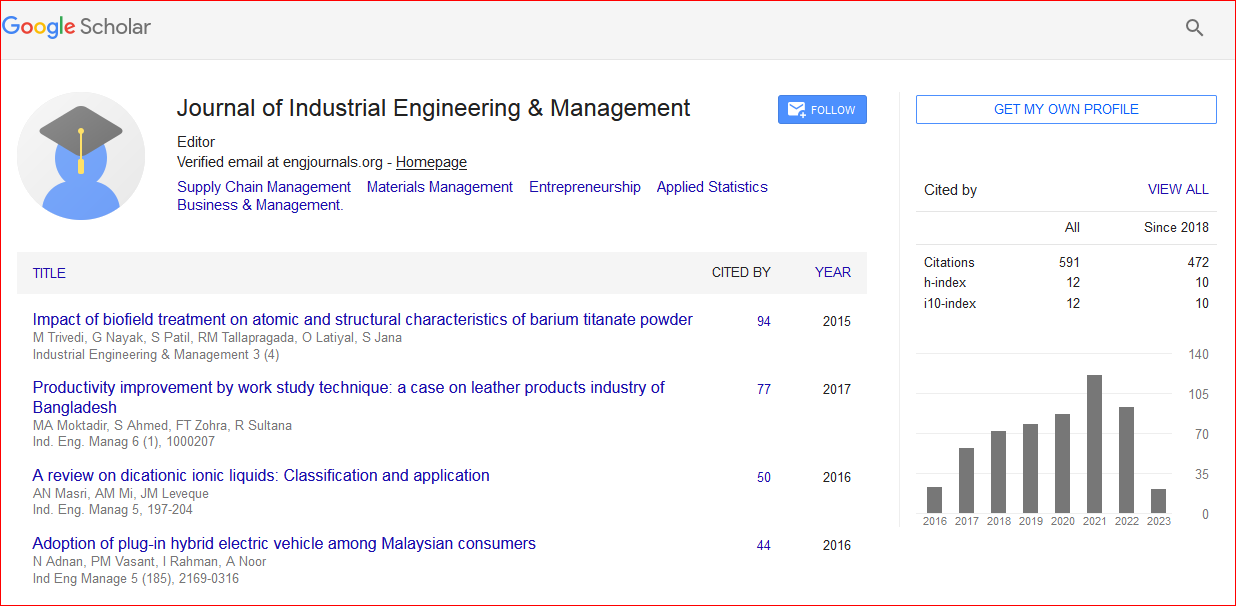
Industrial Engineering & Management received 739 citations as per Google Scholar report