Opinion - (2025) Volume 15, Issue 4
Received: 02-Aug-2025, Manuscript No. jeat-26-188636;
Editor assigned: 04-Aug-2025, Pre QC No. P-188636;
Reviewed: 18-Aug-2025, QC No. Q-188636;
Revised: 25-Aug-2025, Manuscript No. R-188636;
Published:
01-Sep-2025
, DOI: 10.37421/2161-0525.2025.15.858
Citation: Otieno, Joseph. ”Industrial Pollution: Threats, Remediation,
and Sustainable Solutions.” J Environ Anal Toxicol 15 (2025):858.
Copyright: © 2025 Otieno J. This is an open-access article distributed under the terms of the Creative Commons Attribution License, which permits unrestricted use, distribution
and reproduction in any medium, provided the original author and source are credited.
The escalating industrialization across the globe has brought forth a critical challenge: the pervasive presence and detrimental effects of toxic industrial waste on both soil and water ecosystems. This complex issue demands a comprehensive understanding of the pollutants involved, their environmental pathways, and their toxicological mechanisms. Investigations into these contaminants reveal a spectrum of substances, with heavy metals and persistent organic pollutants (POPs) frequently identified as key culprits in industrial pollution scenarios. These substances originate from a myriad of industrial processes and find their way into the environment through various routes, posing significant risks to ecological health and human well-being. The intricate nature of these pollutants and their widespread distribution necessitate robust monitoring and management strategies to mitigate long-term environmental damage and safeguard natural resources [1].
The quantification of specific heavy metals in environmental matrices, particularly in areas adjacent to industrial zones, is a crucial step in assessing the extent of contamination and its potential risks. Research employing advanced analytical techniques has been instrumental in determining the concentrations of metals such as lead, cadmium, and mercury in soil and water samples. Findings often reveal significant exceedances of regulatory limits, underscoring the urgent need for targeted remediation and stricter industrial discharge controls. The implications of such contamination extend beyond ecological systems, directly impacting human health through various exposure pathways, necessitating proactive intervention and stringent regulatory oversight to prevent further environmental degradation [2].
Persistent Organic Pollutants (POPs) represent another significant class of contaminants emanating from industrial activities, posing a unique set of challenges due to their environmental stability and tendency to bioaccumulate. Studies focusing on the impact of POPs on aquatic ecosystems have highlighted their insidious presence in water bodies and their subsequent accumulation in the tissues of aquatic organisms, particularly fish. The biomagnification of these contaminants up the food chain presents considerable risks not only to wildlife but also to human consumers of contaminated fish, prompting calls for international cooperation to manage and phase out these hazardous substances. Effective strategies are needed to address their persistence and reduce their entry into the environment [3].
In the face of growing soil contamination from industrial activities, the exploration of sustainable and cost-effective remediation techniques has become paramount. Phytoremediation, which utilizes specific plant species to extract or degrade contaminants, has emerged as a promising approach. Research in this area evaluates the potential of selected plants to accumulate toxic metals like chromium and zinc from contaminated soils. Understanding the factors that influence phytoremediation efficiency, such as plant selection, soil conditions, and pollutant concentration, is crucial for its successful application in industrial waste sites, offering an environmentally sound solution for soil restoration [4].
The rapid and sensitive detection of toxic organic compounds in industrial wastewater is vital for effective environmental monitoring and early warning systems. The development of novel biosensors has shown considerable promise in this regard. These technologies, often utilizing specific enzymes immobilized on transducer surfaces, can detect pollutants like phenols and pesticides at low concentrations. Such advancements offer a valuable tool for real-time monitoring, enabling prompt responses to pollution incidents and contributing to the overall protection of water resources from industrial effluents [5].
The environmental fate and transport of specific toxic elements, such as arsenic, in industrially contaminated soils are critical considerations for groundwater quality. Investigations into the chemical speciation and mobility of arsenic provide crucial insights into its behavior in the environment. Understanding the different forms of arsenic present and their propensity to leach into groundwater is essential for accurate risk assessments and the development of effective strategies to protect vital water resources from contamination by industrial discharges [6].
Advanced Oxidation Processes (AOPs) offer powerful methods for the degradation of recalcitrant organic pollutants commonly found in industrial effluents. Processes such as Fenton, ozonation, and UV/H2O2 have been extensively studied for their efficiency in breaking down complex organic molecules into less harmful substances. A comparative analysis of these AOPs provides valuable guidance on selecting the most optimal treatment strategy based on specific pollutant characteristics and desired treatment outcomes, thereby improving the management of industrial wastewater [7].
The environmental impact of industrial mining waste on local water bodies is a significant concern, often involving contamination by hazardous substances like cyanide and heavy metals. Comprehensive environmental impact assessments, incorporating field sampling, chemical analysis, and ecological surveys, are essential to evaluate the extent of pollution and its effects on aquatic life. The findings from such studies underscore the critical need for improved waste management practices within the mining sector to prevent further ecological damage and safeguard water quality [8].
The utilization of agricultural waste to develop novel composite adsorbents for the removal of heavy metals from contaminated water represents an innovative and sustainable approach. These bio-composite materials, derived from readily available agricultural byproducts, demonstrate high adsorption capacities and reusability for metals such as copper and zinc. This technology offers a cost-effective and environmentally friendly solution for treating industrial wastewater contaminated with heavy metals, contributing to cleaner water resources [9].
Phthalates, widely used as plasticizers in industrial applications, pose a long-term environmental risk due to their persistence and potential for bioaccumulation in soil and aquatic environments. Studies examining areas with high industrial activity have assessed the presence of these endocrine-disrupting chemicals and the risks they pose to ecosystems and human health through various exposure pathways. Understanding their environmental behavior is crucial for developing strategies to mitigate their impact and protect environmental integrity from industrial chemical usage [10].
Industrial activities inherently generate a wide array of waste products, many of which contain toxic substances that can significantly impact the environment. Among the most concerning are heavy metals and persistent organic pollutants (POPs), which can contaminate soil and water resources, leading to detrimental effects on ecosystems and human health. This article reviews the pervasive presence and multifaceted impacts of these industrial wastes, highlighting the critical need for effective management and remediation strategies to address the challenges posed by industrial pollution. The study emphasizes the importance of integrated approaches, including robust regulatory frameworks and the adoption of sustainable industrial practices, to mitigate long-term environmental damage and ensure the health of our planet's vital ecosystems [1].
Assessing the levels of specific heavy metals in environmental samples is a crucial aspect of understanding the impact of industrial activities. Research involving the collection and analysis of soil and water samples from areas downstream of industrial zones has quantified the concentrations of metals like lead, cadmium, and mercury. The application of advanced analytical techniques ensures accurate determination of these contaminants. The findings from such studies often reveal concentrations that significantly exceed established regulatory limits, thereby emphasizing the urgent necessity for tailored remediation strategies and more stringent controls on industrial wastewater discharge. The health risks associated with these elevated levels necessitate immediate attention and intervention [2].
Persistent Organic Pollutants (POPs) are a group of chemicals that are resistant to environmental degradation, leading to their persistence in ecosystems and potential for long-range transport. Industrial activities are a primary source of these pollutants, which can enter aquatic environments and subsequently bioaccumulate in the food chain. Studies focusing on the bioaccumulation of POPs in fish species from industrially impacted rivers have utilized advanced analytical methods such as gas chromatography-mass spectrometry (GC-MS) to identify and quantify these contaminants. The results demonstrate the biomagnification of POPs, posing substantial risks to both wildlife and humans who consume contaminated fish, highlighting the need for global efforts to manage and phase out these harmful substances [3].
Remediation of industrially contaminated soils is a significant environmental challenge. Phytoremediation, a technique that uses plants to remove or neutralize contaminants, offers a sustainable and cost-effective solution. This research evaluates the effectiveness of specific plant species in removing heavy metals, such as chromium and zinc, from contaminated soils. By conducting laboratory and field experiments, the study elucidates the potential of selected plants to accumulate these toxic metals. Furthermore, it discusses critical factors influencing the success of phytoremediation, including plant selection, soil characteristics, and pollutant concentrations, providing valuable insights for the application of this eco-friendly remediation strategy [4].
Accurate and rapid detection of toxic organic compounds in industrial wastewater is essential for effective environmental monitoring and timely response to pollution events. The development of novel biosensors represents a significant advancement in this field. These biosensors, designed with specific enzymes immobilized on a transducer surface, offer high sensitivity and selectivity for detecting pollutants like phenols and pesticides even at very low concentrations. This technology holds great promise for establishing real-time monitoring systems and early warning mechanisms, thereby enhancing environmental protection efforts against industrial discharge [5].
Understanding the behavior of toxic elements like arsenic in contaminated soils is crucial for safeguarding groundwater resources. This research investigates the chemical speciation and mobility of arsenic originating from industrial discharges. By employing hyphenated analytical techniques, the study elucidates the various forms of arsenic present in the soil and assesses their likelihood of leaching into groundwater. The insights gained from this research are vital for conducting accurate environmental risk assessments and for formulating effective strategies to protect groundwater quality from the persistent threat of industrial contamination [6].
Industrial effluents frequently contain recalcitrant organic pollutants that are difficult to degrade through conventional wastewater treatment methods. Advanced Oxidation Processes (AOPs) offer a promising solution for the effective removal of these complex compounds. This study presents a comparative analysis of different AOPs, including Fenton, ozonation, and UV/H2O2, assessing their efficiency in breaking down organic molecules into less harmful substances. The research provides valuable guidance for selecting the most appropriate AOP based on the specific characteristics of the pollutants and the desired treatment objectives, thereby optimizing industrial wastewater management [7].
Industrial mining operations can lead to significant environmental degradation, particularly concerning the contamination of local water bodies. This research focuses on the environmental impact assessment of mining waste, specifically examining the contamination by cyanide and heavy metals. Through a combination of field sampling, rigorous chemical analysis, and ecological surveys, the study evaluates the extent of pollution and its adverse effects on aquatic ecosystems. The findings highlight the critical need for enhanced waste management practices within the mining industry to prevent further damage to water quality and aquatic biodiversity [8].
The development of sustainable materials for treating contaminated water is a growing area of research. This study explores the use of novel composite adsorbents derived from agricultural waste for the removal of toxic heavy metals from contaminated water. The research details the synthesis and characterization of these eco-friendly adsorbents and evaluates their efficacy in removing metals such as copper and zinc from synthetic wastewater. The results demonstrate the high adsorption capacity and reusability of these materials, presenting a sustainable and cost-effective solution for industrial water treatment and environmental protection [9].
Phthalates, commonly used as plasticizers in various industrial products, can persist in the environment and bioaccumulate in soil and aquatic ecosystems. This paper investigates the long-term environmental persistence and bioaccumulation potential of phthalates in areas with significant industrial activity. The study analyzes environmental samples to assess the risks posed by these endocrine-disrupting chemicals to ecosystems and human health through multiple exposure pathways. Understanding the environmental fate of phthalates is crucial for developing effective strategies to mitigate their impact and protect environmental health from industrial chemical usage [10].
Industrial pollution poses significant environmental threats, primarily through toxic waste impacting soil and water. Heavy metals and persistent organic pollutants (POPs) are key contaminants, originating from diverse industrial sources and entering ecosystems through various pathways. Research quantifies heavy metal levels near industrial zones, revealing exceedances of safety limits and necessitating stricter controls. POPs bioaccumulate in aquatic life, with consequences for food chains and human health. Phytoremediation offers a sustainable approach for soil remediation, while biosensors provide rapid detection of organic pollutants in wastewater. The mobility of elements like arsenic in contaminated soils affects groundwater quality. Advanced Oxidation Processes (AOPs) are effective for degrading recalcitrant organic pollutants in industrial effluents. Mining waste significantly contaminates water bodies with cyanide and heavy metals, requiring improved waste management. Novel bio-composite adsorbents from agricultural waste offer a sustainable solution for heavy metal removal from water. Phthalates, industrial plasticizers, persist in the environment and pose risks of bioaccumulation.
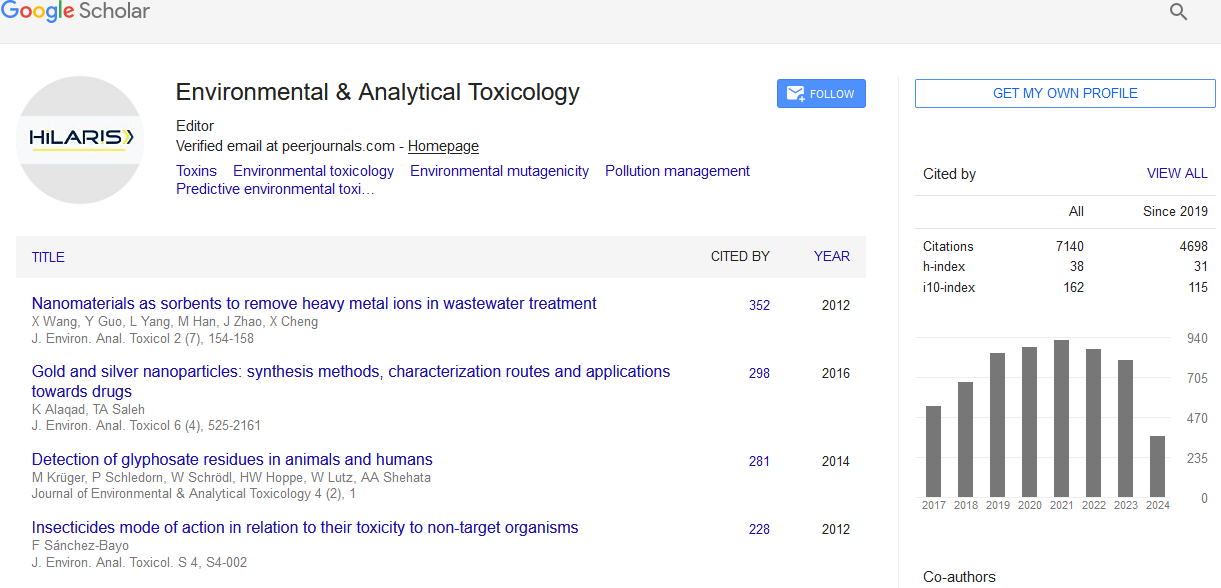
Environmental & Analytical Toxicology received 6818 citations as per Google Scholar report