Commentary - (2025) Volume 14, Issue 4
Received: 01-Jul-2025, Manuscript No. iem-26-179812;
Editor assigned: 03-Jul-2025, Pre QC No. P-179812;
Reviewed: 14-Jul-2025, QC No. Q-179812;
Revised: 22-Jul-2025, Manuscript No. R-179812;
Published:
29-Jul-2025
, DOI: 10.37421/2169- 0316.2025.14.310
Citation: Al-Farsi, Ahmed. âIndustrial Engineering for Sustainable Manufacturing Advancement.â J Ind Eng Manag 14 (2025):310.
Copyright: © 2025 Al-Farsi A. This is an open-access article distributed under the terms of the Creative Commons Attribution License, which permits unrestricted use, distribution and reproduction in any medium, provided the original author and source are credited.
The field of industrial engineering is increasingly embracing sustainability as a core principle, recognizing its vital role in modern manufacturing and operational efficiency. This shift is driven by a growing awareness of environmental challenges and the need for responsible resource management across all industrial sectors. Integrating sustainable practices is no longer an option but a necessity for long-term viability and competitiveness. The evolution of industrial engineering has seen a continuous pursuit of optimization, and sustainability is the latest frontier in this endeavor. By incorporating eco-friendly considerations into design, production, and supply chain management, engineers can create systems that are both productive and environmentally benign. This interdisciplinary approach ensures that economic growth does not come at the expense of ecological health. One of the key aspects of integrating sustainability is the application of established engineering principles to environmental challenges. Methodologies like lean manufacturing, for instance, are being re-examined and adapted to not only eliminate waste in production but also to reduce environmental impact. This signifies a deeper integration where operational excellence and ecological responsibility are intertwined. Furthermore, the concept of the circular economy is gaining significant traction within industrial engineering. This paradigm shift moves away from the linear take-make-dispose model towards one that emphasizes product longevity, reuse, remanufacturing, and recycling. The goal is to keep resources in use for as long as possible, extracting maximum value before recovering and regenerating products and materials at the end of their service life. The development of green design principles is another crucial element in this sustainability integration. Industrial engineers are exploring ways to design products that are not only functional and aesthetically pleasing but also minimize their environmental footprint throughout their entire lifecycle. This involves careful consideration of materials, manufacturing processes, and end-of-life disposal. Life cycle assessment (LCA) has emerged as a critical tool for industrial engineers to systematically evaluate the environmental impacts of manufacturing processes. By quantifying these impacts from raw material extraction to product disposal, LCA provides a comprehensive understanding that can guide decision-making towards more sustainable choices in product design and production methods. The advent of Industry 4.0 technologies, such as the Internet of Things (IoT) and artificial intelligence (AI), presents unprecedented opportunities for achieving sustainable manufacturing. These smart technologies can optimize resource utilization, reduce waste generation, and enhance energy efficiency, paving the way for more environmentally responsible production systems. Supply chain management, a cornerstone of industrial engineering, is also undergoing a transformation towards sustainability. The development of green supply chains involves designing and managing supply chain operations with a focus on minimizing environmental impact. This includes eco-friendly logistics, procurement, and distribution strategies. Energy efficiency is paramount in sustainable manufacturing. Industrial engineers are developing and implementing strategies to optimize energy consumption in production processes. This involves energy audits, process redesign, and the integration of renewable energy sources to reduce reliance on fossil fuels and lower carbon emissions. Ultimately, the integration of sustainability into industrial engineering represents a holistic approach to creating manufacturing systems that are resilient, efficient, and environmentally conscious. This involves a continuous effort to innovate and apply best practices across all facets of industrial operations to foster a more sustainable future for the industry.
Industrial engineering is undergoing a significant transformation with the integration of sustainable practices, a move that promises to enhance operational efficiency while mitigating environmental impact. This evolution is marked by the application of core engineering principles to address ecological concerns across the entire value chain. The focus is on creating systems that are not only productive but also responsible stewards of natural resources, ensuring long-term economic and environmental health. The principles of lean manufacturing are being adapted and expanded to encompass environmental considerations, moving beyond waste reduction in production to minimizing ecological footprints. This involves a deeper understanding of how efficient processes can directly translate into reduced energy consumption, lower emissions, and less material waste, demonstrating a powerful synergy between operational excellence and sustainability. The circular economy framework offers a paradigm shift from linear production models to systems that prioritize resource longevity and recovery. Industrial engineers are actively exploring strategies such as product design for disassembly, robust remanufacturing processes, and efficient recycling systems to keep materials in use and minimize landfill dependency, thereby fostering a more regenerative industrial ecosystem. Green design methodologies are becoming integral to industrial engineering practice, guiding the development of products with reduced environmental impacts throughout their lifecycle. This encompasses informed material selection, optimized manufacturing processes, and considerations for end-of-life management, ensuring that products are designed for sustainability from inception. Life cycle assessment (LCA) serves as a critical analytical tool for industrial engineers to quantify the environmental implications of manufacturing activities. By providing a comprehensive view from raw material acquisition to final disposal, LCA enables informed decision-making and facilitates the identification of opportunities for environmental improvement in product design and production. The integration of Industry 4.0 technologies, including the Internet of Things (IoT) and artificial intelligence (AI), is revolutionizing sustainable manufacturing. These advanced technologies enable real-time monitoring, data-driven optimization of resource utilization, reduction in waste, and significant improvements in energy efficiency, leading to more environmentally sound production processes. Developing green supply chains is another key area of focus within industrial engineering. This involves the strategic design and management of supply chain operations to minimize environmental effects, covering aspects like eco-friendly transportation, sustainable procurement practices, and responsible product distribution throughout the network. Energy efficiency is a fundamental pillar of sustainable manufacturing, and industrial engineers are instrumental in its implementation. This includes conducting thorough energy audits, redesigning processes for lower energy consumption, and advocating for the adoption of renewable energy sources to reduce the carbon footprint of industrial operations. Waste reduction strategies are being systematically developed and implemented to enhance environmental sustainability in industrial manufacturing. These strategies involve waste minimization at the source, effective segregation of waste streams, comprehensive recycling programs, and the exploration of waste-to-energy opportunities, all aimed at improving resource utilization and reducing reliance on landfills. Ultimately, the successful integration of sustainability into industrial engineering requires a holistic and systemic approach. This involves leveraging assessment tools, embracing innovative technologies, and adopting forward-thinking design and operational strategies to create manufacturing systems that are not only efficient and profitable but also environmentally responsible and contribute to a sustainable future.
This collection of articles highlights the critical role of industrial engineering in advancing sustainable manufacturing. It explores the integration of principles like lean manufacturing, circular economy, and green design to reduce environmental impact and enhance operational efficiency. Key themes include the application of Industry 4.0 technologies for optimization, the importance of life cycle assessment (LCA) for evaluating environmental performance, and the development of green supply chains. Strategies for waste reduction and energy efficiency are also detailed, emphasizing the use of assessment tools and sustainable product design methodologies to create more environmentally responsible industrial systems.
None
None
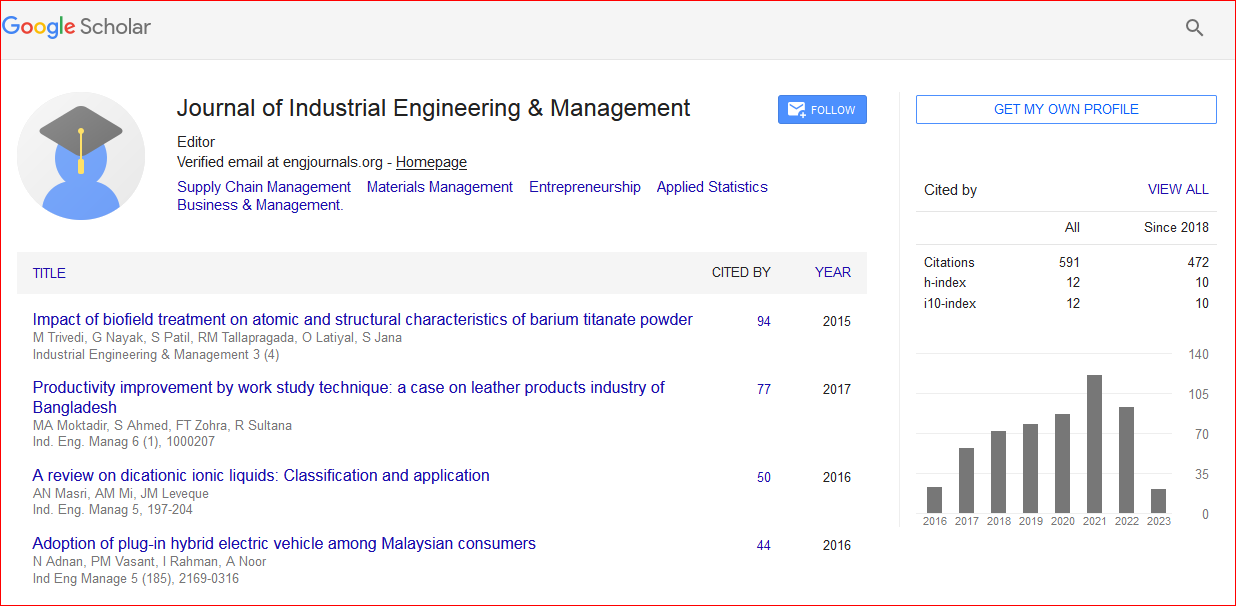
Industrial Engineering & Management received 739 citations as per Google Scholar report