Brief Report - (127) Volume 13, Issue 5
Received: 01-Oct-2025, Manuscript No. JGPR-26-190226;
Editor assigned: 03-Oct-2025, Pre QC No. P-190226;
Reviewed: 17-Oct-2025, QC No. Q-190226;
Revised: 22-Oct-2025, Manuscript No. R-190226;
Published:
29-Oct-2025
, DOI: 10.37421/2329-9126.2025.13.636
Citation: Brown, Laura. ”Improving Health Literacy: A Primary Care Imperative.” J Gen Pract 13 (2025):636.
Copyright: © 2025 Brown L. This is an open-access article distributed under the terms of the Creative Commons Attribution License, which permits unrestricted use, distribution and reproduction in any medium, provided the original author and source are credited.
Enhancing patient education and health literacy in primary care settings is crucial for improving health outcomes and empowering patients to actively participate in their care. Key insights highlight the need for tailored communication strategies, utilizing plain language, and incorporating various formats such as visual aids and teach-back methods to ensure understanding across diverse patient populations. Addressing systemic barriers, like time constraints and resource limitations for healthcare providers, alongside patient-level factors such as socioeconomic status and cultural background, is essential for effective health literacy interventions [1].
The teach-back method, a technique where patients explain in their own words what they need to know, consistently demonstrates its effectiveness in assessing and improving patient comprehension of health information. This approach moves beyond simple information delivery to a dynamic dialogue, ensuring that messages are understood and actionable. Integrating this into routine primary care consultations can significantly reduce misunderstandings and improve adherence to treatment plans [2].
Developing and disseminating patient educational materials in multiple languages and varying literacy levels is paramount for equitable primary care. Studies emphasize that materials designed with universal design principles, clear headings, and minimal jargon are more accessible. When patients can access information in a format they understand, they are more likely to engage in preventive behaviors and manage chronic conditions effectively [3].
The role of digital health literacy in primary care is rapidly growing. Empowering patients with the skills to navigate online health resources, understand electronic health records, and engage with telehealth services is becoming increasingly important. Primary care providers can play a role in guiding patients towards reliable digital health information and teaching them how to critically evaluate online content [4].
Integrating health literacy assessments into routine primary care visits allows providers to identify patients who may struggle with understanding health information. These assessments, when followed by targeted interventions, can prevent medication errors, improve appointment adherence, and enhance overall patient safety. It's not just about providing information; it's about ensuring that information is understood and usable [5].
The impact of health literacy on chronic disease management in primary care is profound. Patients with higher health literacy are more likely to adhere to treatment regimens, engage in self-management strategies, and experience better health outcomes. Primary care interventions focused on improving health literacy can empower individuals with conditions like diabetes and hypertension to take control of their health [6].
Provider communication skills are a cornerstone of effective patient education and health literacy in primary care. Training healthcare professionals in empathetic listening, avoiding medical jargon, and using motivational interviewing techniques can significantly enhance patient understanding and trust. The quality of the provider-patient interaction directly influences how well patients comprehend and act on health advice [7].
The intersection of health literacy and patient safety in primary care warrants significant attention. Low health literacy is a known risk factor for medication errors, missed appointments, and failure to follow diagnostic or treatment recommendations. Primary care settings are ideal for implementing interventions that promote patient understanding and reduce these safety risks [8].
Addressing health literacy in primary care requires a multi-faceted approach that considers socioeconomic factors, cultural beliefs, and individual learning preferences. Community health workers can play a vital role in bridging the gap between healthcare providers and patients, offering culturally sensitive health education and support that improves engagement and understanding [9].
The implementation of health literacy-informed practices in primary care can lead to significant improvements in patient outcomes and satisfaction. This includes training staff to use plain language, providing easy-to-understand written materials, and ensuring that patients have opportunities to ask questions and confirm their understanding. When health literacy is prioritized, the patient-provider relationship is strengthened, fostering better health behaviors and adherence [10].
Improving health literacy in primary care is a multifaceted endeavor that necessitates tailored communication strategies to ensure patient comprehension and engagement. Utilizing plain language, incorporating visual aids, and employing techniques like teach-back are vital for addressing diverse patient needs and backgrounds. Recognizing and overcoming systemic barriers such as time constraints and resource limitations, alongside addressing individual socioeconomic and cultural factors, is paramount for the success of health literacy initiatives [1].
The teach-back method stands out as a particularly effective strategy for confirming patient understanding of health information. By prompting patients to explain concepts in their own words, healthcare providers can move beyond mere information transmission to a genuine dialogue, significantly reducing misinterpretations and improving adherence to medical advice. Its integration into routine primary care consultations is a key recommendation for enhancing patient education [2].
Accessibility of health information is a critical component of equitable primary care. Developing and distributing educational materials that are available in multiple languages and adapted for varying literacy levels is essential. Applying universal design principles, employing clear headings, and minimizing jargon in these materials makes them more approachable and understandable for a broader patient population, encouraging better engagement with preventive health and chronic disease management [3].
The increasing prevalence of digital health services in primary care underscores the growing importance of digital health literacy. Equipping patients with the skills to confidently navigate online health resources, understand electronic health records, and utilize telehealth services is a growing responsibility for primary care providers. Guiding patients to reliable information and teaching critical evaluation of online content are key aspects of this role [4].
Proactive identification of patients at risk for health literacy challenges through integrated assessments in primary care visits is crucial for patient safety. These assessments, when followed by appropriate interventions, can mitigate risks such as medication errors, missed appointments, and non-adherence to treatment plans, ultimately ensuring that provided health information is not only delivered but also understood and actionable [5].
Health literacy plays a significant role in the effective management of chronic diseases within primary care settings. Patients who possess higher levels of health literacy are more inclined to follow prescribed treatment regimens, actively participate in self-management strategies, and consequently achieve better health outcomes. Interventions aimed at bolstering health literacy can empower individuals with chronic conditions to gain greater control over their well-being [6].
Excellent provider communication skills are foundational to effective patient education and the promotion of health literacy. Healthcare professionals trained in empathetic listening, the avoidance of complex medical jargon, and the application of motivational interviewing techniques can substantially improve patient comprehension and foster stronger trust. The dynamics of the provider-patient interaction are directly linked to how well patients understand and act upon health advice [7].
The relationship between health literacy and patient safety in primary care is undeniable and requires considerable focus. Low health literacy is recognized as a contributing factor to medication errors, missed appointments, and difficulties in following medical recommendations. Primary care environments offer a prime opportunity to implement targeted interventions that enhance patient understanding and minimize these critical safety risks [8].
A comprehensive strategy for improving health literacy in primary care must consider a wide array of factors, including socioeconomic status, cultural beliefs, and individual learning styles. The involvement of community health workers can be instrumental in bridging communication gaps, providing culturally competent health education, and offering support that enhances patient engagement and comprehension [9].
Adopting health literacy-informed practices within primary care settings can yield substantial improvements in both patient outcomes and overall satisfaction. Key practices include staff training in plain language communication, the provision of easily understandable written materials, and creating opportunities for patients to ask questions and confirm their understanding. Prioritizing health literacy strengthens the patient-provider relationship, leading to enhanced health behaviors and better treatment adherence [10].
Enhancing patient education and health literacy in primary care is vital for improved health outcomes. Key strategies include tailored communication using plain language and diverse formats like teach-back methods. Addressing systemic and patient-level barriers such as time constraints, resources, socioeconomic status, and cultural background is essential. Developing accessible educational materials in multiple languages and promoting digital health literacy are also crucial. Integrating health literacy assessments and focusing on provider communication skills further strengthens patient understanding and safety. Community health workers can play a significant role in this process. Prioritizing health literacy leads to better chronic disease management, reduced errors, and improved patient satisfaction and adherence.
None
None
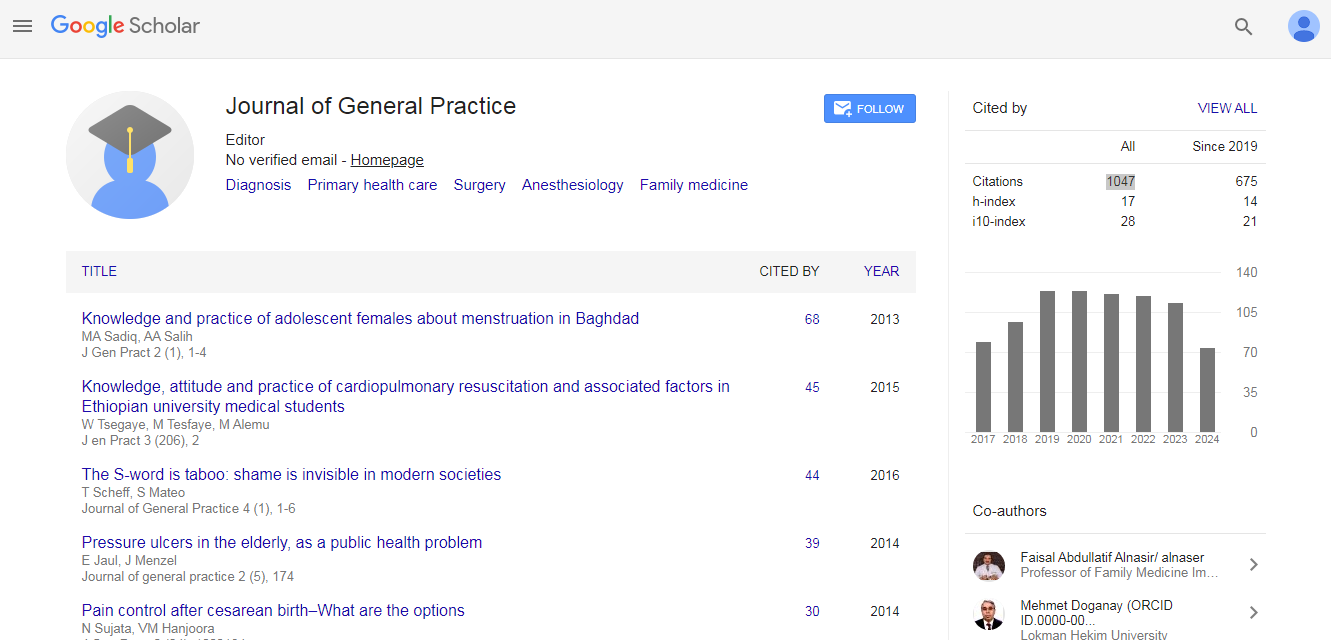
Journal of General Practice received 1047 citations as per Google Scholar report