Short Communication - (2025) Volume 9, Issue 6
Received: 01-Dec-2025, Manuscript No. ahbs-26-182577;
Editor assigned: 03-Dec-2025, Pre QC No. P-182577;
Reviewed: 17-Dec-2025, QC No. Q-182577;
Revised: 22-Dec-2025, Manuscript No. R-182577;
Published:
29-Dec-2025
, DOI: 10.37421/2952-8097.2025.9.352
Citation: Mensah, Kofi. ”Advanced Technologies Shape Modern
Animal Health Research.” J Anim Health Behav Sci 09 (2025):352.
Copyright: © 2025 Mensah K. This is an open-access article distributed under the terms of the Creative Commons Attribution License, which permits unrestricted use,
distribution and reproduction in any medium, provided the original author and source are credited.
The field of animal health and behavior research is undergoing a significant transformation driven by the integration of advanced technological approaches and a multidisciplinary perspective. This evolution is characterized by an increasing reliance on computational tools and novel methodologies to understand and improve animal well-being. Specifically, the application of artificial intelligence and machine learning is becoming more prevalent, offering powerful capabilities for predictive diagnostics and the early detection of diseases in animals. These technologies also facilitate the sophisticated analysis of complex behavioral patterns, providing deeper insights than traditional observational methods alone [1].
Parallel to advancements in AI, gene editing technologies, such as CRISPR-Cas9, are opening new frontiers in animal health. These tools hold immense potential for disease prevention by conferring resistance to various pathogens and for gaining a deeper understanding of the genetic underpinnings that influence animal behavior. This precision in genetic modification allows for targeted research into gene function, paving the way for innovative interventions [3].
The One Health framework is increasingly influencing research directions, emphasizing the intrinsic interconnectedness of animal, human, and environmental health. This holistic approach is crucial for effective zoonotic disease surveillance and the development of robust mitigation strategies, recognizing that the health of one component directly impacts the others [1].
Wearable sensors and remote monitoring technologies are revolutionizing how animal health and behavior are tracked. These non-invasive tools provide continuous data streams, enabling the detection of subtle physiological and behavioral changes that may indicate illness or stress, often before visible symptoms emerge. The data generated can be analyzed to create personalized health management plans and enhance the understanding of individual animal welfare [2].
Furthermore, the capabilities of artificial intelligence and machine learning extend significantly into the realm of animal behavior analysis. These computational tools are adept at processing vast and intricate behavioral datasets, often generated by sophisticated tracking technologies. Their applications range from identifying individual animal signatures and mapping social networks to detecting subtle anomalies that could signal pain or distress [4].
The implications of gene editing technologies like CRISPR-Cas9 for animal breeding and disease resistance are profound. Beyond enhancing resistance to diseases, these tools can be used to investigate the genetic basis of complex behaviors, including social interactions and stress responses, allowing for precise modifications to explore gene function. However, the responsible application of this technology necessitates careful consideration of ethical implications and potential off-target effects [3].
Precision livestock farming represents a significant application of these technological advancements. By leveraging data from sensors, AI, and genomics, this approach aims to optimize animal health, welfare, and productivity. Real-time monitoring of individual animals enables the early detection of diseases, prediction of nutritional needs, and effective management of environmental conditions, leading to more sustainable and efficient animal agriculture [6].
The study of animal behavior also benefits from ongoing research into its neural and genetic underpinnings. Advanced neuroimaging techniques and molecular genetics are providing unprecedented insights into brain function and the influence of genes on behavioral traits. This research is vital for addressing behavioral disorders and enhancing our understanding of cognition and sentience across different species [7].
The field of animal microbiome research is rapidly expanding, highlighting the critical role of these microbial communities in animal health, immunity, and behavior. Understanding the complex interactions between the microbiome and the host is opening new avenues for therapeutic interventions, such as targeted probiotics and prebiotics, and the investigation of dysbiosis-related health and behavioral alterations [5].
Ethical considerations surrounding animal research and welfare are becoming increasingly prominent. These concerns are actively influencing experimental design, the application of research findings, and the overall responsible conduct of studies involving animals, ensuring that their well-being is a central aspect of scientific inquiry [1].
The integration of advanced technological approaches into animal health and behavior research marks a paradigm shift in how we understand and care for animals. Artificial intelligence and machine learning are at the forefront of this revolution, enabling predictive diagnostics and the early detection of diseases, thereby improving treatment outcomes and reducing animal suffering. These computational tools are also instrumental in analyzing intricate behavioral patterns, providing nuanced insights into animal cognition, social structures, and emotional states, which were previously difficult to ascertain through traditional methods [1].
Gene editing technologies, particularly CRISPR-Cas9, are offering unprecedented opportunities to enhance animal health. By conferring genetic resistance to diseases and improving production traits, these technologies have the potential to significantly reduce the incidence of illness and the need for therapeutic interventions. Furthermore, gene editing allows researchers to delve into the genetic basis of complex behaviors, providing a molecular understanding of traits such as social interaction and stress responses, thereby aiding in the development of targeted behavioral interventions [3].
The One Health principle underscores the critical interdependence of animal, human, and environmental health. This perspective is driving research towards more comprehensive strategies for zoonotic disease surveillance and mitigation. By considering the health of all components of an ecosystem, we can develop more effective and sustainable public health policies that protect both animal and human populations from emerging infectious threats [1].
Wearable sensors and remote monitoring technologies are transforming animal care by providing continuous, non-invasive data streams. These devices allow for the real-time tracking of vital signs, activity levels, and behavioral changes, which can alert caregivers to potential health issues before they become severe. The analysis of this data, often facilitated by machine learning algorithms, enables personalized health management and a more profound understanding of individual animal welfare [2].
Artificial intelligence is proving to be an indispensable tool for the analysis of animal behavior. Modern tracking technologies generate massive datasets that AI can process efficiently, identifying subtle behavioral cues and patterns. This capability is crucial for recognizing early signs of pain or distress, understanding social dynamics within animal groups, and developing automated systems for objective welfare assessments, thereby improving the scalability and accuracy of behavioral research [4].
CRISPR-Cas gene editing technology presents a powerful tool for advancing animal breeding and disease resistance. Its precision in modifying DNA allows for the targeted investigation of gene function, which is crucial for understanding both disease susceptibility and the genetic basis of behavioral traits. However, the responsible deployment of this technology requires rigorous attention to ethical considerations, potential unintended genetic alterations, and the establishment of clear regulatory frameworks [3].
Precision livestock farming harnesses the power of data integration from various sources, including sensors, AI, and genomics, to optimize animal husbandry. This approach focuses on individual animal needs, enabling real-time monitoring for early disease detection, tailored nutritional plans, and environmental management. The goal is to enhance animal well-being and productivity while promoting sustainable agricultural practices through data-driven decision-making [6].
The neural and genetic factors influencing animal behavior are a continued area of intense research. Sophisticated neuroimaging techniques and advancements in molecular genetics are providing deeper insights into brain mechanisms and gene expression patterns that shape behavior. This knowledge is vital for understanding and addressing behavioral disorders, improving animal training protocols, and gaining a more comprehensive appreciation of animal cognition and sentience across the diverse animal kingdom [7].
Research into animal microbiomes is revealing their profound impact on host health, immunity, and behavior. The complex interplay between an animal's internal microbial communities and its overall well-being is a burgeoning field of study. Identifying imbalances or dysbiosis in the microbiome is linked to various health issues and behavioral anomalies, opening avenues for novel therapeutic strategies, such as the development of specific probiotics and prebiotics [5].
Ethical considerations are increasingly shaping the landscape of animal research and welfare. The design of experiments, the interpretation of results, and the ultimate application of findings are all being scrutinized through an ethical lens. This heightened awareness ensures that research is conducted responsibly, prioritizing the welfare of the animals involved and fostering a more humane approach to scientific inquiry [1].
Modern animal health and behavior research is increasingly reliant on advanced technologies like AI, machine learning, and gene editing. These tools facilitate predictive diagnostics, early disease detection, and a deeper understanding of genetic influences on behavior. The One Health approach highlights the interconnectedness of animal, human, and environmental health, guiding research towards zoonotic disease surveillance. Wearable sensors and remote monitoring provide continuous data for personalized animal care. Precision livestock farming leverages data for optimized animal management. Research into neural and genetic underpinnings of behavior, along with animal microbiome studies, offers new therapeutic and understanding avenues. Ethical considerations are paramount in all animal research, influencing experimental design and application of findings.
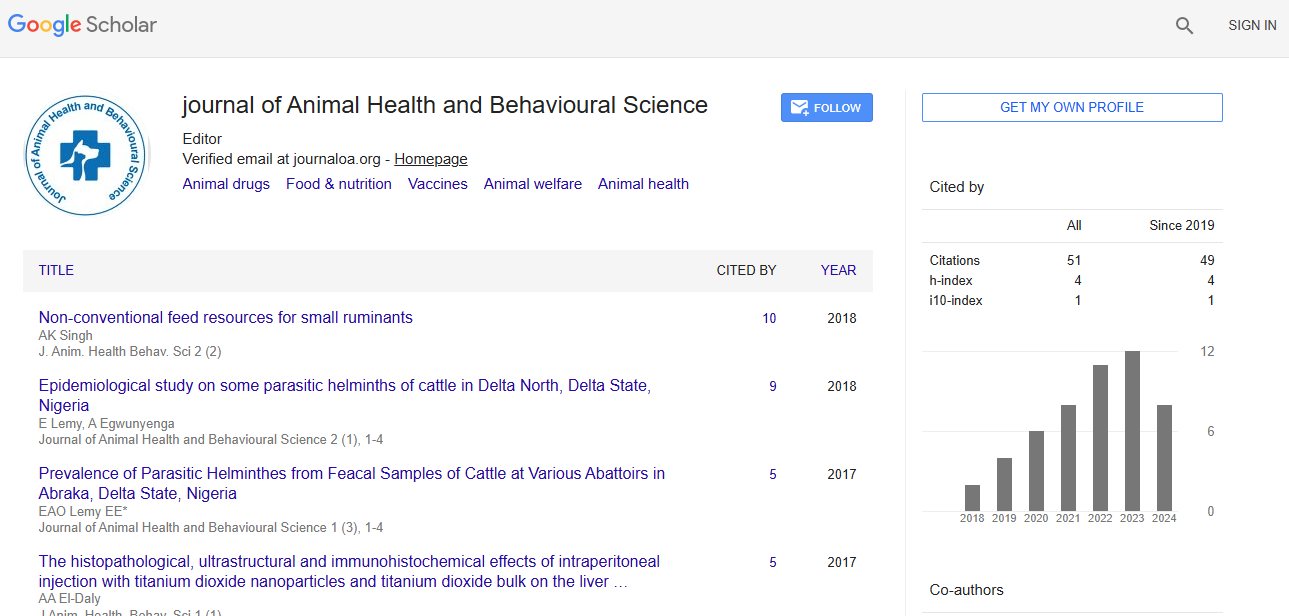
Journal of Animal Health and Behavioural Science received 38 citations as per Google Scholar report