Short Communication - (2025) Volume 11, Issue 4
Received: 01-Aug-2025, Manuscript No. icoa-25-173601;
Editor assigned: 04-Aug-2025, Pre QC No. P-173601;
Reviewed: 18-Aug-2025, QC No. Q-173601;
Revised: 22-Aug-2025, Manuscript No. R-173601;
Published:
29-Aug-2025
, DOI: 10.37421/2469-9756.2025.11.316
Citation: Cooper, Hannah J.. ”Immunotoxicology: Evolving Scope, Advanced Methods, Diverse Threats.” Immunochem Immunopathol 11 (2025):316.
Copyright: © 2025 Cooper J. Hannah This is an open-access article distributed under the terms of the Creative Commons Attribution License, which permits unrestricted use,
distribution and reproduction in any medium, provided the original author and source are credited.
Immunotoxicology is evolving rapidly, moving beyond identifying immunosuppression to understanding complex immune alterations like hyperresponsiveness, allergies, and autoimmunity triggered by various exposures. The field embraces advanced in vitro and in silico methods, reducing reliance on traditional animal models for better human risk assessment predictability. What this really means is we're getting smarter about how chemicals mess with our immune systems, looking at the whole picture instead of just one piece[1].
Understanding how nanomaterials affect the immune system is crucial due to their widespread use. Their unique physicochemical properties, like size and surface chemistry, significantly dictate their immunotoxic potential, leading to outcomes from inflammation to immunosuppression. Here's the thing, current regulatory frameworks struggle to keep pace with nanomaterial development, highlighting a gap in assessing and managing these risks effectively[2].
Pesticides, ubiquitous in our environment, pose significant threats to immune health, not just in wildlife but also in humans, impacting everything from allergic responses to autoimmune conditions. The concern is that even low-level chronic exposures can subtly reprogram immune cells, leading to long-term health consequences that are often overlooked. Let's break it down: understanding the cellular and molecular mechanisms behind these effects is vital for developing effective preventive strategies and mitigating their impact[3].
Exposure to air pollutants, a global health challenge, significantly compromises immune function, contributing to adverse health outcomes like increased susceptibility to infections and exacerbated allergic diseases. What this really means is the air we breathe directly influences our body's ability to fight off disease. Ultrafine particulate matter and gaseous pollutants directly interact with immune cells, initiating inflammatory cascades leading to chronic immune dysregulation[4].
Assessing drug-induced immunotoxicity remains complex in drug development, given immune response intricacies. Emphasis now shifts towards integrating advanced in vitro models and omics technologies to better predict potential immune-mediated adverse drug reactions earlier. Here's the thing, moving beyond traditional assays helps develop safer drugs and reduces the risk of unexpected immune side effects in patients[5].
Endocrine-disrupting chemicals (EDCs) profoundly impact the immune system, often through complex interactions with the endocrine-immune axis, particularly via thyroid hormone disruption. What this really means is these ubiquitous environmental pollutants can lead to immune dysregulation, increasing vulnerability to infections and altering autoimmune responses. Understanding these intricate pathways is essential for grasping the full scope of EDC-induced health risks[6].
While many food additives are deemed safe, evidence suggests some can induce immunotoxic effects, from exacerbating inflammatory bowel diseases to triggering allergic reactions in susceptible individuals. Let's break it down: long-term, low-dose exposure to a cocktail of these chemicals through our diet warrants closer examination, as their cumulative impact on immune health is not fully understood, necessitating more rigorous testing and regulation[7].
Persistent organic pollutants (POPs), particularly polychlorinated biphenyls (PCBs) and dioxins, are notorious for their prolonged environmental presence and profound immunotoxic effects on humans and wildlife. They interfere with immune cell development and function, leading to immunosuppression, altered resistance to infections, and increased autoimmune disorder risk. Here's the thing, their bioaccumulation in the food chain means continued exposure, making their long-term impact on global immune health a significant concern[8].
While immunotherapies have revolutionized cancer treatment, understanding and managing their associated immunotoxicities is paramount for patient safety and treatment efficacy. The challenge lies in distinguishing therapeutic immune activation from adverse immune reactions, which can manifest as autoimmune-like conditions affecting various organ systems. What this really means is as we harness the immune system to fight disease, we must refine strategies to control its potential for collateral damage[9].
Exposure to heavy metals, even at low levels, profoundly influences immune system function, contributing to both immunosuppression and the induction of autoimmune phenomena. Let's break it down: these metals can directly damage immune cells, interfere with cytokine production, and alter gene expression, shifting the delicate balance of immune regulation. Understanding these intricate mechanisms is crucial for assessing environmental risks and developing interventions for metal-induced immune disorders[10].
Immunotoxicology is rapidly evolving, moving beyond simply identifying immunosuppression to understanding more complex immune alterations like hyperresponsiveness, allergies, and autoimmunity triggered by various exposures. The field now embraces advanced in vitro and in silico methods, reducing reliance on traditional animal models while striving for better predictability in human risk assessment. What this really means is we are getting smarter about how chemicals interact with our immune systems, looking at the whole picture instead of just one piece[1].
Understanding how nanomaterials affect the immune system is crucial, considering their widespread use. Their unique physicochemical properties, like size and surface chemistry, significantly dictate their immunotoxic potential, leading to outcomes ranging from inflammation to immunosuppression. Here's the thing, current regulatory frameworks struggle to keep up with the rapid pace of nanomaterial development, highlighting a gap in assessing and managing these risks effectively[2]. Pesticides, ubiquitous in our environment, pose significant threats to immune health, impacting everything from allergic responses to autoimmune conditions in both wildlife and humans. Even low-level chronic exposures can subtly reprogram immune cells, leading to often-overlooked long-term health consequences. Let's break it down: understanding the cellular and molecular mechanisms behind these effects is vital for developing effective preventive strategies and mitigating their impact[3]. Exposure to air pollutants, a global health challenge, significantly compromises immune function, contributing to adverse health outcomes like increased susceptibility to infections and exacerbation of allergic diseases. What this really means is the air we breathe directly influences our body's ability to fight off disease. Ultrafine particulate matter and gaseous pollutants directly interact with immune cells, initiating inflammatory cascades that can lead to chronic immune dysregulation[4].
Endocrine-disrupting chemicals (EDCs) profoundly impact the immune system, often through complex interactions with the endocrine-immune axis, particularly via thyroid hormone disruption. What this really means is these ubiquitous environmental pollutants can lead to immune dysregulation, increasing vulnerability to infections and altering autoimmune responses. Understanding these intricate pathways is essential for grasping the full scope of EDC-induced health risks[6]. Persistent organic pollutants (POPs), particularly polychlorinated biphenyls (PCBs) and dioxins, are notorious for their prolonged environmental presence and profound immunotoxic effects on humans and wildlife. They interfere with immune cell development and function, leading to immunosuppression, altered resistance to infections, and increased autoimmune disorder risk. Here's the thing, their bioaccumulation in the food chain means continued exposure, making their long-term impact on global immune health a significant concern[8]. While many food additives are deemed safe, evidence suggests some can induce immunotoxic effects, from exacerbating inflammatory bowel diseases to triggering allergic reactions in susceptible individuals. Let's break it down: long-term, low-dose exposure to a cocktail of these chemicals through our diet warrants closer examination, as their cumulative impact on immune health is not fully understood, necessitating more rigorous testing and regulation[7].
Assessing drug-induced immunotoxicity remains complex in drug development, given immune response intricacies. Emphasis now shifts towards integrating advanced in vitro models and omics technologies to better predict potential immune-mediated adverse drug reactions earlier. Here's the thing, moving beyond traditional assays helps develop safer drugs and reduces the risk of unexpected immune side effects in patients[5]. While immunotherapies have revolutionized cancer treatment, understanding and managing their associated immunotoxicities is paramount for patient safety and treatment efficacy. The challenge lies in distinguishing therapeutic immune activation from adverse immune reactions, which can manifest as autoimmune-like conditions affecting various organ systems. What this really means is as we harness the immune system to fight disease, we must refine strategies to control its potential for collateral damage[9].
Exposure to heavy metals, even at low levels, profoundly influences immune system function, contributing to both immunosuppression and the induction of autoimmune phenomena. Let's break it down: these metals can directly damage immune cells, interfere with cytokine production, and alter gene expression, shifting the delicate balance of immune regulation. Understanding these intricate mechanisms is crucial for assessing environmental risks and developing interventions for metal-induced immune disorders[10].
Immunotoxicology is a dynamically evolving field, expanding its scope beyond simple immunosuppression to encompass a broader understanding of immune alterations such as hyperresponsiveness, allergies, and autoimmunity, which are often triggered by various environmental and therapeutic exposures. The discipline is increasingly adopting advanced in vitro and in silico methods to enhance predictability in human risk assessment, thereby reducing reliance on traditional animal models. This shift reflects a more sophisticated approach to understanding how chemicals interact with our immune systems, considering the full biological picture. Numerous factors contribute to immunotoxicity. Nanomaterials, with their unique physicochemical properties, present significant immunotoxic potential and pose challenges for current regulatory frameworks. Widespread environmental contaminants like pesticides are known to subtly reprogram immune cells, leading to long-term health issues. Air pollutants, particularly ultrafine particulate matter and gaseous substances, directly disrupt immune function, increasing vulnerability to infections and allergic responses. Endocrine-disrupting chemicals (EDCs) and persistent organic pollutants (POPs) further complicate immune health by interfering with hormonal pathways and immune cell functions, respectively, often leading to dysregulation and increased risks of autoimmune conditions. Even commonly consumed food additives can have cumulative immunotoxic effects at low doses, necessitating more rigorous scrutiny. Beyond environmental agents, the assessment of drug-induced immunotoxicity is a critical challenge in drug development, driving the integration of omics technologies for earlier prediction of adverse reactions. Similarly, while immunotherapies offer revolutionary cancer treatments, managing their potential immunotoxicitiesâ??distinguishing beneficial immune activation from adverse autoimmune-like effectsâ??remains paramount for patient safety. Heavy metals, even at low concentrations, also profoundly influence immune function, causing both immunosuppression and autoimmune phenomena. All these areas highlight the urgent need for comprehensive understanding and effective mitigation strategies.
None
None
1. Gabriel AG, Michael PFMdH, G. MLVdB. "Immunotoxicology: State-of-the-Art and Future Directions".Immunopharmacol Immunotoxicol 45 (2023):701-713.
Indexed at, Google Scholar, Crossref
2. Shaojie Y, Peng Y, Yujie L. "Nanomaterials and immunotoxicity: Mechanistic insights and regulatory challenges".Environ Pollut 309 (2022):119853.
Indexed at, Google Scholar, Crossref
3. Kyung HK, Sunghyun P, Mi SK. "Immunotoxicity of pesticides: From mechanisms to human health effects".Ecotoxicol Environ Saf 208 (2021):111666.
Indexed at, Google Scholar, Crossref
4. Shweta S, Parul P, Manish S. "Air pollution and immunotoxicity: A comprehensive review".Environ Sci Pollut Res Int 27 (2020):39867-39893.
Indexed at, Google Scholar, Crossref
5. Arnab RM, Daniel MRO, Kevin MVdJ. "Current challenges and future directions in drug-induced immunotoxicity assessment".Expert Opin Drug Metab Toxicol 19 (2023):589-603.
Indexed at, Google Scholar, Crossref
6. Prachi S, Manisha S, Pooja M. "Immunomodulation by endocrine-disrupting chemicals: A focus on thyroid hormone disruption".Environ Res 212 (2022):113303.
Indexed at, Google Scholar, Crossref
7. Shanshan Y, Min S, Na Z. "The immunotoxicity of food additives: A review".Food Chem Toxicol 153 (2021):112270.
Indexed at, Google Scholar, Crossref
8. Seok-Kyu L, Myung-Ho C, In-Hwan L. "Persistent organic pollutants and immunotoxicity: A review on the effects of polychlorinated biphenyls and dioxins".J Hazard Mater 399 (2020):122971.
Indexed at, Google Scholar, Crossref
9. Thomas DR, Amy PW, . "Immunotoxicology of immunotherapies: Challenges and opportunities".Curr Opin Toxicol 36 (2023):100412.
Indexed at, Google Scholar, Crossref
10. Rihab A, Mohammed A, Omar A. "Immunotoxicity of heavy metals: An updated review".J Immunotoxicol 16 (2019):18-32.
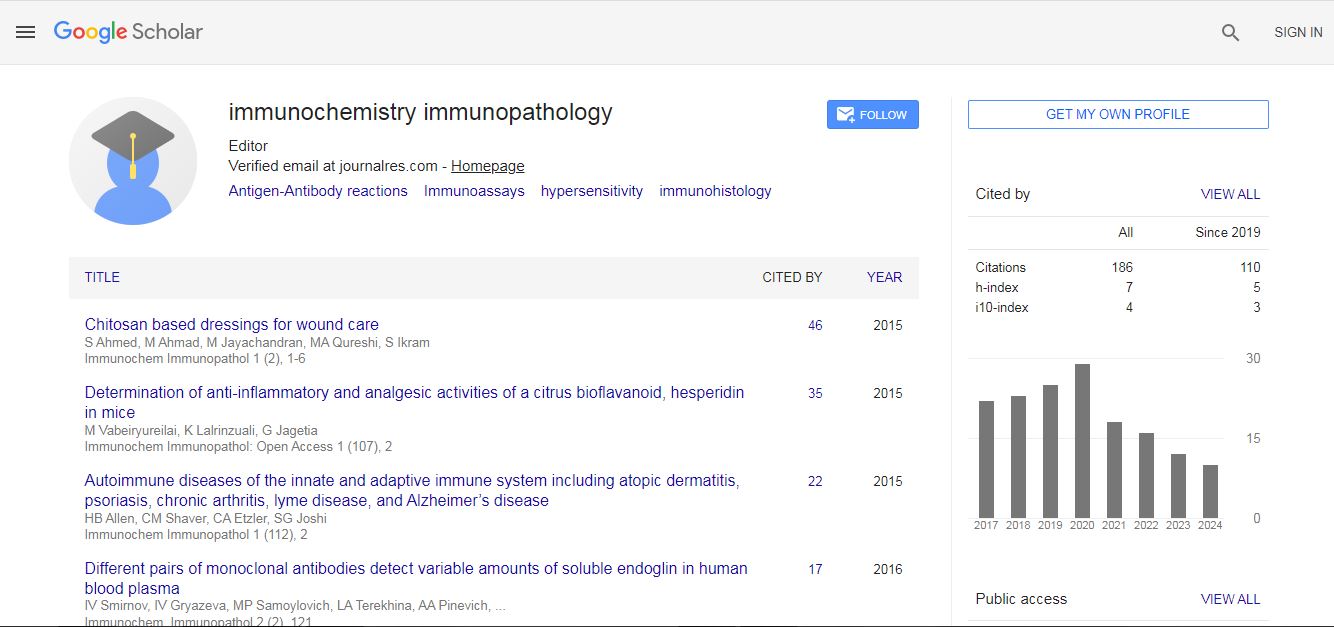
Immunochemistry & Immunopathology received 174 citations as per Google Scholar report