Perspective - (2025) Volume 17, Issue 4
Received: 01-Jul-2025, Manuscript No. jcst-25-174954;
Editor assigned: 03-Jul-2025, Pre QC No. P-174954;
Reviewed: 17-Jul-2025, QC No. Q-174954;
Revised: 22-Jul-2025, Manuscript No. R-174954;
Published:
29-Jul-2025
, DOI: 10.37421/1948-5956.2025.17.717
Citation: Wilson, James. ”Immunotherapy: Revolutionizing Cancer
Care, Exploring New Frontiers.” J Cancer Sci Ther 17 (2025):717.
Copyright: © 2025 Wilson J. This is an open-access article distributed under the terms of the Creative Commons Attribution License, which permits unrestricted use, distribution
and reproduction in any medium, provided the original author and source are credited.
Cancer immunotherapy represents a monumental shift in oncology, offering innovative strategies to mobilize the body's intrinsic defenses against malignant cells. This approach has led to unprecedented breakthroughs, fundamentally altering the prognosis for many patients across various cancer types. The landscape of immunotherapy is broad, encompassing diverse modalities from cell-based therapies to targeted antibodies and viral agents, each designed to engage the immune system in unique ways to combat tumor growth. One significant advancement is Chimeric Antigen Receptor (CAR) T-cell therapy, which has revolutionized the treatment of hematological cancers. This therapy involves genetically modifying a patient's own T cells to express a CAR that specifically targets cancer antigens. While remarkably effective, it presents specific challenges, notably potential toxicities such as cytokine release syndrome (CRS) and immune effector cell-associated neurotoxicity syndrome (ICANS). The ongoing evolution in this area is directed towards enhancing safety, broadening its application to solid tumors, and addressing mechanisms of resistance[1].
Immune checkpoint inhibitors, particularly those targeting the PD-1/PD-L1 pathway, have also profoundly transformed cancer treatment by reactivating anti-tumor immunity. These agents have achieved considerable success across various cancer types, leading to durable responses for a substantial number of patients. Despite these successes, a notable proportion of patients either do not respond to these therapies or eventually develop resistance. Current research is intensely focused on identifying predictive biomarkers to better select patients, developing effective combination strategies, and exploring novel targets to overcome these limitations and expand the therapeutic benefit[2].
While immunotherapy has made considerable progress in solid tumors, its efficacy remains highly variable, contingent on specific cancer types and individual patient factors. Current reviews highlight advancements in melanoma, lung cancer, and renal cell carcinoma, underscoring the critical role of predictive biomarkers and the exploration of combination therapies to improve response rates. Significant challenges persist in identifying non-responders and devising effective strategies for immunologically "cold" tumors, which typically lack significant immune cell infiltration[3].
A critical aspect of managing patients undergoing immunotherapy involves addressing immune-related adverse events (irAEs). These events can mimic autoimmune conditions and are crucial for patient safety and treatment continuity. Comprehensive overviews focus on diagnosis and management strategies for common irAEs affecting various organ systems, emphasizing the need for timely recognition and multidisciplinary care to mitigate potentially severe outcomes[4].
Beyond established therapies, cancer vaccines represent another promising domain within immunotherapy. These vaccines aim to leverage the immune system to recognize and eliminate cancer cells. After facing initial challenges in clinical trials, the field has been revitalized by recent advancements in neoantigen identification, adjuvant design, and delivery systems. Current discussions cover the historical context, present strategies, and future directions for both therapeutic and prophylactic cancer vaccines, highlighting their potential as standalone treatments or in conjunction with other immunotherapies[5].
Similarly, oncolytic viruses offer a powerful dual mechanism: directly lysing tumor cells and subsequently stimulating an anti-tumor immune response. This emerging approach shows promise in clinical trials, with ongoing research exploring how these viruses sensitize tumors to immune attack, addressing challenges like systemic delivery, and outlining strategies for combining them with other immunotherapeutic agents for enhanced efficacy[6].
Innovative agents like bispecific antibodies are also gaining prominence. These represent a class of immunotherapeutic agents capable of simultaneously targeting two distinct antigens. This dual specificity allows them to redirect immune effector cells, such as T cells, to tumor cells, or to block two different signaling pathways. The growing number of bispecific antibodies in clinical development, especially in hematological malignancies, demonstrates their potential in overcoming resistance observed with monospecific antibodies through their unique design and mechanisms of action[7].
A powerful strategy emerging in the field is combining different immunotherapeutic agents, or integrating immunotherapy with conventional treatments like chemotherapy or radiation. This approach is proving effective in enhancing anti-tumor responses and overcoming resistance by leveraging synergistic mechanisms that target multiple facets of the tumor-immune microenvironment. Reviews examine various successful and experimental combination strategies, focusing on their rationale and the ongoing efforts to optimize treatment sequences and patient selection for maximal benefit[8].
Furthermore, emerging evidence strongly points to a significant influence of the gut microbiome on the efficacy and toxicity of cancer immunotherapy. Specific microbial compositions can either augment or diminish a patient's response to treatments such as checkpoint inhibitors, underscoring the gut-immune axis as a critical determinant of clinical outcomes. Research explores the mechanisms by which microbiota modulate anti-tumor immunity and discusses the potential for microbial interventions, like fecal microbiota transplantation or probiotics, to improve immunotherapy effectiveness[9].
The broader field of cancer immunotherapy is rapidly advancing beyond existing checkpoint blockade therapies, actively exploring a multitude of novel targets and therapeutic modalities. This includes cutting-edge strategies like next-generation CAR T cells, innate immune cell engagers, and sophisticated oncolytic viral platforms. An emphasis is placed on understanding the intricate tumor microenvironment to develop more effective and personalized immunotherapeutic approaches, ultimately aiming for sustained anti-tumor immunity in diverse patient populations[10].
The field of cancer immunotherapy is dynamically evolving, introducing diverse strategies to leverage the body's immune system against malignancies. This expansive approach encompasses cell-based therapies, targeted antibodies, and viral agents, continuously refining methods to combat tumor growth effectively.
CAR T-cell therapy exemplifies a significant breakthrough, particularly for hematological cancers. It involves genetically engineering a patient's T cells to target specific cancer antigens. While profoundly effective, this therapy is associated with unique toxicities like cytokine release syndrome (CRS) and immune effector cell-associated neurotoxicity syndrome (ICANS). Research efforts are keenly focused on enhancing safety, broadening its application to solid tumors, and countering resistance mechanisms [1]. Similarly, immune checkpoint inhibitors, specifically targeting PD-1/PD-L1, have fundamentally altered cancer treatment by reactivating anti-tumor immunity. These agents have achieved durable responses across various cancers. However, a notable proportion of patients either do not respond or develop resistance, necessitating ongoing research into biomarkers, combination strategies, and novel targets to expand therapeutic benefits [2]. The efficacy of immunotherapy in solid tumors, though progressing, remains highly variable, depending on cancer type and individual factors. Progress in melanoma, lung cancer, and renal cell carcinoma highlights the need for predictive biomarkers and combination therapies, especially for challenging "cold" tumors [3]. Furthermore, managing immune-related adverse events (irAEs), which can mimic autoimmune conditions, is critical for patient safety. This requires timely diagnosis and multidisciplinary care to mitigate severe outcomes [4].
Emerging frontiers in immunotherapy include revitalized cancer vaccines and innovative oncolytic viruses. Cancer vaccines aim to educate the immune system to recognize and eliminate cancer cells, with recent advancements in neoantigen identification and delivery systems renewing their promise as standalone or combination treatments [5]. Oncolytic viruses offer a dual mechanism by directly lysing tumor cells and subsequently stimulating an anti-tumor immune response. This approach, showing promise in clinical trials, sensitizes tumors to immune attack, though challenges in systemic delivery and pre-existing immunity are being addressed through combination strategies [6]. Another innovative class is bispecific antibodies, engineered to simultaneously target two distinct antigens. This dual specificity redirects immune effector cells to tumor cells or blocks multiple signaling pathways, showing particular promise in hematological malignancies and offering a way to overcome resistance to monospecific antibodies [7].
Combination immunotherapy, either layering different immunotherapeutic agents or integrating them with conventional treatments like chemotherapy or radiation, is proving to be a powerful strategy. This approach enhances anti-tumor responses and overcomes resistance by leveraging synergistic mechanisms that target various aspects of the tumor-immune microenvironment. Research continuously refines these strategies, optimizing treatment sequences and patient selection for maximal benefit [8]. Intriguingly, the gut microbiome profoundly influences the efficacy and toxicity of cancer immunotherapy, with specific microbial compositions either enhancing or diminishing responses to therapies like checkpoint inhibitors. This highlights the gut-immune axis as a critical determinant, suggesting potential for microbial interventions to improve immunotherapy effectiveness [9]. The fieldâ??s future is dynamic, moving beyond established checkpoint blockade to explore a multitude of novel targets and therapeutic modalities. This includes next-generation CAR T cells, innate immune cell engagers, and sophisticated oncolytic viral platforms, all emphasizing a deep understanding of the tumor microenvironment for personalized and sustained anti-tumor immunity in diverse patient populations [10].
Cancer immunotherapy has revolutionized cancer treatment, employing various strategies to harness the body's immune system. Therapies like CAR T-cell therapy have demonstrated significant success in hematological cancers by genetically modifying T cells to target specific antigens, though they pose challenges such as cytokine release syndrome and neurotoxicity. Immune checkpoint inhibitors, especially PD-1/PD-L1 blockers, have fundamentally changed cancer therapy by reactivating anti-tumor immunity, achieving durable responses in many patients. However, a notable portion of individuals do not respond or develop resistance, prompting research into biomarkers and combination strategies. Immunotherapy's effectiveness in solid tumors varies, highlighting the need for predictive biomarkers and tailored combination approaches, particularly for immunologically "cold" tumors. Managing immune-related adverse events is also paramount for patient safety, necessitating prompt diagnosis and multidisciplinary care. Newer modalities include cancer vaccines, which have seen a resurgence with advancements in neoantigen identification, and oncolytic viruses, offering dual action by lysing tumor cells and stimulating immune responses. Bispecific antibodies represent an innovative class, capable of simultaneously targeting two antigens to redirect immune cells. Combination therapies, whether integrating different immunotherapies or traditional treatments, represent a powerful strategy to overcome resistance and enhance anti-tumor effects. The gut microbiome is increasingly recognized for its profound influence on immunotherapy efficacy and toxicity, suggesting potential for microbial interventions. The field continues to evolve rapidly, exploring next-generation CAR T cells, innate immune cell engagers, and sophisticated viral platforms, emphasizing the importance of understanding the tumor microenvironment for personalized and sustained anti-tumor immunity.
Indexed at, Google Scholar, Crossref
Indexed at, Google Scholar, Crossref
Indexed at, Google Scholar, Crossref
Indexed at, Google Scholar, Crossref
Indexed at, Google Scholar, Crossref
Indexed at, Google Scholar, Crossref
Indexed at, Google Scholar, Crossref
Indexed at, Google Scholar, Crossref
Indexed at, Google Scholar, Crossref
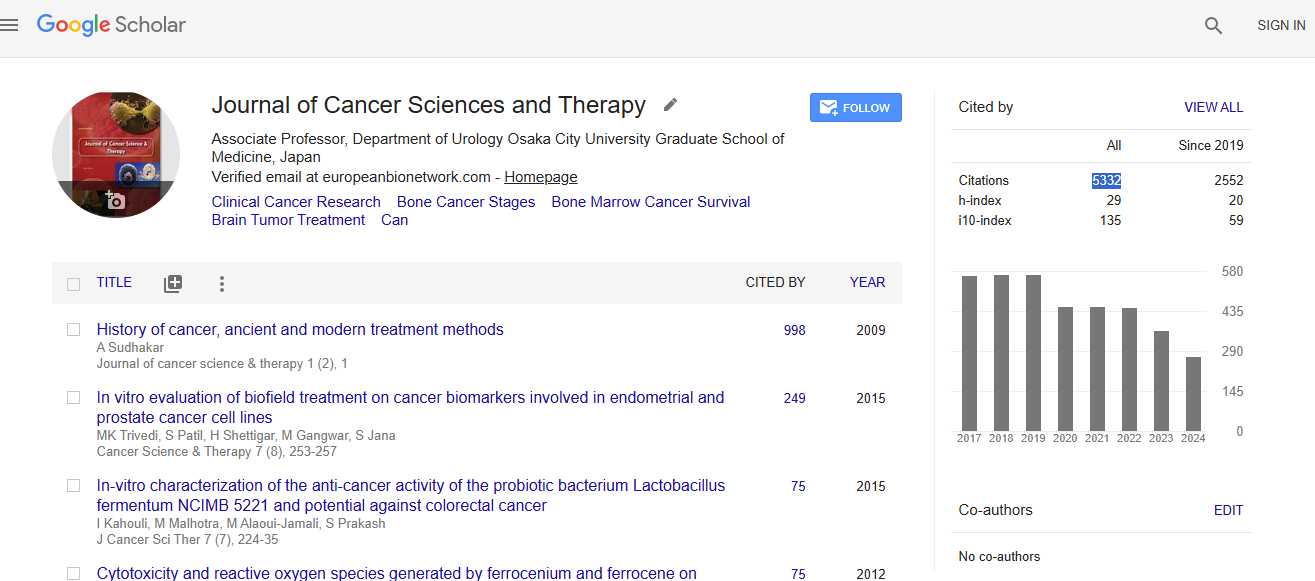
Cancer Science & Therapy received 5332 citations as per Google Scholar report