Perspective - (2025) Volume 11, Issue 3
Received: 02-Jun-2025, Manuscript No. icoa-25-173588;
Editor assigned: 04-Jun-2025, Pre QC No. P-173588;
Reviewed: 18-Jun-2025, QC No. Q-173588;
Revised: 23-Jun-2025, Manuscript No. R-173588;
Published:
30-Jun-2025
, DOI: 10.37421/2469-9756.2025.11.303
Citation: Bennett, Sarah L.. ”IHC: Foundation, Evolution, and Future of Diagnostics.” Immunochem Immunopathol 11 (2025):303.
Copyright: © 2025 Bennett L. Sarah This is an open-access article distributed under the terms of the Creative Commons Attribution License, which permits unrestricted use,
distribution and reproduction in any medium, provided the original author and source are credited.
This review offers a critical look at how immunohistochemistry currently helps diagnose cancer, examining its established uses and highlighting newer developments. It covers how this technique provides crucial insights into tumor classification, prognosis, and therapeutic targets, serving as an indispensable tool in modern oncology [1].
This article explores the vital role of immunohistochemistry in diagnosing neurodegenerative diseases. It delves into how specific protein aggregates and cellular changes can be identified using this technique, offering crucial insights for accurate classification and understanding of various neurological disorders like Alzheimer's and Parkinson's diseases [2].
This paper discusses the significant impact of multiplex immunohistochemistry on cancer immunotherapy. It highlights how this advanced technique allows for simultaneous detection of multiple biomarkers within a single tissue section, providing a more comprehensive understanding of the tumor microenvironment and guiding personalized treatment strategies for patients [3].
This article examines the evolving landscape of artificial intelligence in digital immunohistochemistry. It details how AI algorithms are being applied to analyze complex IHC images, addressing current challenges in adoption while outlining promising opportunities for enhancing diagnostic accuracy, efficiency, and predictive capabilities in pathology [4].
This paper evaluates the present status of standardization in immunohistochemistry and the obstacles ahead. It highlights the critical need for consistent protocols and quality control measures to ensure reliable and reproducible results, which are fundamental for accurate diagnosis and research across various clinical and scientific settings [5].
This review focuses on the indispensable contribution of immunohistochemistry to diagnosing infectious diseases. It outlines how this technique precisely identifies pathogens and their associated tissue changes, offering valuable insights that complement conventional methods and significantly improve diagnostic accuracy for a wide range of infections [6].
This article explores the challenges and advancements in applying immunohistochemistry within preclinical research. It discusses how consistent methodologies and proper validation are crucial for reliable data, emphasizing its utility in drug development, toxicology studies, and understanding disease mechanisms, while also highlighting areas for improvement [7].
This paper discusses the pivotal role of immunohistochemistry in the context of precision medicine. It illustrates how IHC-based biomarker detection guides patient stratification, therapeutic selection, and prognostic assessment, thereby enabling highly individualized treatment strategies, particularly in oncology, to improve patient outcomes [8].
This review provides a comprehensive overview of immunohistochemistry's current state and future trajectories in diagnostic pathology. It emphasizes how technological advancements, particularly in automation and multiplexing, are enhancing its capabilities for precise diagnosis, classification of diseases, and identification of therapeutic targets across various medical specialties [9].
This article examines the utility of immunohistochemistry in biomarker discovery, with a particular emphasis on quantitative methodologies. It highlights how precise, quantifiable measurements of protein expression via IHC can lead to the identification of novel diagnostic, prognostic, and predictive biomarkers, crucial for advancing personalized medicine [10].
Immunohistochemistry (IHC) stands as a cornerstone technique in modern medical diagnostics and research, offering profound insights into disease pathology. Particularly in oncology, IHC is invaluable; it provides a critical framework for cancer diagnosis by facilitating precise tumor classification, predicting patient prognosis, and identifying specific therapeutic targets. This crucial utility makes it an indispensable tool for guiding individualized treatment strategies in modern oncology [1]. Beyond cancerous conditions, IHC plays an equally vital role in understanding and accurately diagnosing neurodegenerative diseases. The technique allows for the identification of characteristic protein aggregates and subtle cellular changes, offering essential insights for classifying various neurological disorders, including complex conditions like Alzheimer's and Parkinson's diseases, and enhancing our overall comprehension of these challenging pathologies [2].
The diagnostic prowess of IHC extends significantly to the realm of infectious diseases. It uniquely enables the precise identification of pathogens and associated tissue alterations, providing valuable diagnostic information that complements and often enhances conventional laboratory methods. This capability drastically improves the accuracy in diagnosing a broad spectrum of infections [6]. Looking at diagnostic pathology more broadly, IHC offers a comprehensive overview of a disease's current state and future trajectories. Continuous technological advancements, such as automation and multiplexing, are consistently improving its capabilities, leading to more precise diagnoses, better disease classification, and the identification of novel therapeutic targets across diverse medical specialties, marking its evolution as a state-of-the-art technique [9].
Recent methodological innovations have further amplified the impact of IHC. Multiplex immunohistochemistry, for example, represents a significant leap forward. This advanced technique facilitates the simultaneous detection of multiple biomarkers within a single tissue section, yielding a far more comprehensive understanding of complex biological landscapes, such as the tumor microenvironment. This detailed insight is especially critical for guiding personalized treatment strategies, particularly within the dynamic field of cancer immunotherapy, allowing for tailored interventions [3]. Parallel to this, Artificial Intelligence (AI) is rapidly transforming digital immunohistochemistry. AI algorithms are increasingly being deployed to analyze intricate IHC images, addressing existing challenges in their adoption while simultaneously uncovering promising new opportunities for dramatically enhancing diagnostic accuracy, efficiency, and predictive capabilities within pathology [4].
Despite its considerable utility and ongoing innovations, the application of IHC is not without its hurdles. A pressing concern is the current state of standardization. There is a critical and continuous need for robust, consistent protocols and stringent quality control measures to ensure that results are not only reliable but also reproducible across different laboratories, clinical settings, and research environments. This fundamental consistency is vital for maintaining diagnostic accuracy and the integrity of research findings [5]. Similarly, in preclinical research, the consistent application and proper validation of IHC methodologies are paramount. This ensures reliable data for critical areas such as drug development, toxicology studies, and the elucidation of disease mechanisms, while also highlighting specific areas where further improvements are necessary to maximize its effectiveness [7].
Ultimately, immunohistochemistry plays a pivotal and ever-growing role in the realization of precision medicine. Its capacity for IHC-based biomarker detection is central to guiding patient stratification, informing therapeutic selection, and conducting accurate prognostic assessments. This capability directly enables the development and deployment of highly individualized treatment strategies, particularly within oncology, leading to significantly improved patient outcomes [8]. This push towards personalized care is further supported by the utility of IHC in biomarker discovery, with a distinct emphasis on quantitative methodologies. By providing precise, quantifiable measurements of protein expression, IHC facilitates the identification of novel diagnostic, prognostic, and predictive biomarkers, which are essential drivers for advancing personalized medicine and tailoring interventions to individual patient profiles [10]. The continuous evolution and refinement of IHC techniques underscore its lasting importance in shaping the future of diagnostic and therapeutic approaches.
Immunohistochemistry (IHC) stands as a foundational technique in modern diagnostics and research, with a broad array of applications spanning various medical fields. It critically aids in cancer diagnosis, providing insights into tumor classification, prognosis, and identifying therapeutic targets [1]. Beyond oncology, IHC plays a vital role in understanding and diagnosing neurodegenerative diseases like Alzheimer's and Parkinson's by identifying specific protein aggregates and cellular changes [2]. The technique is also indispensable in diagnosing infectious diseases, precisely identifying pathogens and associated tissue alterations, thereby improving diagnostic accuracy alongside conventional methods [6]. The evolution of IHC is marked by significant advancements, including multiplexing, which enables simultaneous detection of multiple biomarkers for a more comprehensive understanding of complex biological environments, especially relevant for cancer immunotherapy [3]. Further progress includes the integration of Artificial Intelligence (AI) into digital IHC for analyzing complex images, promising enhanced diagnostic accuracy and efficiency in pathology [4]. However, challenges remain, particularly in standardizing protocols and quality control measures to ensure reliable and reproducible results across clinical and research settings [5]. IHC's utility extends to preclinical research, where consistent methodologies are vital for drug development, toxicology, and disease mechanism studies [7]. Its pivotal role in precision medicine is undeniable, guiding patient stratification and therapeutic selection through biomarker detection to enable individualized treatment strategies [8]. The ongoing focus on quantitative approaches in IHC is crucial for biomarker discovery, leading to novel diagnostic, prognostic, and predictive tools essential for personalized medicine advancements [10]. Overall, IHC continues to evolve, pushing the boundaries of diagnostic pathology through technological innovation and rigorous application [9].
None
None
1. Gourav S, Himanshu S, Amit G. "Immunohistochemistry in cancer diagnosis: A critical appraisal of current applications and emerging trends.".Indian J Pathol Microbiol 65 (2022):1-10.
Indexed at, Google Scholar, Crossref
2. Gabor GK, Istvan A, Hajnalka Z. "Immunohistochemistry for the Diagnosis of Neurodegenerative Diseases.".Handb Clin Neurol 175 (2021):3-13.
Indexed at, Google Scholar, Crossref
3. Paul R, Anjali D, Deepak G. "Multiplex Immunohistochemistry for Cancer Immunotherapy.".Int J Mol Sci 24 (2023):986.
Indexed at, Google Scholar, Crossref
4. Rangan J, George J, George L. "Artificial Intelligence in Digital Immunohistochemistry: Challenges and Opportunities.".Cancers (Basel) 14 (2022):828.
Indexed at, Google Scholar, Crossref
5. Qing S, Zhiyong L, Xiaoqin W. "Current State of Standardization in Immunohistochemistry and the Future Challenges.".Front Cell Dev Biol 10 (2022):943031.
Indexed at, Google Scholar, Crossref
6. Rakesh G, Pooja S, Vinita S. "The Role of Immunohistochemistry in the Diagnosis of Infectious Diseases.".Crit Rev Eukaryot Gene Expr 32 (2022):31-40.
Indexed at, Google Scholar, Crossref
7. Corinda GVE, Joost HS, Jochem HWBG. "Challenges and Progress in the Application of Immunohistochemistry to Preclinical Research.".Front Pharmacol 12 (2021):650392.
Indexed at, Google Scholar, Crossref
8. Camilla R, Paolo V, Stefano F. "Immunohistochemistry in the era of precision medicine.".Int J Mol Sci 23 (2022):1955.
Indexed at, Google Scholar, Crossref
9. Vinita S, Rakesh G, Pooja S. "Immunohistochemistry in Diagnostic Pathology: State-of-the-Art and Future Directions.".Crit Rev Eukaryot Gene Expr 31 (2021):1-10.
Indexed at, Google Scholar, Crossref
10. Young K, Jin-Kyu K, Hyoun SK. "Immunohistochemistry for Biomarker Discovery: A Focus on Quantitative Approaches.".Front Cell Dev Biol 10 (2022):943336.
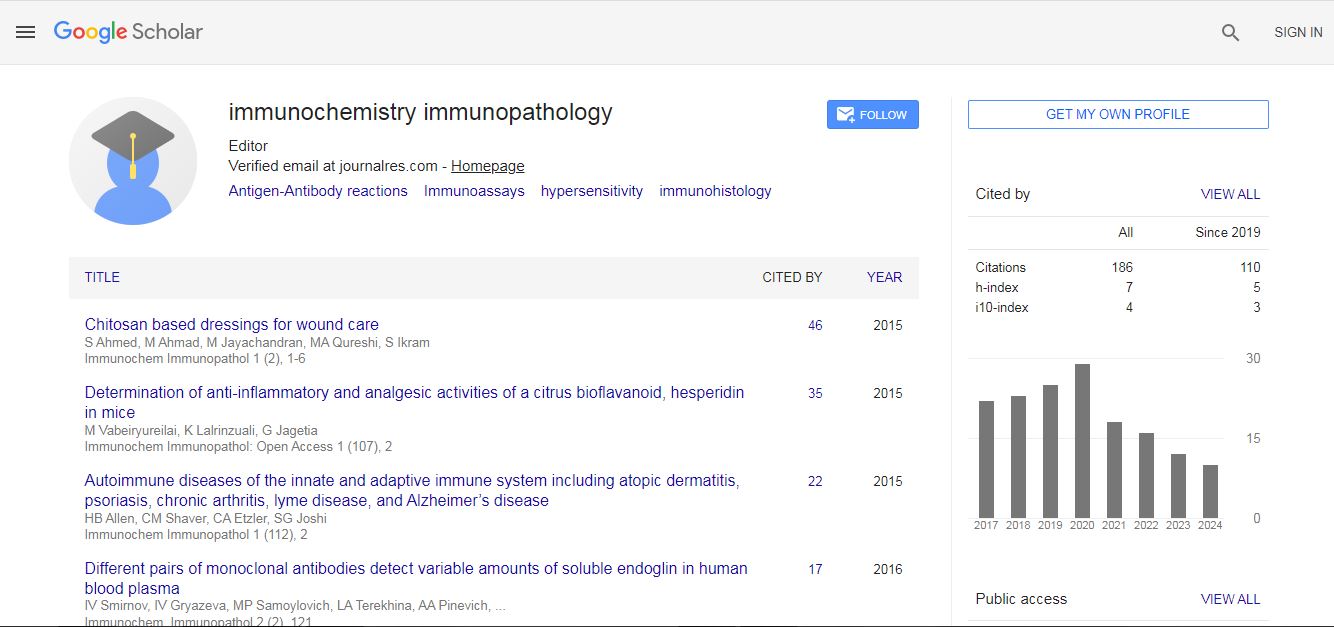
Immunochemistry & Immunopathology received 174 citations as per Google Scholar report