Perspective - (2025) Volume 14, Issue 5
Received: 01-Oct-2025, Manuscript No. jhoa-26-187841;
Editor assigned: 03-Oct-2025, Pre QC No. P-187841;
Reviewed: 17-Oct-2025, QC No. Q-187841;
Revised: 22-Oct-2025, Manuscript No. R-187841;
Published:
29-Oct-2025
, DOI: 10.37421/2167-1095.2025.14.541
Citation: Kowalczyk, Teresa. ”Hypertension Risk: Lifestyle, Genetics, And Prevention.” J Hypertens 14 (2025):541.
Copyright: © 2025 Kowalczyk T. This is an open-access article distributed under the terms of the Creative Commons Attribution License, which permits unrestricted use, distribution and reproduction in any medium, provided the original author and source are credited.
Assessing hypertension risk in middle-aged adults is critically important due to their heightened susceptibility to cardiovascular events. This demographic faces numerous challenges that contribute to the development and progression of hypertension. Key risk factors encompassing age, a significant family history of the condition, and various lifestyle choices such as diet, physical activity levels, smoking habits, and alcohol consumption are paramount considerations in risk stratification. Furthermore, the presence of pre-existing conditions like diabetes and dyslipidemia significantly elevates their risk profile, necessitating focused attention on these intertwined health issues. Understanding the genetic and epigenetic influences on hypertension risk in this age group is increasingly recognized as vital for comprehensive risk assessment. Recent scientific endeavors have shed light on specific gene variants and epigenetic modifications that, particularly when interacting with prevailing environmental factors, substantially amplify an individual's susceptibility to developing hypertension. The prospect of personalized risk assessment integrating these genetic biomarkers holds promise for developing more precisely tailored preventative strategies, moving beyond generalized recommendations. The role of lifestyle modifications in effectively mitigating hypertension risk among middle-aged adults is well-supported by extensive research and clinical practice. Adherence to established dietary patterns, notably the DASH diet, engaging in regular moderate-to-vigorous physical activity, consistent weight management efforts, and the cessation of smoking are all pivotal in reducing hypertension incidence and severity. This emphasizes the foundational importance of patient education and robust behavioral support systems designed to foster sustainable and lasting lifestyle changes. Metabolic syndrome, characterized by a clustering of conditions that includes elevated blood pressure, high blood sugar levels, excess abdominal body fat, and abnormal cholesterol or triglyceride levels, stands out as a significant contributor to hypertension risk during middle age. The effective management of each of these individual components of metabolic syndrome is not merely beneficial but absolutely essential for comprehensive cardiovascular protection and the prevention of related complications. Sleep disturbances, with a particular emphasis on obstructive sleep apnea, are now being increasingly recognized and understood as independent risk factors contributing to the development of hypertension in middle-aged adults. Proactive diagnosis and effective treatment of these underlying sleep disorders can have a profoundly positive impact on an individual's blood pressure control and contribute significantly to their overall cardiovascular health and well-being. The impact of psychosocial stress on the development of hypertension in middle-aged individuals is a critical aspect that warrants significant attention and further investigation. Chronic exposure to stress can instigate a cascade of physiological changes within the body that are known to promote the onset and exacerbation of hypertension. Therefore, the implementation of stress management techniques and the cultivation of supportive social environments are likely to play a crucial role in effective risk reduction. Early detection of elevated blood pressure and pre-hypertension stages in middle-aged adults is of paramount importance in preventing the progression to established hypertensive disease. Regular and consistent blood pressure monitoring, crucially including out-of-office measurements that provide a more comprehensive and accurate representation of an individual's hypertensive status, allows for timely and effective intervention, thereby preventing the transition to more severe forms of hypertension. Environmental factors, such as exposure to air pollution and certain chemical agents, are emerging as potential, albeit often overlooked, contributors to the increased risk of hypertension observed in middle-aged populations. While scientific research in this area is still evolving and ongoing, a deeper understanding of these specific environmental exposures may pave the way for the development of novel and targeted preventative strategies. The intricate role of inflammation and oxidative stress in the pathogenesis of hypertension during middle age represents a significant and active area of ongoing scientific research. The exploration of therapeutic interventions or lifestyle modifications specifically designed to target these underlying pathways offers promising new avenues for effective risk reduction and improved management of this prevalent cardiovascular condition. Precision medicine approaches are progressively being explored and developed for the more accurate assessment of hypertension risk specifically within middle-aged adult populations. By meticulously integrating a diverse array of data, encompassing genetic predispositions, detailed lifestyle factors, and relevant biomarkers, the development of highly personalized risk scores and tailored treatment strategies can be achieved, ultimately optimizing individual cardiovascular health outcomes.
Assessing hypertension risk in middle-aged adults is crucial due to their elevated susceptibility to cardiovascular events. Key risk factors include age, family history, lifestyle choices (diet, physical activity, smoking, alcohol), and pre-existing conditions like diabetes and dyslipidemia. Early identification and intervention through regular screening and personalized management plans are vital for preventing long-term complications [1].
Understanding the genetic and epigenetic influences on hypertension risk in middle-aged individuals is gaining importance. Recent research highlights specific gene variants and epigenetic modifications that, when combined with environmental factors, significantly increase susceptibility. Personalized risk assessment may eventually incorporate these genetic biomarkers for more tailored preventative strategies [2].
The role of lifestyle modifications in mitigating hypertension risk for middle-aged adults is well-established. Adherence to dietary patterns like the DASH diet, regular moderate-to-vigorous physical activity, weight management, and smoking cessation are pivotal. This review emphasizes the importance of patient education and behavioral support for sustainable lifestyle changes [3].
Metabolic syndrome, a cluster of conditions including high blood pressure, high blood sugar, excess body fat around the waist, and abnormal cholesterol or triglyceride levels, is a significant contributor to hypertension risk in middle age. Effective management of metabolic syndrome components is essential for cardiovascular protection [4].
Sleep disturbances, particularly obstructive sleep apnea, are increasingly recognized as independent risk factors for hypertension in middle-aged adults. Addressing sleep disorders through diagnosis and treatment can have a positive impact on blood pressure control and overall cardiovascular health [5].
The impact of psychosocial stress on hypertension development in middle-aged individuals warrants attention. Chronic stress can lead to physiological changes that promote hypertension. Stress management techniques and supportive social environments may play a role in risk reduction [6].
Early detection of elevated blood pressure and pre-hypertension in middle age is critical. Regular blood pressure monitoring, including out-of-office measurements, provides a more comprehensive picture of an individual's hypertensive status and allows for timely intervention to prevent progression to established hypertension [7].
Environmental factors, such as air pollution and exposure to certain chemicals, are emerging as potential contributors to hypertension risk in middle-aged populations. While research is ongoing, understanding these exposures may lead to new preventative strategies [8].
The role of inflammation and oxidative stress in the pathogenesis of hypertension in middle age is a significant area of research. Targeting these pathways through therapeutic interventions or lifestyle modifications may offer new avenues for risk reduction and disease management [9].
Precision medicine approaches are being explored for hypertension risk assessment in middle-aged adults. By integrating diverse data, including genetic predispositions, lifestyle factors, and biomarkers, personalized risk scores and treatment strategies can be developed to optimize cardiovascular health outcomes [10].
Hypertension risk in middle-aged adults is a significant concern due to elevated cardiovascular event susceptibility. Key risk factors include age, family history, lifestyle choices, and pre-existing conditions. Genetic and epigenetic factors are increasingly important, with potential for personalized risk assessment. Lifestyle modifications like the DASH diet, regular exercise, weight management, and smoking cessation are crucial for prevention and management. Metabolic syndrome is a major contributor, necessitating its effective management. Sleep disturbances, particularly sleep apnea, are recognized independent risk factors. Psychosocial stress can also promote hypertension, making stress management important. Early detection through regular blood pressure monitoring is vital. Emerging environmental factors and the roles of inflammation and oxidative stress are areas of active research. Precision medicine approaches integrating various data types are being developed for tailored risk assessment and treatment strategies to optimize cardiovascular health.
None
None
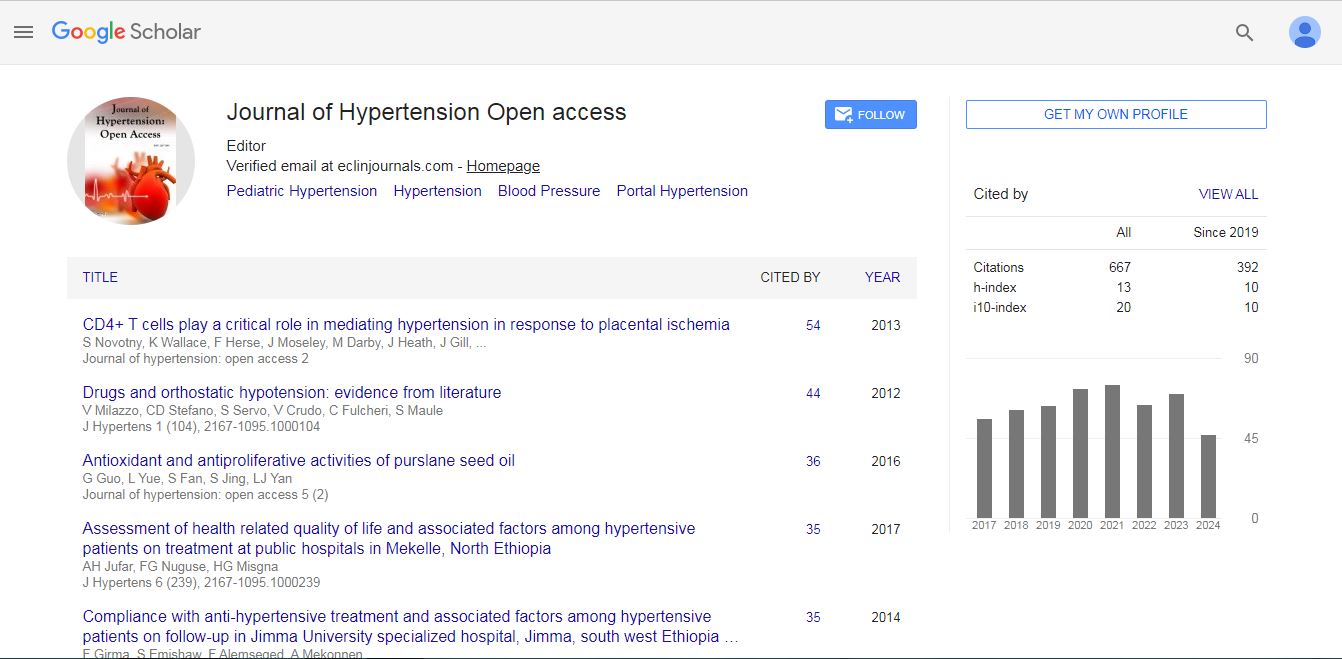
Journal of Hypertension: Open Access received 614 citations as per Google Scholar report