Perspective - (2025) Volume 16, Issue 5
Received: 01-Oct-2025, Manuscript No. jbsbe-26-183322;
Editor assigned: 03-Oct-2025, Pre QC No. P-183322;
Reviewed: 17-Oct-2025, QC No. Q-183322;
Revised: 22-Oct-2025, Manuscript No. R-183322;
Published:
29-Oct-2025
, DOI: 10.37421/2165-6210.2025.16.528
Citation: Liu, Wenhao. ”Hurdles in Commercializing Biosensors and Bioelectronic Devices.” J Biosens Bioelectron 16 (2025):528.
Copyright: © 2025 Liu W. This is an open-access article distributed under the terms of the Creative Commons Attribution License, which permits unrestricted use, distribution and reproduction in any medium, provided the original author and source are credited.
The commercialization of biosensors and bioelectronics is a field brimming with potential, yet it is significantly hampered by a multitude of intricate challenges. A primary obstacle involves bridging the substantial gap between initial laboratory-scale innovations and the demands of scalable manufacturing processes. This transition often requires substantial re-engineering and investment to move from proof-of-concept to industrial production levels. Furthermore, the path to market is frequently complicated by the complexities of obtaining regulatory approval. Different jurisdictions have varying requirements and timelines, necessitating extensive validation studies to demonstrate safety, efficacy, and reliability. This can be a lengthy and resource-intensive undertaking. For widespread adoption, the development of robust and user-friendly designs is paramount. Devices must be intuitive to operate and integrate seamlessly into existing workflows or daily life, reducing the learning curve and increasing user acceptance. This aspect is often overlooked in early-stage research. Achieving cost-effectiveness for mass production represents another critical hurdle. The cost of materials, manufacturing techniques, and quality control all contribute to the final price of a biosensor. For many applications, particularly in healthcare, the economic viability of widespread deployment is a key determinant of success. Ensuring long-term stability and reliability in diverse environmental conditions is also a significant challenge. Biosensors are often exposed to varying temperatures, humidity, and biological matrices, all of which can affect their performance. Maintaining consistent accuracy and functionality under these circumstances is crucial. The translation of laboratory performance to real-world clinical settings is a particularly vexing issue for point-of-care diagnostic biosensors. Factors such as sample variability, potential for interfering substances, and the inevitable introduction of user error can drastically alter diagnostic outcomes compared to controlled lab environments. The manufacturing scalability of flexible biosensors presents its own set of unique difficulties. The transition from producing small batches of high-cost prototypes to achieving cost-effective mass production necessitates the optimization of fabrication processes, the sourcing of affordable materials, and the implementation of stringent quality control measures. Navigating the labyrinthine regulatory pathways for novel biosensors and bioelectronic medical devices is a formidable task. These pathways are often complex and subject to frequent changes, requiring rigorous validation studies that encompass performance, safety, and efficacy. Of particular concern is the long-term stability and shelf-life of biosensor components, especially the biological recognition elements such as enzymes and antibodies. Degradation over time can lead to a marked decrease in sensitivity and accuracy, diminishing the device's overall utility. Finally, the environmental impact associated with the production and eventual disposal of biosensors and bioelectronic devices is gaining increasing attention. The development of sustainable materials and recyclable or biodegradable components is essential for long-term viability and societal acceptance of these technologies.
The journey to commercialize biosensors and bioelectronic devices is fraught with significant obstacles. One of the most prominent is the substantial chasm between laboratory-driven innovation and the practicalities of scalable manufacturing. This often requires considerable re-engineering and investment to move from initial prototypes to high-volume production. Compounding these manufacturing challenges are the intricate complexities of navigating regulatory approval processes. Different regulatory bodies worldwide have distinct requirements and timelines, necessitating extensive validation studies to confirm safety, efficacy, and consistent performance before a product can reach the market. For biosensors to achieve widespread adoption, they must be designed with robustness and user-friendliness at their core. Devices need to be intuitive to operate and integrate seamlessly into daily routines or clinical workflows, minimizing the learning curve and enhancing user experience. Economical mass production is another pivotal factor for commercial success. The collective costs associated with raw materials, advanced fabrication techniques, and rigorous quality assurance play a crucial role in determining the final price point and market accessibility of biosensors. The ability of biosensors to maintain stable and reliable performance across a variety of environmental conditions is critical. Exposure to fluctuating temperatures, humidity levels, and diverse biological samples can all impact sensor accuracy and functionality. Ensuring consistent operation under these variable circumstances is a key requirement. For biosensors designed for point-of-care diagnostics, the challenge of translating high laboratory performance to the unpredictable realities of clinical settings is paramount. Factors such as inherent sample variability, the presence of interfering substances, and potential user errors can significantly compromise the accuracy of diagnostic results. When considering flexible biosensors, the scalability of their manufacturing processes becomes a major concern. Shifting from small-batch, high-cost prototypes to efficient, large-scale production demands the optimization of fabrication methods, the identification of cost-effective materials, and the implementation of stringent, consistent quality control protocols. The regulatory landscape for novel biosensors and bioelectronic medical devices presents a complex and often shifting terrain. Compliance with stringent healthcare regulations necessitates comprehensive validation studies, including rigorous testing of performance, safety, and efficacy, which can be a time-consuming and resource-intensive endeavor. A critical concern for the commercial viability of biosensors is the long-term stability and shelf-life of their constituent components, particularly the biological recognition elements like enzymes and antibodies. Over time, degradation of these elements can lead to a reduction in sensitivity and accuracy. Furthermore, the environmental implications associated with the manufacturing and disposal of biosensors and bioelectronic devices are becoming increasingly significant. The development and adoption of sustainable materials, along with the creation of biodegradable or recyclable components, are vital for ensuring the long-term viability and societal acceptance of these technologies.
Commercializing biosensors and bioelectronic devices faces numerous hurdles. Key challenges include the transition from lab-scale innovation to scalable manufacturing, the complexities of regulatory approval, and the necessity for robust, user-friendly designs. Achieving cost-effectiveness for mass production and ensuring long-term stability and reliability in diverse environments are also critical. Translating laboratory performance to real-world clinical settings, particularly for point-of-care diagnostics, is difficult due to sample variability and user error. Manufacturing scalability for flexible biosensors requires process optimization and cost-effective materials. Regulatory pathways are complex and resource-intensive. The stability and shelf-life of biological recognition elements are vital. Interfacing bioelectronic devices with biological systems demands biocompatible materials and stable signal transduction. Cybersecurity and data privacy are growing concerns for connected devices. User-centric design and integration strategies are essential for adoption. Finally, addressing the environmental impact of production and disposal through sustainable materials is increasingly important.
None
None
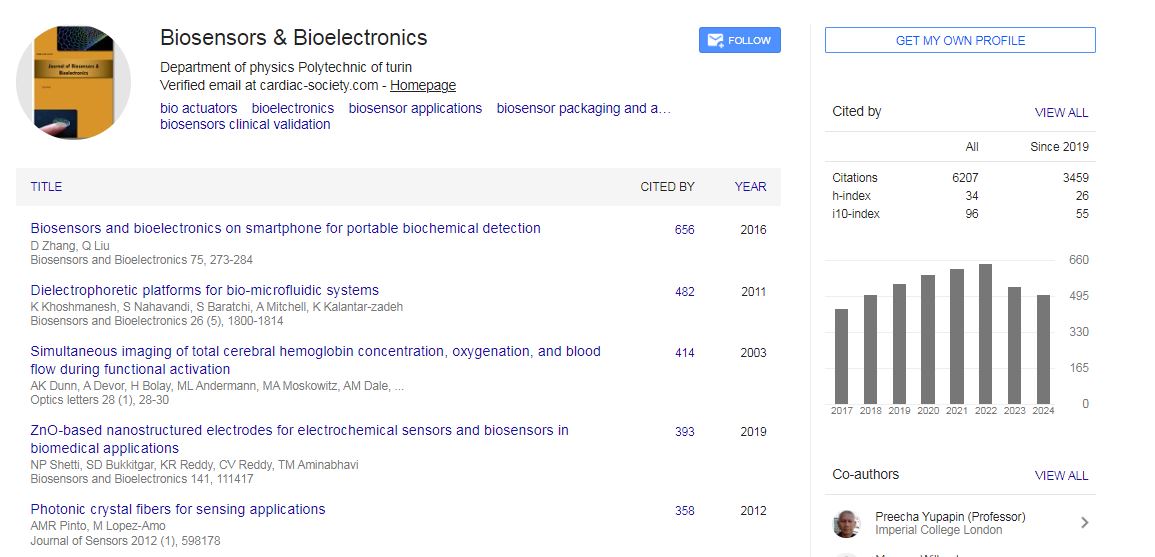
Biosensors & Bioelectronics received 6207 citations as per Google Scholar report