Opinion - (2025) Volume 9, Issue 4
Received: 01-Aug-2025, Manuscript No. ahbs-26-182493;
Editor assigned: 04-Aug-2025, Pre QC No. P-182493;
Reviewed: 18-Aug-2025, QC No. Q-182493;
Revised: 22-Aug-2025, Manuscript No. R-182493;
Published:
29-Aug-2025
, DOI: 10.37421/2952-8097.2025.9.327
Citation: Fujimoto, Keiko. ”Hormones: Governing Animal Behavior,
Health, and Environment.” J Anim Health Behav Sci 09 (2025):327.
Copyright: © 2025 Fujimoto K. This is an open-access article distributed under the terms of the Creative Commons Attribution License, which permits unrestricted use,
distribution and reproduction in any medium, provided the original author and source are credited.
Hormones are fundamental to animal behavior and health, orchestrating everything from reproduction and stress responses to social interactions and metabolism. This review highlights how specific hormones like testosterone, estrogen, cortisol, and oxytocin profoundly influence mating rituals, aggression, maternal care, and flocking behavior. Understanding these hormonal mechanisms is crucial for diagnosing and managing health issues, improving welfare, and developing effective breeding and conservation strategies in diverse animal species. [1]
The intricate interplay between hormones and the gut microbiome significantly impacts animal health and behavior, particularly concerning stress and mood. This study explores how microbial metabolites can influence the hypothalamic-pituitary-adrenal (HPA) axis and neurotransmitter production, offering insights into gut-brain communication and its implications for conditions like anxiety and depression in animals. [2] Reproductive hormones are central drivers of seasonal breeding behaviors in many animal species. This research elucidates the hormonal cascades, including GnRH, FSH, LH, and gonadal steroids, that synchronize reproductive cycles with environmental cues like photoperiod and temperature, influencing mating displays, territorial defense, and successful reproduction. [3] Cortisol, a key stress hormone, plays a critical role in the animal's physiological and behavioral response to adversity. This paper examines the chronic effects of elevated cortisol levels on immune function, growth, and cognitive abilities, highlighting its significance in understanding animal welfare and the development of stress-related disorders. [4] Oxytocin, often termed the 'love hormone,' has profound effects on social bonding, trust, and maternal behaviors in animals. This study investigates its role in facilitating parent-offspring recognition, promoting altruistic behaviors, and influencing social hierarchies, underscoring its importance in social dynamics and animal welfare. [5] Thyroid hormones are essential for regulating metabolism, growth, and development across numerous animal species. This paper explores their influence on energy expenditure, thermoregulation, and neurological function, impacting an animal's overall health, activity levels, and response to environmental changes. [6] The impact of endocrine disruptors on animal behavior and health is a growing concern. This research investigates how environmental chemicals mimicking or blocking natural hormones can disrupt reproductive cycles, alter social behaviors, and compromise immune function in wildlife, emphasizing the need for monitoring and mitigation. [7] Melatonin, a hormone produced by the pineal gland, is crucial for regulating circadian rhythms and sleep-wake cycles in animals. This study explores its influence on seasonal reproductive patterns, immune function, and behavior, particularly in response to changes in light exposure. [8] The adrenal medulla hormones, adrenaline and noradrenaline, are vital for the 'fight-or-flight' response, preparing animals for immediate action in stressful situations. This paper examines their rapid effects on cardiovascular function, respiration, and energy mobilization, essential for survival and adaptation to acute challenges. [9] Estrogens and androgens, the primary sex hormones, are critical not only for reproductive development and function but also for a wide range of non-reproductive behaviors, including aggression, social dominance, and cognitive processes in both males and females. This review explores their diverse roles in shaping animal behavior and maintaining physiological health throughout an animal's life. [10]Hormonal regulation is a cornerstone of animal physiology, profoundly shaping behavior and overall health across a vast spectrum of species. This foundational aspect of endocrinology encompasses the orchestration of complex processes, ranging from the initiation and maintenance of reproductive cycles to the nuanced modulation of social interactions and the intricate balancing of metabolic functions. Understanding the specific actions of key hormones such as testosterone, estrogen, cortisol, and oxytocin is paramount, as these molecules exert significant influence over mating rituals, the expression of aggression, the establishment of maternal care, and collective behaviors like flocking. This comprehensive understanding is not merely academic; it provides critical insights for the diagnosis and effective management of various health issues, contributes to the enhancement of animal welfare standards, and informs the development of more successful breeding programs and robust conservation strategies for diverse animal populations. [1]
The sophisticated dialogue between the endocrine system and the gut microbiome represents a critical nexus impacting animal health and behavioral patterns, with particular relevance to stress regulation and mood. Emerging research illuminates how metabolites produced by gut microbes can exert influence over the hypothalamic-pituitary-adrenal (HPA) axis, a central regulator of the stress response, and also affect the synthesis of neurotransmitters. These discoveries offer profound insights into the complex mechanisms of gut-brain communication, revealing its significant implications for understanding and potentially managing conditions such as anxiety and depression in animals. [2] Seasonal breeding behaviors in many animal species are intrinsically driven by the precise regulation of reproductive hormones. These hormonal cascades, involving key players like gonadotropin-releasing hormone (GnRH), follicle-stimulating hormone (FSH), luteinizing hormone (LH), and various gonadal steroids, are essential for synchronizing the animals' reproductive cycles with critical environmental cues, such as changes in photoperiod and ambient temperature. This precise hormonal timing is crucial for facilitating characteristic mating displays, enabling effective territorial defense, and ultimately ensuring successful reproduction. [3] Cortisol, a principal hormone released by the adrenal glands, plays an indispensable role in the physiological and behavioral adaptations of animals when faced with adversity. Scientific inquiry has extensively examined the chronic consequences of persistently elevated cortisol levels, which can adversely affect immune function, hinder growth processes, and impair cognitive abilities. Consequently, understanding the dynamics of cortisol is vital for assessing and improving animal welfare and for comprehending the underlying mechanisms of stress-related disorders in animal populations. [4] Oxytocin, widely recognized for its role in social bonding and often referred to as the 'love hormone,' exerts a powerful influence on various aspects of social behavior in animals, including the formation of bonds, the establishment of trust, and the execution of maternal care. Current research is actively investigating its specific mechanisms in facilitating parent-offspring recognition, promoting altruistic actions within social groups, and shaping social hierarchies. This work underscores oxytocin's fundamental importance in maintaining social dynamics and ensuring animal welfare. [5] Thyroid hormones are indispensable regulators of fundamental physiological processes such as metabolism, growth, and development across a wide array of animal species. Scientific investigations into these hormones reveal their pervasive influence on energy expenditure rates, the maintenance of body temperature (thermoregulation), and the optimal functioning of the nervous system. Consequently, thyroid hormones significantly impact an animal's general health status, modulate its activity levels, and determine its capacity to adapt to fluctuating environmental conditions. [6] The pervasive influence of endocrine-disrupting chemicals (EDCs) on animal health and behavior represents a significant and escalating concern, particularly within wildlife populations. This area of research focuses on identifying and characterizing environmental chemicals that possess the capacity to either mimic or antagonize the effects of natural hormones. Such disruptions can lead to significant alterations in reproductive cycles, profound changes in social behaviors, and a marked compromise of immune system functionality, thereby highlighting the critical need for continuous environmental monitoring and effective mitigation strategies. [7] Melatonin, a hormone synthesized and secreted by the pineal gland, serves as a critical regulator of circadian rhythms and the cyclical patterns of sleep and wakefulness in animals. Extensive studies have explored its multifaceted influence, revealing its significant role in modulating seasonal reproductive patterns, supporting immune function, and affecting various behavioral responses, particularly those triggered by fluctuations in ambient light exposure. [8] The hormones produced by the adrenal medulla, namely adrenaline and noradrenaline, are central mediators of the acute stress response, commonly known as the 'fight-or-flight' response. These hormones prepare animals for immediate, decisive action in potentially threatening situations by rapidly influencing cardiovascular function, respiratory rate, and the mobilization of energy resources. Their swift action is essential for ensuring survival and facilitating adaptation to acute environmental challenges. [9] Estrogens and androgens, the principal classes of sex hormones, play a pivotal role not only in the development and functional capacity of the reproductive system but also in a broad spectrum of non-reproductive behaviors and cognitive processes. These hormones are instrumental in modulating aggression, establishing social dominance hierarchies, and influencing learning and memory in both male and female animals. This review comprehensively examines their diverse and far-reaching contributions to shaping animal behavior and maintaining overall physiological health throughout the lifespan. [10]Hormones are essential for animal behavior and health, influencing reproduction, stress, social interactions, and metabolism. Key hormones like testosterone, estrogen, cortisol, and oxytocin impact mating, aggression, maternal care, and flocking. The gut microbiome interacts with hormones to affect stress and mood via the gut-brain axis. Reproductive hormones, regulated by environmental cues, drive seasonal breeding. Cortisol affects immune function, growth, and cognition under stress. Oxytocin is crucial for social bonding and maternal behavior. Thyroid hormones regulate metabolism, growth, and development. Endocrine disruptors pose risks to wildlife by interfering with hormonal functions. Melatonin regulates circadian rhythms and seasonal physiology. Adrenaline and noradrenaline mediate the fight-or-flight response. Sex hormones influence reproductive and non-reproductive behaviors.
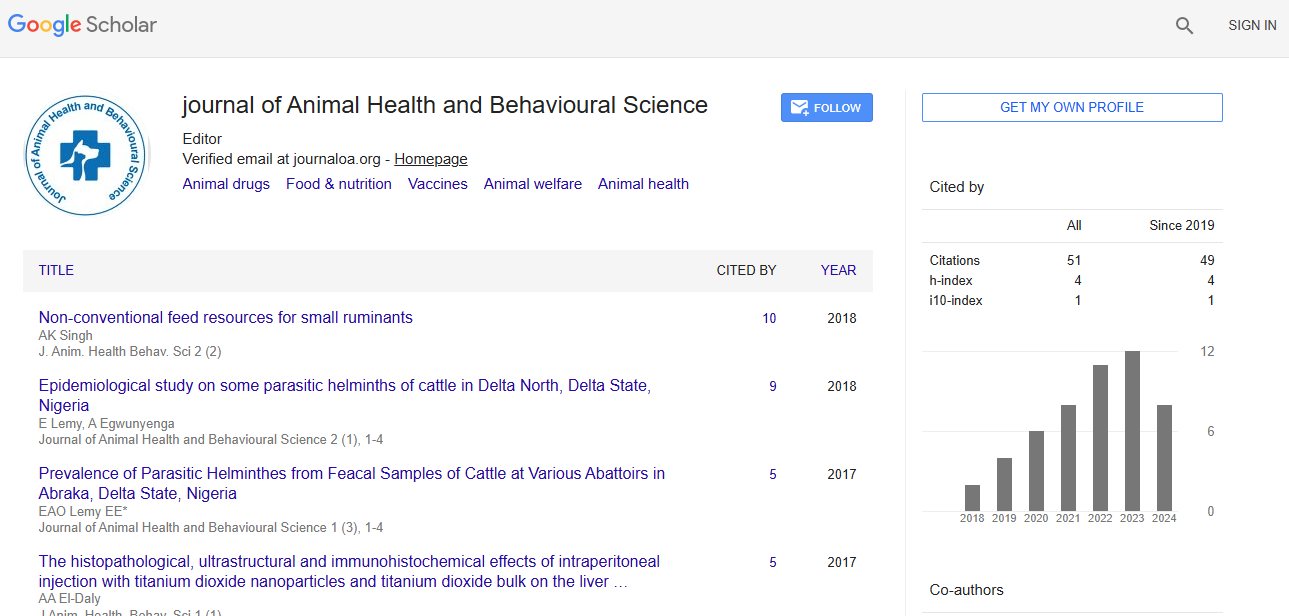
Journal of Animal Health and Behavioural Science received 38 citations as per Google Scholar report