Short Communication - (2025) Volume 16, Issue 2
Received: 01-Apr-2025, Manuscript No. jar-25-176287;
Editor assigned: 03-Apr-2025, Pre QC No. P-176287;
Reviewed: 17-Apr-2025, QC No. Q-176287;
Revised: 22-Apr-2025, Manuscript No. R-176287;
Published:
29-Apr-2025
, DOI: 10.37421/2155-6113.2025.16.1060
Citation: Martin, Isabelle. "HIV-1: T Cell Reprogramming, Latency,
Cure." J AIDS Clin Res 16 (2025):1060.
Copyright: © 2025 Martin I. This is an open-access article distributed under the terms of the Creative Commons Attribution License, which permits unrestricted use, distribution
and reproduction in any medium, provided the original author and source are credited.
This article dives into how HIV-1 inserts its genetic material into the DNA of primary human CD4 T-cells, detailing the patterns of these integration sites and how they shift over time. It highlights the lasting impact these integration dynamics have on the virus's ability to replicate, providing crucial insights into the establishment and persistence of the latent viral reservoir [1].
Moving on, here's the thing, this review explores the complex mechanisms that allow HIV-1 to persist within T-cells, even in the presence of antiretroviral therapy. It covers key strategies the virus employs to evade immune detection and drug effects, and discusses various approaches aimed at eradicating the latent viral reservoir, a major challenge in achieving an HIV cure [2].
This perspective is further enriched by an update on HIV-1 latency within T cells, covering the latest discoveries regarding how the virus hides and persists. This paper breaks down the significant therapeutic hurdles we face in reactivating and eliminating this latent reservoir, which is crucial for moving towards a cure [4].
What this really means is tracking the changes in the HIV-1 reservoir within CD4+ T cells, particularly during the crucial early stages of antiretroviral therapy, offers insights into how the latent reservoir forms and evolves soon after treatment initiation, which is vital for understanding why eradication remains challenging and for designing effective cure strategies [10].
Let's break it down: this research, using humanized mice models, shows how HIV-1 infecting memory CD4 T cells doesn't just reduce cell count. What this really means is it also messes with the overall balance of T cells and severely disrupts the structure of lymphoid tissues, giving us a clearer picture of how the virus causes immune dysfunction in living systems [3].
In understanding viral mechanisms, this article focuses on the HIV-1 Tat protein and its significant role in manipulating T cell function. It explains how Tat influences T cell activation, often driving chronic immune activation, and also contributes to the increased apoptosis (programmed cell death) of these crucial immune cells, which is central to HIV's pathogenesis [5].
Here's the thing about HIV-1 Vpr: this paper reveals its critical role in causing T cell dysfunction and helping the virus dodge the immune system. Vpr impacts various cellular processes, leading to impaired T cell responses and creating an environment where the virus can thrive and persist more effectively [7].
Adding another layer, this research highlights how HIV-1 profoundly alters the metabolism of infected CD4+ T cells. It shows that the virus essentially reprograms the cell's metabolic pathways to support its own replication, impacting processes like glycolysis and mitochondrial function. Understanding these changes is key to developing new therapeutic strategies [6].
What this really means is that HIV-1 doesn't just act alone; it heavily relies on various host factors within CD4+ T cells for its replication cycle. This article systematically reviews these host proteins and pathways that the virus hijacks or modifies, underscoring their importance as potential targets for new antiviral therapies [8].
Finally, this study reveals that HIV-1 infection in human T cells triggers a unique set of gene expression changes, and this happens independently of the T cell's activation state. This finding challenges previous assumptions and suggests that the virus has specific mechanisms to manipulate cellular processes, which could open new avenues for intervention [9].
HIV-1 establishes its presence by inserting its genetic material into the DNA of primary human CD4 T-cells. The patterns of these integration sites and their temporal shifts have a lasting impact on the virus's ability to replicate, providing crucial insights into the formation and persistence of the latent viral reservoir [1]. The persistence of HIV-1 within T-cells, even in the face of antiretroviral therapy, involves complex mechanisms where the virus employs key strategies to evade immune detection and drug effects [2].
A significant therapeutic hurdle is HIV-1 latency in T cells, where the virus hides and persists, making reactivation and elimination of this latent reservoir crucial for achieving a cure [4]. Understanding the dynamics of the HIV-1 reservoir in CD4+ T cells during the early stages of antiretroviral therapy is vital for comprehending why eradication remains challenging and for designing effective cure strategies [10].
HIV-1 infection profoundly impacts the host immune system. What this really means is that HIV-1 infecting memory CD4 T cells not only reduces cell count but also severely disrupts overall T cell balance and the structure of lymphoid tissues, providing a clearer picture of viral-induced immune dysfunction in living systems [3]. The viral Tat protein, for instance, significantly manipulates T cell function, driving chronic immune activation and increasing apoptosis of these crucial immune cells, which is central to HIV's pathogenesis [5].
Here's the thing about HIV-1 Vpr: it plays a critical role in causing T cell dysfunction and helping the virus dodge the immune system. Vpr affects various cellular processes, leading to impaired T cell responses and creating an environment conducive for viral thriving and persistence [7]. Moreover, HIV-1 doesn't just act alone; it heavily relies on various host factors within CD4+ T cells for its replication cycle. This involves hijacking or modifying host proteins and pathways, underscoring their importance as potential targets for new antiviral therapies [8].
This research highlights how HIV-1 profoundly alters the metabolism of infected CD4+ T cells. It shows that the virus essentially reprograms the cell's metabolic pathways to support its own replication, impacting processes like glycolysis and mitochondrial function. Understanding these changes is key to developing new therapeutic strategies [6]. Furthermore, a unique set of gene expression changes is triggered in human T cells upon HIV-1 infection, independently of the T cell's activation state. This finding challenges previous assumptions and suggests specific mechanisms by which the virus manipulates cellular processes, potentially opening new avenues for intervention [9].
Research into HIV-1 focuses on its complex interactions with human T cells, particularly CD4 T-cells, revealing how the virus integrates its genetic material and establishes a persistent latent reservoir. This integration significantly impacts viral replication and the long-term presence of the virus within the host. Even with antiretroviral therapy, HIV-1 demonstrates sophisticated mechanisms for persistence, evading immune detection and drug effects, which makes eradicating the latent reservoir a major challenge for achieving a cure. Insights into how this reservoir forms and evolves, especially during early therapy, are crucial for future cure strategies. The virus profoundly alters T cell function and homeostasis. For instance, HIV-1 infection of memory CD4 T cells disrupts cell count, T cell balance, and lymphoid tissue architecture, contributing to overall immune dysfunction. Specific viral proteins like Tat manipulate T cell activation, leading to chronic immune activation and increased apoptosis, central to pathogenesis. Similarly, the Vpr protein contributes to T cell dysfunction and immune evasion, allowing the virus to thrive. HIV-1 also extensively reprograms host cell machinery. It relies on various host factors within CD4+ T cells for replication, highlighting these factors as potential targets for new antiviral therapies. Metabolic pathways in infected CD4+ T cells are altered to support viral replication, impacting processes like glycolysis and mitochondrial function. Moreover, HIV-1 infection induces distinct gene expression changes in T cells, independently of their activation state, suggesting specific viral manipulation strategies. Understanding these multifaceted viral strategies and host responses is vital for developing novel therapeutic interventions against HIV-1.
Indexed at, Google Scholar, Crossref
Indexed at, Google Scholar, Crossref
Indexed at, Google Scholar, Crossref
Indexed at, Google Scholar, Crossref
Indexed at, Google Scholar, Crossref
Indexed at, Google Scholar, Crossref
Indexed at, Google Scholar, Crossref
Indexed at, Google Scholar, Crossref
Indexed at, Google Scholar, Crossref
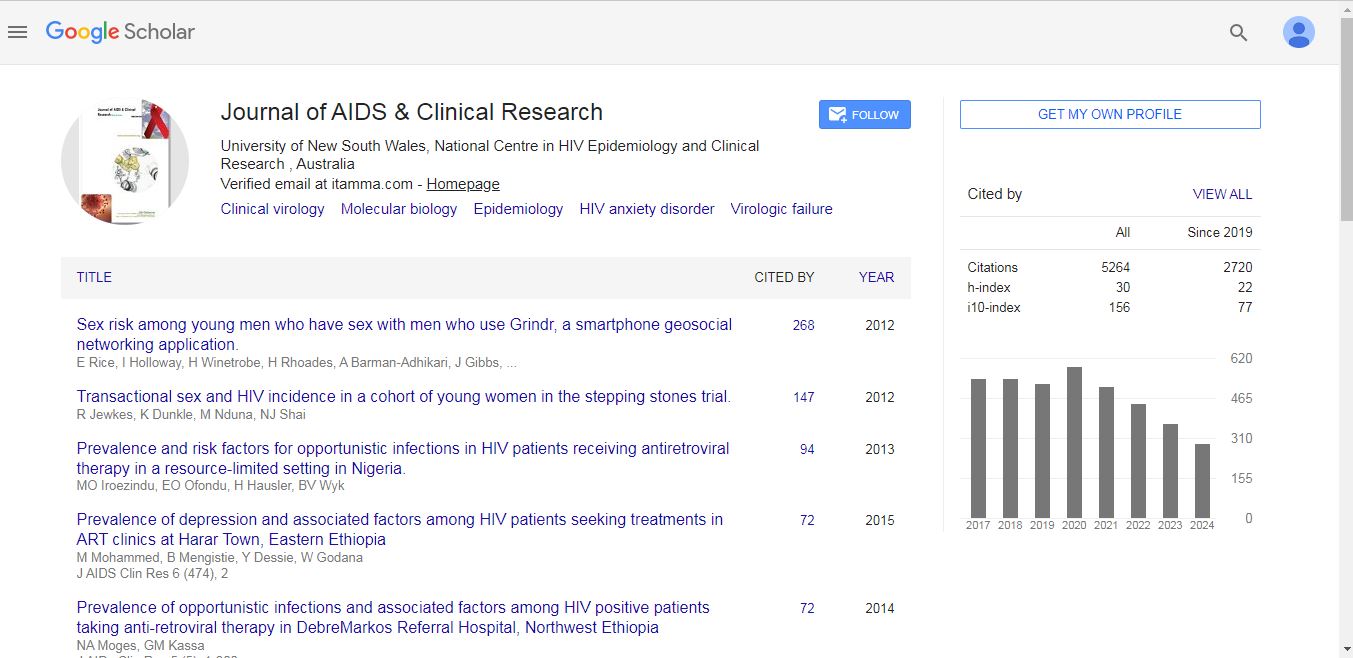
Journal of AIDS & Clinical Research received 5264 citations as per Google Scholar report