Brief Report - (2025) Volume 16, Issue 2
Received: 01-Apr-2025, Manuscript No. jar-25-176259;
Editor assigned: 03-Apr-2025, Pre QC No. P-176259;
Reviewed: 17-Apr-2025, QC No. Q-176259;
Revised: 22-Apr-2025, Manuscript No. R-176259;
Published:
29-Apr-2025
, DOI: 10.37421/2155-6113.2025.16.1052
Citation: Hadi, Fatima Zahra El. "HIV: Advancements, Challenges,
and Future Directions." J AIDS Clin Res 16 (2025):1052.
Copyright: © 2025 Hadi E. Zahra Fatima This is an open-access article distributed under the terms of the Creative Commons Attribution License, which permits unrestricted
use, distribution and reproduction in any medium, provided the original author and source are credited.
A significant breakthrough in HIV prevention involves the development and efficacy of long-acting injectable Cabotegravir. This innovative regimen, administered every two months, has been shown to substantially reduce HIV acquisition in cisgender men and transgender women. Its effectiveness, when compared to daily oral Emtricitabine-Tenofovir disoproxil fumarate, marks a major advancement in Pre-Exposure Prophylaxis (PrEP) options, providing a less frequent and potentially more adherent method for at-risk populations to prevent HIV infection [1].
Concurrently with prevention efforts, the quest for an HIV cure remains a central focus of global health research. Recent comprehensive reviews offer an insightful panorama of the latest advancements and ongoing clinical trials aimed at eradicating HIV. These reviews illuminate promising strategies primarily targeting the elusive HIV reservoir. Such approaches encompass innovative 'shock and kill' methodologies, sophisticated gene therapies designed to modify host cells, and diverse immune-based interventions. Together, these efforts are actively shaping the path forward, aiming to move beyond lifelong viral suppression to complete eradication [2].
The complex journey of HIV vaccine development continues to present both moments of significant progress and persistent challenges. A detailed article exploring this trajectory discusses a variety of vaccine strategies, including those designed to elicit broadly neutralizing antibodies and robust T-cell-based immune responses. A major hurdle is the virus's inherent genetic variability, which constantly demands innovative vaccine designs. Overcoming this variability is crucial for developing a universally effective vaccine that can protect diverse populations worldwide [3].
Beyond direct viral interventions, the holistic well-being of people living with HIV is gaining increased recognition. Here's a crucial point: a systematic review specifically focused on mental health outcomes among individuals with HIV in Sub-Saharan Africa. The findings highlight an alarmingly high prevalence of depression, anxiety, and other mental health disorders across the region. This research strongly advocates for the implementation of integrated care models, ensuring that both HIV and co-occurring mental health challenges are addressed synergistically, thereby improving overall patient outcomes and quality of life [4].
As the success of effective antiretroviral therapy (ART) has led to increased life expectancy for people living with HIV, the concept of healthy aging in this population has become a prominent concern. A primer on this subject elucidates the complexities involved, shifting the focus of care towards managing non-AIDS comorbidities and navigating the challenges of polypharmacy. This evolution underscores the critical need for specialized geriatric care approaches to be seamlessly integrated within established HIV clinics, ensuring comprehensive, age-appropriate support for this growing demographic [5].
Optimizing the delivery and effectiveness of HIV prevention and treatment strategies, particularly in resource-limited settings like Sub-Saharan Africa, is often tackled through implementation science. A comprehensive report examines the role of this discipline, identifying current trends and outlining future directions for translating vital research findings into tangible, effective public health practice. The emphasis here is on developing context-specific interventions and fostering strong community engagement, which are pivotal for sustainable impact and widespread adoption of best practices [6].
Even with highly effective ART, people living with HIV face an elevated risk of cardiovascular disease (CVD), presenting another significant health challenge. A detailed article reviews the epidemiology, prevention, and management strategies for CVD in this specific population. What this really means is that despite viral suppression, individuals with HIV require aggressive risk factor modification and the implementation of tailored management strategies to mitigate their increased susceptibility to heart-related conditions [7].
The future of HIV care is increasingly moving towards precision medicine, which seeks to transcend the traditional 'one size fits all' treatment paradigm. This evolving concept advocates for a highly individualized approach, integrating genomic data, host factors, and specific viral characteristics. The ultimate goal is to personalize antiretroviral regimens, thereby optimizing treatment outcomes for each individual by aligning therapies with their unique biological and viral profiles [8].
Further validation for less frequent dosing options comes from the 2-year results of the FLAIR study. This research robustly affirmed the long-term efficacy and safety of switching to a long-acting injectable regimen comprising Cabotegravir and Rilpivirine for HIV-1 infection. The findings provide crucial evidence, supporting the sustained viral suppression achievable with this simplified, less frequent dosing option, which can significantly enhance patient convenience and potentially improve treatment adherence over the long term [9].
Expanding the array of HIV prevention strategies, particularly those tailored for women, is a critical public health goal. A randomized, double-blind, placebo-controlled trial specifically evaluated Tenofovir Alafenamide/Emtricitabine for HIV prevention in women, successfully demonstrating its effectiveness. These findings are vital for broadening the existing PrEP options and are instrumental in developing and tailoring prevention strategies to meet the specific and diverse needs of women globally, ensuring more equitable and accessible protection [10].
Recent advancements in HIV prevention offer promising new options. A landmark study showcased the high efficacy of long-acting injectable Cabotegravir for HIV prevention in cisgender men and transgender women, significantly reducing HIV acquisition compared to daily oral Emtricitabine-Tenofovir disoproxil fumarate. This bimonthly injection represents a substantial step forward in PrEP, offering a less frequent dosing schedule that could enhance adherence and accessibility [1]. Furthermore, a randomized, double-blind, placebo-controlled trial provided crucial findings regarding Tenofovir Alafenamide/Emtricitabine for HIV prevention specifically in women, demonstrating its effectiveness. These results are vital for expanding PrEP choices and tailoring prevention strategies to meet the diverse and specific needs of women globally [10]. Such developments signify a broadening array of prophylactic tools available to at-risk populations.
Innovations in HIV treatment continue to improve patient outcomes, while the pursuit of a cure remains a primary goal. The 2-year results from the FLAIR study, for instance, affirmed the long-term efficacy and safety of switching to a long-acting injectable regimen of Cabotegravir and Rilpivirine for HIV-1 infection. This provides compelling evidence for sustained viral suppression with a more convenient, less frequent dosing option, enhancing the quality of life for many patients [9]. Simultaneously, an insightful review details the latest advancements and ongoing clinical trials in HIV cure research. It highlights promising strategies that target the persistent HIV reservoir, including 'shock and kill' approaches, gene therapies, and various immune-based interventions, charting an ambitious path toward eradication [2]. These parallel efforts in treatment and cure aim for increasingly better long-term health for those living with HIV.
The development of an HIV vaccine progresses amidst complex challenges, emphasizing the need for robust research. An article exploring the trajectory of HIV vaccine development outlines both significant progress and persistent hurdles. It discusses various vaccine strategies, such as those involving broadly neutralizing antibodies and T-cell-based approaches, underscoring the continuous demand for innovative designs to overcome the virus's notorious variability [3]. Complementing this, as individuals with HIV live longer due to effective ART, a primer addresses the complexities of healthy aging. The focus has shifted to managing non-AIDS comorbidities and the challenges of polypharmacy, highlighting the critical need for specialized geriatric care approaches integrated within HIV clinics to support this growing population [5]. This demonstrates a shift towards managing HIV as a chronic, complex condition.
Managing comorbidities and mental health are increasingly recognized as central to comprehensive HIV care. A review examines the epidemiology, prevention, and management of cardiovascular disease (CVD) in people living with HIV. It unequivocally states that despite effective ART, these individuals face an elevated risk of CVD, necessitating aggressive risk factor modification and tailored management strategies to improve long-term health [7]. Crucially, a systematic review focused on Sub-Saharan Africa synthesizes mental health outcomes among people living with HIV, underscoring a high prevalence of depression, anxiety, and other mental health disorders. This research advocates strongly for integrated care models to simultaneously address both HIV and co-occurring mental health challenges in the region, recognizing their profound impact on overall well-being [4]. This multi-faceted approach acknowledges the intertwined nature of physical and mental health.
Advancing beyond standardized care, the concept of precision medicine is reshaping HIV treatment. This approach moves beyond 'one size fits all' by integrating genomic data, host factors, and viral characteristics to personalize antiretroviral regimens, thereby optimizing individual patient outcomes [8]. Parallel to this, implementation science plays a vital role in ensuring these advancements reach global communities. A report meticulously examines the role of implementation science in optimizing HIV prevention and treatment strategies across Sub-Saharan Africa. It identifies current trends and future directions for translating research into effective public health practice, emphasizing context-specific interventions and robust community engagement. This ensures that cutting-edge research is practically applied to achieve real-world impact [6]. These complementary fields are crucial for delivering effective, equitable, and individualized care worldwide.
Recent research in HIV prevention, treatment, and care reveals a dynamic landscape of advancements and persistent challenges. Long-acting injectable Cabotegravir has emerged as a highly effective Pre-Exposure Prophylaxis (PrEP) option for cisgender men and transgender women, administered bimonthly to significantly reduce HIV acquisition. Similarly, Tenofovir Alafenamide/Emtricitabine has proven effective for HIV prevention in women, expanding crucial options tailored to specific needs. For individuals already living with HIV, long-acting injectable regimens of Cabotegravir and Rilpivirine demonstrate sustained viral suppression over two years, offering enhanced convenience and adherence. The scientific quest for an HIV cure continues, with ongoing clinical trials exploring strategies like 'shock and kill' approaches, gene therapies, and immune-based interventions to target the viral reservoir. HIV vaccine development also progresses, focusing on broadly neutralizing antibodies and T-cell-based approaches, despite the challenge of viral variability. Beyond direct viral management, a holistic view of care is essential. Studies highlight the complexities of healthy aging for people with HIV, emphasizing the need to manage non-AIDS comorbidities and polypharmacy, and integrate specialized geriatric care. People living with HIV also face an elevated risk of cardiovascular disease, necessitating tailored prevention and management strategies. Mental health outcomes, particularly in Sub-Saharan Africa, show a high prevalence of depression and anxiety, underscoring the need for integrated care models. Furthermore, precision medicine is evolving to personalize antiretroviral regimens using genomic and viral characteristics, moving beyond a 'one size fits all' approach. Implementation science is crucial for translating these advancements into effective public health practices, especially in regions like Sub-Saharan Africa, by focusing on context-specific interventions and community engagement.
Indexed at, Google Scholar, Crossref
Indexed at, Google Scholar, Crossref
Indexed at, Google Scholar, Crossref
Indexed at, Google Scholar, Crossref
Indexed at, Google Scholar, Crossref
Indexed at, Google Scholar, Crossref
Indexed at, Google Scholar, Crossref
Indexed at, Google Scholar, Crossref
Indexed at, Google Scholar, Crossref
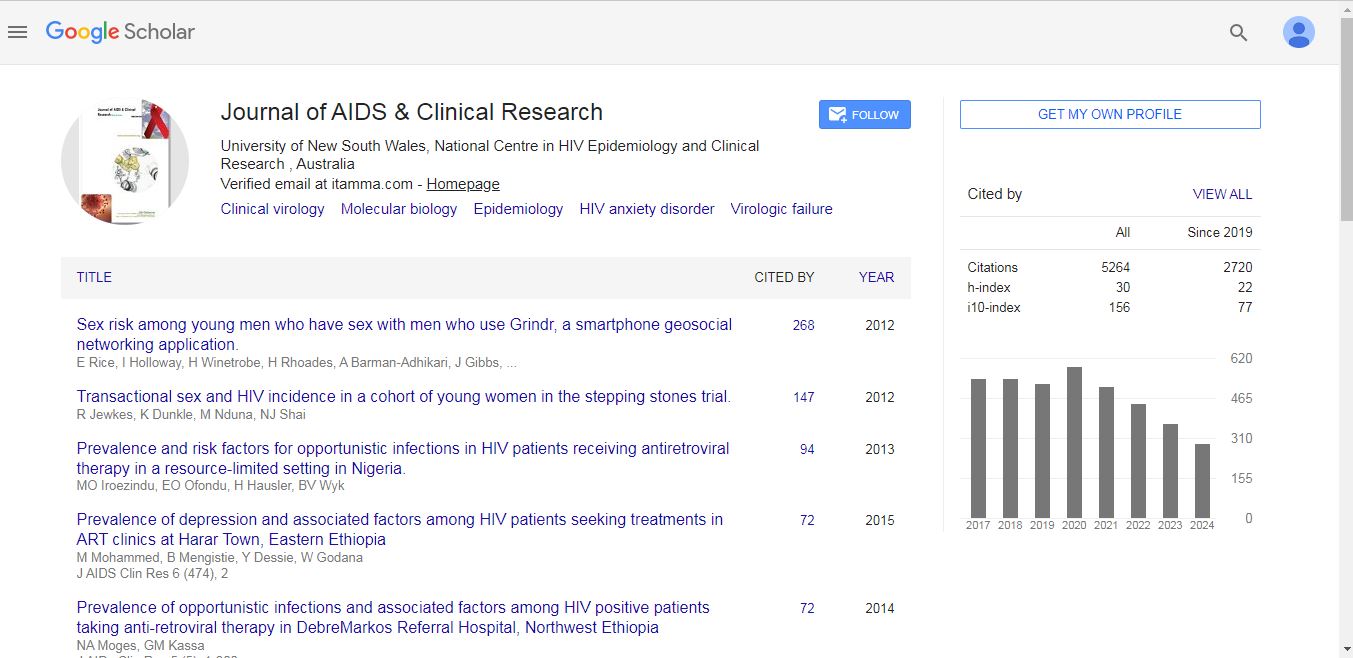
Journal of AIDS & Clinical Research received 5264 citations as per Google Scholar report