Opinion - (2025) Volume 15, Issue 3
Received: 01-May-2025, Manuscript No. bpbt-25-178502;
Editor assigned: 05-May-2025, Pre QC No. P-178502;
Reviewed: 19-May-2025, QC No. Q-178502;
Revised: 22-May-2025, Manuscript No. R-178502;
Published:
29-May-2025
, DOI: 10.37421/2155-9821.2025.15.678
Citation: Svensson, Johan M.. ”High-Throughput Screening: Revolutionizing Bioprocess Development.” J Bioprocess Biotech 15 (2025):678.
Copyright: © 2025 Svensson M. Johan This is an open-access article distributed under the terms of the Creative Commons Attribution License, which permits unrestricted use,
distribution and reproduction in any medium, provided the original author and source are credited.
High-throughput screening (HTS) is profoundly transforming the landscape of bioprocess development, offering an unprecedented ability to rapidly evaluate a multitude of experimental conditions. This accelerated assessment is crucial for optimizing critical parameters such as media composition, temperature, pH, and aeration, ultimately leading to significant improvements in yields and product quality. Key enablers of this revolution are automation and miniaturization, which facilitate the parallel processing of hundreds or even thousands of samples, thereby substantially reducing development timelines and the associated expenditure of resources. This advancement is pivotal for industries reliant on efficient biological production systems. [1] Microfluidic technologies represent a significant stride in HTS for bioprocesses, providing exceptional control over reaction environments at the micro- and nanoliter scales. These systems enable precise manipulation of reagents, leading to improved mass and heat transfer characteristics and a marked reduction in reagent consumption. Consequently, this allows for a more extensive exploration of the design space for process optimization with enhanced efficiency. The precision offered by microfluidics is invaluable. [2] Automated robotic platforms are integral to the successful implementation of HTS in bioprocess development, performing tasks such as liquid handling, incubation, and sampling with remarkable precision and reproducibility. This automation allows for the systematic variation of numerous parameters and the rapid assessment of their impact on crucial bioprocess performance indicators, including microbial growth and product formation. The systematic nature of these platforms is a major advantage. [3] For the selection of microbial strains or cell lines exhibiting enhanced bioproductivity, HTS offers a substantial acceleration. Techniques such as fluorescence-activated cell sorting (FACS) and luminescence-based assays can efficiently identify superior variants from large libraries in a single experimental run. This direct impact on the selection of robust production hosts is a key benefit of HTS. The ability to rapidly identify elite performers is critical. [4] The extensive data generated by HTS necessitates sophisticated data analysis and interpretation strategies. Advanced bioinformatics tools and statistical methods are essential for discerning meaningful trends, identifying outliers, and determining optimal conditions. This ensures that the insights gleaned from HTS experiments translate effectively into practical and impactful process improvements. Robust data analysis is paramount. [5] Miniaturized bioreactor systems, often referred to as "bioreactor-on-a-chip" or "lab-on-a-chip" platforms, are fundamental to HTS by enabling the parallel cultivation and monitoring of numerous small-scale cultures. These systems provide excellent control over process parameters and facilitate the rapid screening of various media and process conditions to achieve optimal bioprocess performance. The parallel processing capability is a significant advantage. [6] The application of HTS is also expanding into downstream processing (DSP) development, an area critical for product purification. Techniques that allow for the rapid assessment of separation and purification efficiencies, such as microfluidic-based chromatography or automated sample preparation for analytical purposes, enable faster optimization of purification strategies. This speed is vital for achieving high-purity products efficiently. The optimization of purification is essential. [7] The synergy between HTS and Design of Experiments (DoE) methodologies significantly amplifies the efficiency of bioprocess optimization efforts. By strategically selecting experimental conditions and employing DoE for result analysis, HTS can pinpoint optimal parameters with a reduced number of experiments. This leads to the development of more robust and cost-effective bioprocesses. The combination of these techniques is powerful. [8] In the realm of microbial bioprocesses, HTS facilitates the rapid screening of genetic variants and engineered strains. This includes the evaluation of metabolic engineering strategies, the assessment of promoter strengths, and the analysis of gene knockouts, all aimed at identifying strains with improved production capabilities for valuable compounds such as biofuels or biochemicals. The genetic screening aspect is highly valuable. [9] Crucially, the development of novel sensors and advanced analytical tools is indispensable for effective HTS in bioprocess development. Real-time monitoring of key parameters like dissolved oxygen, pH, and metabolite concentrations within miniaturized systems provides rapid feedback. This informed decision-making capability during the screening process ultimately leads to more efficient and successful bioprocess optimization. Sensor development is a critical enabler. [10]
High-throughput screening (HTS) has emerged as a transformative technology in bioprocess development, offering the capability to rapidly assess a vast array of experimental conditions. This accelerated evaluation process is instrumental in optimizing key parameters, including media composition, temperature, pH, and aeration, which directly contributes to enhanced yields and superior product quality. The widespread adoption of automation and miniaturization technologies underpins HTS, enabling the parallel processing of thousands of samples, thereby drastically reducing development timelines and optimizing resource utilization. This efficiency is paramount for modern biomanufacturing. [1] Microfluidic technologies are particularly well-suited for HTS in bioprocesses due to their exceptional ability to control reaction environments at the micro- and nanoliter scales. They facilitate precise manipulation of reagents and enhance mass and heat transfer, while simultaneously minimizing reagent consumption. This allows for a more comprehensive exploration of process variables, leading to greater efficiency in optimization efforts. The intricate control offered by microfluidics is a significant advantage. [2] Automated robotic platforms are fundamental to the execution of HTS in bioprocess development. These sophisticated systems perform crucial tasks such as liquid handling, incubation, and sampling with high levels of precision and reproducibility. This enables the systematic variation of numerous parameters and the prompt assessment of their influence on vital bioprocess performance metrics, including microbial growth and product yield. The consistent performance of robotic systems is essential. [3] In the selection of microbial strains or cell lines for improved bioproductivity, HTS significantly expedites the process. Techniques like fluorescence-activated cell sorting (FACS) and luminescence-based assays are capable of identifying superior variants from large libraries in a single experimental run. This direct impact on the selection of robust production hosts represents a key advantage of HTS. The speed at which superior variants can be identified is revolutionary. [4] The substantial volume of data generated by HTS workflows necessitates the use of advanced data analysis and interpretation methodologies. Sophisticated bioinformatics tools and statistical methods are indispensable for identifying significant trends, detecting outliers, and determining optimal process conditions. This ensures that the insights derived from HTS experiments can be effectively translated into tangible process improvements. The complexity of the data requires specialized tools. [5] Miniaturized bioreactor systems, commonly referred to as "bioreactor-on-a-chip" or "lab-on-a-chip" platforms, are crucial for HTS by enabling the parallel cultivation and monitoring of numerous small-scale cultures. These advanced systems offer superior control over process parameters and facilitate the rapid screening of diverse media and process conditions to achieve optimal bioprocess performance. The parallel nature of these systems accelerates discovery. [6] HTS is increasingly being applied to downstream processing (DSP) development, an area critical for product recovery and purification. Techniques for rapidly assessing separation and purification efficiencies, such as microfluidic chromatography or automated sample preparation for analytical assessments, allow for accelerated optimization of purification strategies. This is vital for obtaining high-purity bioproducts efficiently. The efficiency gains in DSP are substantial. [7] The integration of HTS with Design of Experiments (DoE) methodologies serves to dramatically enhance the efficiency of bioprocess optimization. By strategically selecting experimental conditions and utilizing DoE for result analysis, HTS can identify optimal parameters with a reduced experimental burden. This approach leads to the development of more robust and economically viable bioprocesses. The strategic combination of HTS and DoE is highly effective. [8] For microbial bioprocesses, HTS provides a powerful tool for the rapid screening of genetic variants and engineered strains. This screening encompasses the evaluation of metabolic engineering strategies, the characterization of promoter strengths, and the assessment of gene knockouts, all with the objective of identifying strains with enhanced production capabilities for valuable compounds such as biofuels or biochemicals. The ability to screen genetic modifications rapidly is a key benefit. [9] The advancement of novel sensors and sophisticated analytical tools is a prerequisite for the effective implementation of HTS in bioprocess development. Real-time monitoring of critical parameters like dissolved oxygen, pH, and metabolite concentrations within miniaturized systems provides immediate feedback. This allows for informed decision-making throughout the screening process, ultimately contributing to more efficient bioprocess optimization. Sensor technology is a critical enabler of HTS. [10]
High-throughput screening (HTS) is revolutionizing bioprocess development by enabling rapid evaluation of numerous experimental conditions, accelerating the optimization of parameters like media composition, temperature, pH, and aeration to improve yields and product quality. Automation and miniaturization are key drivers, allowing for parallel processing of thousands of samples, significantly reducing development timelines and resource expenditure. Microfluidic technologies offer precise control over micro- and nanoliter scale reactions, enhancing efficiency and reducing reagent consumption. Automated robotic platforms ensure high precision and reproducibility in liquid handling, incubation, and sampling. HTS expedites the screening of microbial strains and cell lines for enhanced bioproductivity using techniques like FACS and luminescence-based assays. Sophisticated bioinformatics and statistical tools are essential for analyzing the vast data generated by HTS, translating insights into practical improvements. Miniaturized bioreactor systems facilitate parallel cultivation and monitoring, while HTS is also being applied to downstream processing for faster optimization of purification strategies. Integrating HTS with Design of Experiments amplifies optimization efficiency by pinpointing optimal parameters with fewer experiments. For microbial processes, HTS is used to screen genetic variants and engineered strains for improved production capabilities. The development of novel sensors and analytical tools is crucial for real-time monitoring and informed decision-making during HTS.
None
None
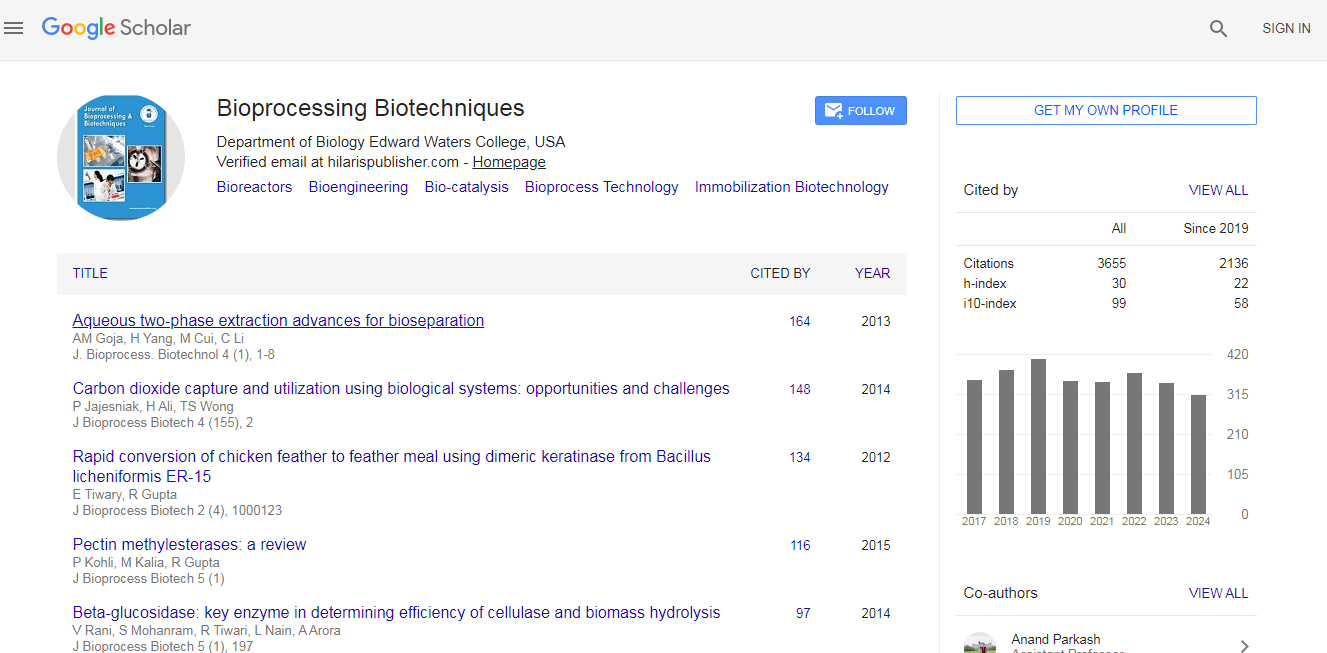
Journal of Bioprocessing & Biotechniques received 3351 citations as per Google Scholar report