Brief Report - (2025) Volume 14, Issue 2
Received: 01-Mar-2025, Manuscript No. aim-25-177338;
Editor assigned: 03-Mar-2025, Pre QC No. P-177338;
Reviewed: 17-Mar-2025, QC No. Q-177338;
Revised: 24-Mar-2025, Manuscript No. R-177338;
Published:
31-Mar-2025
, DOI: 10.37421/2427-5162.2025.14.566
Citation: Reed, Jonathan. "Herbal Medicine: Diverse Roles for Holistic Health." Alt Integr Med 14 (2025):559.
Copyright: © 2025 Reed J. This is an open-access article distributed under the terms of the Creative Commons Attribution License, which permits unrestricted use, distribution and reproduction in any medium, provided the original author and source are credited.
Traditional herbal medicine offers profound insights into mental health care, particularly from the perspectives of African Traditional Health Practitioners. These practices emphasize a holistic paradigm, integrating spiritual, social, and physical aspects of well-being, often overlooked by conventional medicine. The cultural relevance and accessibility of these herbal remedies in specific communities highlight their significant role in promoting mental wellness and supporting local healthcare systems, demonstrating a rich, culturally embedded heritage of healing that continues to serve diverse populations [1].
The therapeutic potential of herbal medicine extends to fundamental biological processes, such as enhancing mitochondrial function. A systematic review revealed that specific herbal compounds can positively influence mitochondrial activity, crucial for cellular health and energy production. By targeting these essential biological mechanisms, herbal interventions offer promising avenues for addressing various chronic diseases, thereby supporting a holistic approach to health that begins at the cellular level and promises systemic benefits [2].
Herbal medicine also provides crucial supportive care in severe medical conditions, such as managing cancer cachexia. This debilitating syndrome, characterized by profound weight loss and muscle wasting, significantly impacts patients' quality of life. Research, including systematic reviews and meta-analyses, suggests that specific herbal interventions can effectively ameliorate these severe symptoms. This indicates a valuable complementary role for herbal remedies within comprehensive cancer care strategies, ensuring that the holistic needs of patients undergoing arduous treatments are adequately addressed, potentially enhancing comfort and resilience [3].
The management of metabolic syndrome, a widespread health challenge encompassing obesity, insulin resistance, and dyslipidemia, represents another domain where phytotherapy demonstrates considerable promise. A systematic review compiles evidence that various plant-derived compounds possess the potential to positively influence these metabolic components. This body of research advocates for the integration of herbal medicine as a vital element within a holistic management strategy, aiming not only to treat but also to prevent the progression of metabolic syndrome, offering a natural complement to conventional interventions [4].
Addressing mental health challenges in vulnerable populations, particularly older adults, is a significant concern. A systematic review focused on herbal medicine for anxiety and depression in this demographic synthesizes compelling evidence on the efficacy and safety of various herbal remedies. The findings underscore their potential as valuable complementary treatments, contributing to improved mental health and overall well-being in older individuals. These natural interventions are often associated with a reduced incidence of adverse effects compared to many conventional pharmacological agents, making them an attractive option for geriatric care [5].
The global challenge of antimicrobial resistance necessitates the exploration of novel therapeutic avenues, and traditional herbal medicines present a promising direction. A systematic review in this field compiles evidence on numerous plant-derived compounds that exhibit potent antimicrobial properties. This research highlights the significant potential for developing new therapeutic strategies based on these natural agents. Integrating such herbal remedies into a holistic approach to infectious disease management could offer crucial alternatives and adjuncts to conventional antibiotics, thereby contributing to the global fight against drug-resistant pathogens [6].
Non-alcoholic fatty liver disease (NAFLD) is a growing health concern, and herbal medicine offers an intriguing perspective on its prevention and treatment. A systematic review focused on NAFLD consolidates extensive research demonstrating the hepatoprotective effects of various herbs. These studies provide invaluable insights into the specific mechanisms of action through which these natural compounds exert their beneficial effects on liver health. The cumulative evidence strongly advocates for the potential role of herbal therapies as complementary interventions within a comprehensive, holistic management strategy designed to combat the progression of NAFLD [7].
Neurodegenerative conditions, such as Alzheimer's disease, pose immense therapeutic challenges. Current trends and future perspectives on herbal medicines for Alzheimer's disease have been systematically reviewed, revealing encouraging evidence for various herbal interventions. These natural compounds show considerable promise in promoting neuroprotection and enhancing cognitive function, suggesting their utility as crucial adjunct therapies. By integrating these remedies into a holistic management approach, the focus can extend beyond mere symptom management to improving patients' overall quality of life and potentially slowing disease progression [8].
The maintenance of cognitive function throughout the lifespan is paramount for overall well-being. A systematic review of randomized controlled trials investigated the efficacy of herbal medicine in improving cognitive function. The findings from this rigorous analysis identify numerous herbal remedies that possess the potential to enhance critical cognitive domains, including memory, attention, and overall cognitive performance. This evidence firmly supports their role as effective complementary therapies, contributing significantly to the proactive maintenance of brain health and cognitive vitality within a broader holistic health paradigm [9].
Chronic fatigue represents a widespread and often debilitating symptom, for which effective and holistic treatment strategies are highly sought after. A systematic review and meta-analysis of randomized controlled trials rigorously assessed the effectiveness of herbal medicine in alleviating fatigue. The compelling research indicates that specific herbal interventions can lead to a significant reduction in fatigue symptoms. This robust evidence positions herbal medicine as a valuable natural and holistic approach, facilitating energy restoration and enhancing overall vitality, particularly for individuals experiencing persistent or chronic states of fatigue [10].
A seminal article delves into traditional herbal medicine's application in mental health, specifically examining the insights from African Traditional Health Practitioners. The core finding underscores how these practices offer uniquely holistic approaches to mental well-being, meticulously integrating spiritual, social, and physical dimensions that are often marginalized in conventional medical frameworks. Furthermore, the study highlights the profound cultural relevance and enhanced accessibility of these herbal remedies within the distinct communities they serve. This demonstrates a vital, patient-centered model that recognizes the broader determinants of health, providing comprehensive care [1]. Focusing on foundational cellular processes, a systematic review meticulously investigated herbal medicine's capacity to enhance mitochondrial function. This research illuminates how specific herbal compounds actively improve mitochondrial activity, which is indispensable for robust cellular health and efficient energy production throughout the body. The implications are significant, suggesting therapeutic potential for a spectrum of chronic diseases. By targeting these fundamental biological processes, herbal medicine contributes to an overarching holistic health paradigm, offering interventions that operate at the core of physiological vitality and disease prevention [2]. The utility of herbal medicine extends to addressing severe comorbidities in cancer patients, as evidenced by a systematic review and meta-analysis on cancer cachexia management. This research rigorously evaluates the efficacy of herbal interventions in mitigating this debilitating condition, characterized by profound weight loss and muscle wasting. The findings strongly indicate that certain herbal treatments can significantly alleviate symptoms, proposing a critical complementary role in supportive cancer care. This approach prioritizes addressing the holistic needs of patients, enhancing their overall well-being and resilience during challenging treatment phases [3]. Another systematic review explores the integral role of phytotherapy, synonymous with herbal medicine, in managing metabolic syndrome. This comprehensive review synthesizes extensive evidence on various plant-derived compounds demonstrating considerable potential in addressing key components of the syndrome, including obesity, insulin resistance, and dyslipidemia. The compiled findings advocate for a holistic and integrative approach to prevention and treatment, positioning phytotherapy as a valuable natural adjunct. This emphasizes how herbal interventions can contribute substantially to mitigating this widespread health condition through multi-targeted mechanisms, offering a broader therapeutic scope [4]. Addressing the specific mental health needs of older adults, a systematic review meticulously examined the efficacy and safety of herbal medicine for anxiety and depression. This review consolidates current evidence, highlighting the potential of various herbal remedies as effective complementary treatments for this vulnerable population. Notably, these herbal options frequently present fewer side effects compared to conventional pharmaceutical drugs, making them particularly advantageous for geriatric patients who may be susceptible to polypharmacy. Their role in supporting mental health and overall well-being in older adults is thus reinforced, offering gentler alternatives [5]. In the critical battle against antimicrobial resistance, a systematic review investigated the potential contributions of traditional herbal medicines. This study comprehensively compiles evidence on numerous plant-derived compounds that possess significant antimicrobial properties, suggesting a promising new frontier for therapeutic development. The research advocates for these natural remedies as vital components in evolving new strategies for infectious disease management. Integrating these into a holistic approach could provide crucial alternatives to conventional antibiotics, thereby bolstering global efforts to combat the growing threat of drug-resistant pathogens, ensuring more sustainable treatments [6]. The prevention and treatment of non-alcoholic fatty liver disease (NAFLD) is explored through the lens of herbal medicine in a dedicated systematic review. This review rigorously consolidates research highlighting various herbs exhibiting potent hepatoprotective effects. It provides crucial insights into their specific mechanisms of action, such as reducing inflammation and oxidative stress, thereby positioning them as valuable complementary therapies. The findings strongly support their inclusion within a comprehensive, holistic management strategy for NAFLD, offering natural alternatives to protect liver health and slow disease progression effectively [7]. A systematic review sheds light on current trends and future perspectives regarding herbal medicines for Alzheimer's disease. The compilation of evidence reveals various herbal interventions demonstrating considerable promise in neuroprotection and cognitive enhancement. These natural therapies are proposed as crucial adjuncts within a holistic approach to managing neurodegenerative conditions, moving beyond mere symptom control. The focus extends to improving patients' overall quality of life by potentially slowing cognitive decline, offering valuable avenues for integrated care and novel treatment developments for this challenging disease [8]. Improving cognitive function is a key focus of a systematic review of randomized controlled trials evaluating herbal medicine. This rigorous analysis identifies various herbal remedies with demonstrated potential to enhance crucial cognitive capacities, including memory, attention, and overall cognitive performance. The evidence strongly supports their role as effective complementary therapies for maintaining brain health and cognitive vitality. This underscores the potential for natural interventions to be integrated into a holistic context, offering accessible and effective strategies for sustaining optimal cognitive function throughout life and mitigating age-related decline [9]. Addressing chronic fatigue, a prevalent and often debilitating condition, is the subject of a systematic review and meta-analysis of randomized controlled trials on herbal medicine. The research comprehensively assesses the effectiveness of various herbal interventions, indicating their capacity to significantly reduce fatigue symptoms. This robust evidence positions herbal medicine as a valuable natural and holistic approach to energy restoration and enhancing overall vitality. It particularly highlights their utility for individuals experiencing persistent fatigue states, offering a complementary therapeutic pathway to improve daily functioning and quality of life [10].
A comprehensive review of recent literature highlights the diverse and significant roles of herbal medicine across various health domains. Studies demonstrate its efficacy in mental health care, particularly in African traditional contexts, emphasizing holistic approaches that integrate spiritual, social, and physical well-being. Herbal interventions show promise in enhancing mitochondrial function, crucial for cellular health and addressing chronic diseases. Furthermore, they offer supportive roles in managing severe conditions like cancer cachexia and metabolic syndrome, targeting components such as weight loss, insulin resistance, and dyslipidemia. Herbal remedies are also explored for their potential in alleviating anxiety and depression in older adults, often with fewer side effects than conventional treatments. The research extends to combating antimicrobial resistance, preventing and treating non-alcoholic fatty liver disease, and managing neurodegenerative conditions like Alzheimer's disease through neuroprotective and cognitive-enhancing effects. Finally, herbal medicine has been found effective in improving general cognitive function and reducing symptoms of chronic fatigue, offering natural, holistic approaches to improve overall vitality and quality of life across diverse patient populations. These findings collectively underscore the substantial potential of herbal medicine as a complementary therapeutic strategy.
None
None
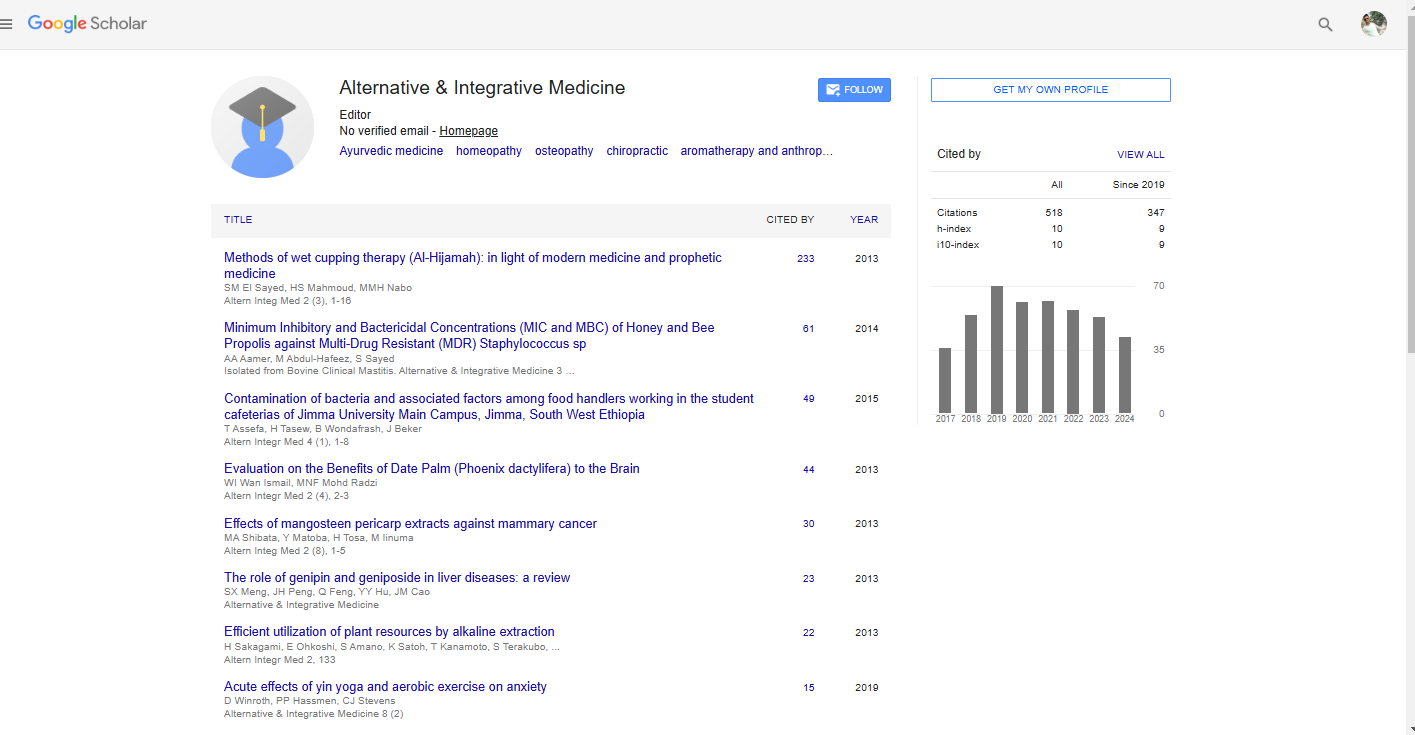
Alternative & Integrative Medicine received 476 citations as per Google Scholar report