Brief Report - (2025) Volume 15, Issue 4
Received: 01-Jul-2025, Manuscript No. jnt-26-178944;
Editor assigned: 03-Jul-2025, Pre QC No. P-178944;
Reviewed: 17-Jul-2025, QC No. Q-178944;
Revised: 22-Jul-2025, Manuscript No. R-178944;
Published:
29-Jul-2025
, DOI: 10.37421/2161-0959.2025.15.572
Citation: Valverde, Andrés. ”Hemodialysis Innovations: Better Patient Outcomes, Greater Autonomy.” J Nephrol Ther 15 (2025):572.
Copyright: © 2025 Valverde A. This is an open-access article distributed under the terms of the Creative Commons Attribution License, which permits unrestricted use, distribution and reproduction in any medium, provided the original author and source are credited.
Recent advancements in hemodialysis technology are profoundly enhancing patient outcomes and the overall quality of life for individuals undergoing this vital treatment. Innovations are actively pushing the boundaries of dialyzer efficiency, aiming to optimize the removal of uremic toxins and restore a more natural filtration process. Simultaneously, there is a significant focus on developing more biocompatible materials that minimize adverse reactions and inflammation, thereby improving long-term patient well-being. The integration of smart technologies is a growing trend, enabling better real-time monitoring of critical patient parameters and facilitating more personalized treatment regimens tailored to individual needs. This proactive approach aims to prevent complications before they arise and refine existing treatment strategies for maximum efficacy. Wearable and home hemodialysis devices are steadily gaining traction, representing a significant shift towards greater patient autonomy and flexibility in managing their treatment. These devices offer the potential to decentralize care and empower patients with more control over their daily lives. The incorporation of sophisticated analytical tools, such as artificial intelligence and machine learning, is paving the way for predictive analytics in dialysis management. These advanced algorithms can process vast datasets to anticipate potential issues and guide optimal treatment decisions. Collectively, these cutting-edge developments in hemodialysis are focused on making the treatment safer, more effective, and less burdensome for patients, ultimately aiming to improve their overall health and independence. The progress in home hemodialysis (HHD) is significantly supported by technological advancements that are making these treatments more accessible and manageable outside of traditional clinical settings. Newer HHD machines are being engineered with user-friendliness, enhanced safety, and portability as primary design considerations. This notable shift towards HHD is underpinned by its potential to offer improved blood pressure control, more effective anemia management, and a demonstrably enhanced quality of life for patients, although it necessitates robust patient education and comprehensive support systems. The integration of remote monitoring capabilities is a crucial component, further aiding in the effective management and oversight of patients undertaking HHD at home, providing a vital link to healthcare professionals. Advanced dialyzer membranes represent a critical area of ongoing innovation, directly contributing to the enhancement of both the efficiency and biocompatibility of hemodialysis procedures. These next-generation membranes are meticulously designed to improve toxin removal and reduce patient morbidity. The development of sorbent-based dialysis systems is presenting a promising pathway toward miniaturizing dialysis devices, which is essential for creating more portable and home-use friendly solutions. These systems utilize regenerative cartridges to efficiently remove waste products from the dialysate.
Recent innovations in hemodialysis technology are significantly enhancing patient outcomes and improving the quality of life for those undergoing treatment. A major focus of these advancements is the improvement of dialyzer efficiency, ensuring more effective removal of waste products from the blood. Simultaneously, considerable effort is being dedicated to the development of more biocompatible materials, which are crucial for minimizing adverse reactions and inflammation during dialysis. The integration of smart technologies is a defining characteristic of modern hemodialysis, enabling enhanced monitoring of patient vital signs and treatment parameters. This allows for a more personalized approach to treatment, where dialysis prescriptions can be fine-tuned to meet the unique needs of each patient. Wearable and home hemodialysis devices are increasingly becoming a reality, offering patients greater flexibility and a sense of autonomy in managing their treatment. This decentralization of care aims to improve patient convenience and reduce the burden associated with frequent clinic visits. The application of artificial intelligence and machine learning is revolutionizing dialysis management. These sophisticated analytical tools are being employed to predict potential complications, optimize treatment strategies, and personalize dialysis prescriptions based on individual patient data. Collectively, these technological advancements are making hemodialysis a safer, more effective, and less intrusive treatment option, contributing to a better overall patient experience and improved health outcomes. The increasing adoption of home hemodialysis (HHD) is being propelled by technological progress that makes these treatments more accessible and manageable outside of a clinical environment. The design of new HHD machines prioritizes ease of use, robust safety features, and enhanced portability. This shift towards HHD is motivated by its potential to yield better blood pressure control, improve anemia management, and significantly enhance the quality of life for patients, although this transition requires comprehensive patient education and well-established support systems. The integration of remote monitoring capabilities plays a pivotal role in the effective management of patients undergoing HHD, allowing healthcare providers to maintain oversight and intervene when necessary. Advanced dialyzer membranes are a cornerstone of improved hemodialysis, focusing on enhancing both efficiency and biocompatibility through the use of novel materials designed to better mimic the kidney's natural filtration capabilities. The exploration of sorbent-based dialysis systems represents a significant technological stride, offering the potential to drastically miniaturize dialysis devices and render them more suitable for portable or home-use applications, thereby increasing patient independence.
Recent breakthroughs in hemodialysis technology are significantly enhancing patient outcomes and quality of life. Innovations include more efficient dialyzers, biocompatible materials, and integrated smart technologies for better monitoring and personalized treatment. Wearable and home hemodialysis devices offer greater patient autonomy. Artificial intelligence and machine learning are being used for predictive analytics and optimizing treatment. Advanced dialyzer membranes improve toxin removal and biocompatibility. Smart dialysis machines and personalized treatments are becoming more feasible. Sorbent-based systems aim for miniaturization, and improved fluid management technologies enhance patient comfort and outcomes. These developments collectively aim to make hemodialysis safer, more effective, and less burdensome.
None
None
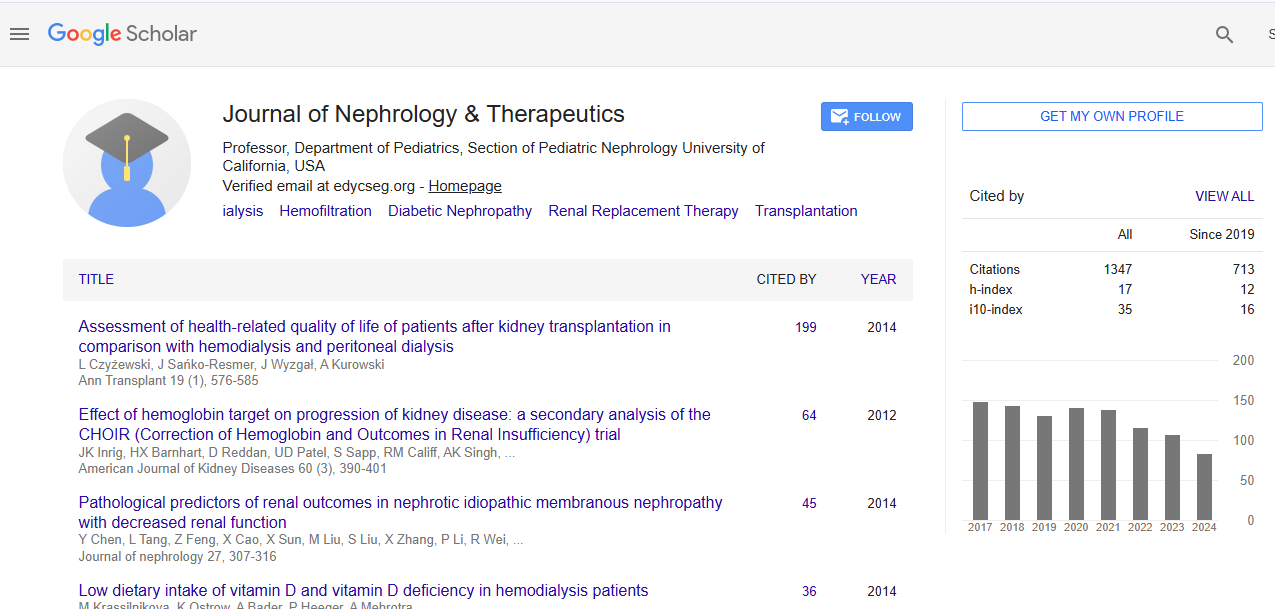
Journal of Nephrology & Therapeutics received 784 citations as per Google Scholar report