Opinion - (2025) Volume 15, Issue 5
Received: 30-Sep-2025, Manuscript No. jmcj-25-176919;
Editor assigned: 02-Oct-2025, Pre QC No. P-176919;
Reviewed: 14-Oct-2025, QC No. Q-176919;
Revised: 21-Oct-2025, Manuscript No. R-176919;
Published:
28-Oct-2025
, DOI: 10.37421/2165-7912.2025.15.644
Citation: Lindberg, Hannah F.. ”Health Journalism: Truth, Trust, Evolving Challenges.” J Mass Communicat Journalism 15(2025):644.
Copyright: © 2025 Lindberg F. Hannah This is an open-access article distributed under the terms of the Creative Commons Attribution License, which permits unrestricted use, distribution and reproduction in any medium, provided the original author and source are credited.
Journalism plays a critical role in addressing health misinformation, a challenge made especially clear during the COVID-19 pandemic. This systematic review underscores the essential function of journalists in rigorously verifying facts and actively combating the proliferation of false health narratives, pinpointing key operational challenges and effective communication strategies crucial for public safety and understanding[1].
Health journalists frequently encounter profound ethical challenges in their profession. A qualitative study explored their perspectives on these issues, revealing consistent dilemmas around reporting sensitive health topics, maintaining absolute accuracy, safeguarding patient privacy, and expertly balancing broader public interest with their strict professional responsibilities[2].
Public trust in health journalism is not automatic but built upon several foundational factors. A cross-national survey diligently investigated these elements, identifying that perceived accuracy, demonstrable journalistic independence, and the clear objectivity of reporting are paramount for fostering and sustaining public confidence in health news and its dissemination[3].
The influence of health journalism on public health policy is substantial, a dynamic clearly illustrated by a case study of the COVID-19 pandemic. This research revealed how extensive media coverage effectively shaped public discourse, directly impacted government responses to the crisis, and significantly influenced public adherence to critical health guidelines throughout that period[4].
The integration of Artificial Intelligence (AI) into health reporting introduces both novel ethical challenges and considerable opportunities for enhancement. A systematic review on this topic discusses how AI tools possess the potential to significantly augment journalistic practices, yet simultaneously raise serious concerns regarding data accuracy, algorithmic bias, and the fundamental preservation of journalistic autonomy in content creation[5].
Social media platforms have assumed a complex and often central role in health journalism, particularly prominent during public health crises. A scoping review highlighted their capacity for rapid information dissemination, but critically also pointed out inherent challenges related to the rapid spread of misinformation and the continuous effort required to maintain journalistic credibility amidst diverse online narratives[6].
Incorporating patient narratives into health journalism offers significant benefits, notably its ability to enhance public understanding and foster empathy. However, this practice also necessitates careful consideration of several ethical dimensions, including patient privacy, obtaining informed consent, and vigilantly guarding against the potential for misrepresentation of personal experiences[7].
Effective science communication within health journalism faces distinct challenges and presents important opportunities for public education. This research emphasizes the profound need for journalists to accurately translate often complex scientific information into accessible content for public audiences, while skillfully navigating conflicting research findings and steadfastly maintaining their journalistic independence in reporting[8].
The evolving training needs of health journalists have become increasingly critical in the wake of recent global health crises. Providing a global perspective, one paper outlines the essential skills and knowledge journalists now require to report accurately and effectively on intricate health issues within a rapidly changing and often challenging media landscape[9].
Finally, the representation of diverse populations in health journalism remains a crucial area for scrutiny and improvement. A content analysis investigated this aspect, evaluating the inclusivity and accuracy of current media portrayals and clearly highlighting specific areas where representation can be substantially improved to better serve and reflect all communities equitably[10].
Health journalism serves as a crucial bulwark against misinformation, a role that became acutely evident during the COVID-19 pandemic. Systematic reviews highlight the indispensable function of journalists in rigorously verifying information and actively combating the proliferation of false health narratives, outlining specific challenges and strategic approaches essential for effective public communication and ensuring public safety [1]. This proactive stance is vital in an era where health claims can spread rapidly and have significant public health consequences.
The field of health journalism is inherently fraught with complex ethical challenges. Qualitative studies delve into the perspectives of journalists themselves, revealing the constant navigation required when reporting sensitive health issues. Journalists must uphold stringent standards of accuracy, protect patient privacy with utmost care, and continuously strive to balance the broader public interest against their fundamental professional responsibilities [2]. These ethical dilemmas often shape how stories are framed and disseminated, impacting both individual lives and public discourse.
Building and maintaining public trust in health journalism is paramount. Cross-national surveys identify key determinants of this trust, including the perceived accuracy of reporting, the demonstrable independence of journalistic operations, and the clear objectivity with which health news is presented [3]. When these elements are strong, public confidence in health news sources solidifies, allowing for better-informed health decisions across communities.
Health journalism also exerts significant influence over public health policy. A compelling case study from the COVID-19 pandemic illustrates how media coverage was instrumental in shaping public discourse, guiding governmental responses to the crisis, and influencing public adherence to crucial health guidelines [4]. This demonstrates the power of well-informed reporting to directly impact public health outcomes and policy direction.
The integration of Artificial Intelligence (AI) into health reporting presents a dual landscape of ethical challenges and innovative opportunities. Systematic reviews explore how AI tools can enhance journalistic practices through improved data analysis and content generation. Yet, these advancements also raise serious concerns regarding the accuracy of AI-generated content, potential inherent biases in algorithms, and the ultimate preservation of journalistic autonomy and critical oversight in the newsroom [5].
Social media platforms have irrevocably changed the landscape of health journalism, particularly during public health emergencies. Scoping reviews highlight the immense capacity of these platforms for rapid information dissemination, but simultaneously underscore the formidable challenges associated with the rapid spread of misinformation and the continuous effort required to maintain journalistic credibility in a fragmented and often sensationalized digital environment [6].
Incorporating patient narratives into health journalism is a powerful method to enhance public understanding and foster empathy towards health issues. However, this approach demands meticulous ethical consideration, including scrupulous attention to patient privacy, securing explicit informed consent, and vigilantly preventing any potential misrepresentation of personal experiences [7]. Beyond personal stories, effective science communication remains a core challenge, requiring journalists to accurately translate complex scientific information for diverse public audiences while navigating conflicting research findings and maintaining journalistic independence [8].
Finally, the professional development of health journalists is a pressing concern, especially in the wake of global health crises. A global perspective indicates a clear need for updated training, equipping journalists with the necessary skills and knowledge to report accurately and effectively on complex health issues within a rapidly evolving media landscape [9]. Concurrently, content analysis reveals critical aspects of how diverse populations are represented in health journalism, emphasizing the need to improve the inclusivity and accuracy of media portrayals to ensure all communities are adequately served and reflected in health news [10].
Health journalism navigates a complex landscape marked by the persistent challenge of health misinformation, particularly evident during global crises like COVID-19. Journalists play a critical role in verifying facts, combating false narratives, and shaping public health policy, as studies emphasize their influence on public discourse and adherence to health guidelines. Ethical considerations are paramount, with journalists constantly balancing accuracy, patient privacy, public interest, and professional responsibilities when reporting sensitive health issues. Public trust in health news hinges on perceived accuracy, journalistic independence, and objectivity. The field is rapidly evolving with technological advancements. The integration of Artificial Intelligence (AI) offers opportunities to enhance reporting but also raises concerns about accuracy, bias, and journalistic autonomy. Similarly, social media platforms, while enabling rapid information dissemination during crises, pose significant challenges related to misinformation and maintaining credibility. Beyond technology, effective health journalism relies on diverse communication strategies, including the careful incorporation of patient narratives to build empathy and understanding, while diligently managing privacy and consent. It also demands precise science communication, where complex scientific information must be accurately translated for public audiences, often amidst conflicting research. To meet these demands, there's a clear need for ongoing training for journalists, equipping them with the skills to navigate this intricate environment. Furthermore, studies highlight the importance of improving the representation of diverse populations in health journalism to ensure inclusivity and accuracy across all communities.
None
None
Anamaria H, Laura MS, Kevin RT. "Journalism and health misinformation in the age of COVID-19: A systematic review".Health Promot Pract 24 (2023):1079-1092.
Indexed at, Google Scholar, Crossref
Mohammad ZM, Mostofa JH, Md. ATM. "Ethical Dilemmas in Health Journalism: A Qualitative Study of Journalists' Perspectives".J Med Ethics Hist Med 15 (2022):Article 10.
Indexed at, Google Scholar, Crossref
Daniela K, Julia M, Jörg M. "Trust in Health Journalism: A Cross-National Survey of Factors Influencing Public Perceptions".J Health Commun 26 (2021):189-200.
Indexed at, Google Scholar, Crossref
Sarah O, Liam M, Rachel E. "The Role of Health Journalism in Shaping Public Health Policy: A Case Study of the COVID-19 Pandemic".Public Health 185 (2020):32-38.
Indexed at, Google Scholar, Crossref
Laura MS, Kevin RT, Anamaria H. "AI in Journalism: A Systematic Review of Ethical Challenges and Opportunities in Health Reporting".Health Promot Pract 24 (2023):1093-1102.
Indexed at, Google Scholar, Crossref
Jessica GK, Laura MS, Kevin RT. "The Role of Social Media in Health Journalism During Public Health Crises: A Scoping Review".J Health Commun 27 (2022):541-554.
Indexed at, Google Scholar, Crossref
Daniel AS, Jessica GK, Anamaria H. "Incorporating Patient Narratives in Health Journalism: Benefits and Challenges".Patient Educ Couns 104 (2021):1687-1693.
Indexed at, Google Scholar, Crossref
Jörg M, Julia M, Daniela K. "Challenges and Opportunities for Science Communication in Health Journalism".Public Underst Sci 29 (2020):625-640.
Indexed at, Google Scholar, Crossref
Kevin RT, Anamaria H, Laura MS. "Training Needs of Health Journalists in the Post-Pandemic Era: A Global Perspective".J Health Commun 28 (2023):833-845.
Indexed at, Google Scholar, Crossref
Andrew PM, Jessica GK, Daniel AS. "Representation of diverse populations in health journalism: A content analysis".Health Educ Behav 46 (2019):789-798.
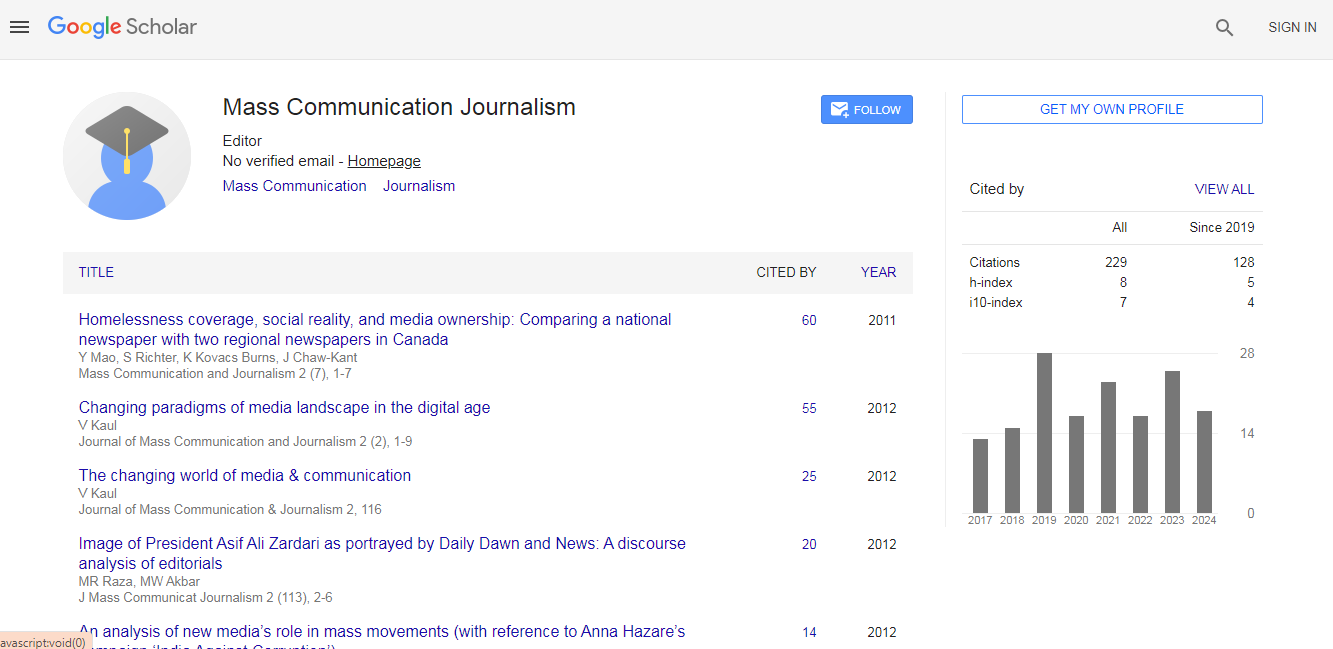
Journal of Mass Communication & Journalism received 205 citations as per Google Scholar report