Research Article - (2023) Volume 13, Issue 6
Received: 19-Oct-2023, Manuscript No. jmcj-23-117491;
Editor assigned: 21-Oct-2023, Pre QC No. P-117491;
Reviewed: 04-Nov-2023, QC No. Q-117491;
Revised: 10-Nov-2023, Manuscript No. R-117491;
Published:
18-Nov-2023
Citation: Chibueze, Nnaemeka. “Illegible type and Reading of Health Information on Food Packs: Survey of University of Nsukka Campus Staff and Students. ” J Mass Communicat Journalism 13 (2023): 547.
Copyright: © 2023 Chibueze N. This is an open-access article distributed under the terms of the Creative Commons Attribution License, which permits unrestricted use, distribution, and reproduction in any medium, provided the original author and source are credited.
This study was done to find if consumers properly use health information inscribed on food packs before they buy and consume them. The study was predicted on one theory – Feature Integration Theory (FIT). The objectives among other things, were to ascertain if consumers notice and read inscriptions on food packs; and if the illegible type of inscriptions on food packs restrain readability of the inscriptions. Survey was adopted as the study design, while questionnaire was used to collect data from a sample size of 370 Staff and Students of Nsukka campus in Enugu State. Findings showed that most of the consumers notice and read the products’ brand names but do not notice and read the health information inscribed on the food packs. The findings also indicate, amongst others that consumers do not notice and read health information on food packs because such inscriptions are not colourful, and have smaller type sizes. Based on the forgoing, it was recommended that the stakeholders (NAFDAC, and manufacturers) should device a means to increase the type size of health inscriptions on food packs, so consumers will read it the way they read brand names of the food products they want to buy. Stakeholders should set up programmes to sensitize consumers on the importance of being healthfully informed before consuming packaged foods. Further, Nigerian government should take cue from UK health policies, and implement front-of-pack nutrition labelling.
Illegible • Type • Inscription • Label
Recognition that good health is not just the absence of illness, but includes the optimal physical and mental well-being of the people has made packaged foods become a topic of importance [1].
Food packs apart from being a means for proper preservation and protection against contaminations [2], also provide needful health information such as nutrient composition, food additives, and preservatives about their contents [3]. These needful information which are seen on the nutrition label on food packs, should play a vital role in conveying first-hand information to consumers and guides their decision in buying products that will not be harmful to them after consumption. Thereby, helping in contributing to public health efforts to combat food-related diseases [4].
Research objectives
The research objectives of this study are to:
1. To ascertain the number of consumers who notice the inscriptions on food packs.
2. To ascertain the number of consumers who read the inscriptions on food packs.
3. To determine if nutritional and other information on food packs are decipherable.
4. To ascertain if the illegible type of inscriptions on food packs restrain readability.
Research questions
For the purpose of this study, they following research questions were posed:
1. Do consumers notice inscriptions on food packs?
2. How many consumers read inscriptions on food packs?
3. Are the nutritional and other information displayed on food packs readable?
4. Do illegible inscriptions inhibit the reading of nutrition and other information on food packs?
However, the manner at which these health information are illegibly inscribed on food packs has become a major concern. Because, failure to read these information before consumption, possibly due to the illegibility of the information, can be hazardous to health.
The question then arises: Do consumers read the information in nutrition labels on food packs they consume, or, does the illegibility of the information on food packs prevent consumers from reading health information of the packaged foods they consume? This study, "Illegible type on food packs and reading of health information: survey of University of Nsukka campus staff and students" aims to determine whether consumers read health information on food packs before buying and consuming them.
Statement of the problem
The essence of labels on food packs is for consumers to make informed and best choices. Consumers who buy packaged foods are supposed to read the nutrition information, so as to avoid potential health challenges associated with consuming unhealthy foods.
Labels on food packs can be complicated to read. On the front sides of the packs are boldly typed, colorful, and appealing product brand names that can easily attract consumers’ attention to the products. But the back sides of the packs have tiny, illegible, and difficult-to-read nutrition labels that should convey health information about the products to the customers.
Dietary diseases are among the leading causes of death and disability in Nigeria, accounting for 10.9% of total deaths, according to the Global Nutrition Report 2020. This includes diseases like malnutrition and obesity, as well as non-communicable diseases like diabetes, cardiovascular disease, and some types of cancer. Furthermore, according to World Health Organisation [5,6] reports, the prevalence of obesity in Nigeria is increasing, with an estimated 8.5% of the adult population affected. Non-communicable diseases caused by diet are estimated to account for approximately 29% of all deaths in Nigeria. So, based on these reports, one wonders if consumers actually use nutrition information on packaged foods they buy and consume, and there is a need to determine if consumers read the nutrition information inscribed on the food packs they consume.
The purpose of this research is to determine whether illegible and unclear nutrition information on food packs hinders consumers from reading and making informed and healthy food choices. The purpose of this study is to raise awareness about reading nutrition information on food packages and, as a result, to reduce the prevalence of common dietary-related diseases in the country.
Conceptual review
Food pack labeling has evolved, with regulatory symbols used in the Roman Empire and the 14th-15th century in London [7]. The US made it popular through the Food and Drug Administration (FDA), established in 1906, which enacted the Food and Drug Act and the Federal Food Drug and Cosmetic Act in 1938 [8]. Laws like the Nutrition Labeling and Education Act of 1990 (NLEA) and the Food and Drug Administration Modernization Act (FDAMA) of 1997, aimed to ensure consumers receive proper information about the food they consume [9]. African countries such as Nigeria, South Africa, Kenya, Cameroon, etc., comply with Codex Alimentarius standards through international organizations like the United Nations' Food and Agricultural Organization (FAO) and the World Health Organization (WHO), by ensuring labeling adherence (Codex Alimentarius, 2013). Nigeria's NAFDAC implemented labeling regulations in 2005, requiring food labels on packaged products with accurate food names, ingredient lists, nutritional values, and more [10].
Food label type sizes on packaged products are determined by the size of the food pack/container and the display panel. Regulatory bodies set minimum and maximum type size guidelines for food labels. In the US, the FDA provides specific recommendations for manufacturers and importers. The two tables below show how the type size is determined based on the available space on the
Principal Display Panel (PDP) of the food label.
FDA’s statement of food label type size. (Table 1 and 2).
| Minimum Type Size | Area of Principal Display Panel |
|---|---|
| 1/16 in. (1.6 mm) | 5 sq. in. (32 sq. cm.) or less |
| 1/8 in. (3.2 mm) | More than 5 sq. in. (32 sq. cm.) but not more than 25 sq. in. (161 sq. cm.) |
| 3/16 in. (4.8 mm) | More than 25 sq. in. (161 sq. cm.) but not more than 100 sq. in. (645 sq. cm.) |
| 1/4 in. (6.4 mm) | More than 100 sq. in. (645 sq. cm.) but not more than 400 sq. in. (2580 sq. cm.) |
| 1/2 in. (12.7 mm) | Over 400 sq. in. (2580 sq. cm.) |
| Gender | Male | 178 | 53.5% |
| Female | 155 | 46.5% | |
| Age | 18-30 years | 169 | 50.8% |
| 31-50 years | 119 | 35.7% | |
| 51-above years | 45 | 13.5% | |
| Educational Status | Secondary | 2 | 0.6% |
| Undergraduate | 177 | 53.2% | |
| Graduate | 97 | 29.1% | |
| Postgraduate | 57 | 17.1% | |
| Occupation | Student | 172 | 51.7% |
| Teaching | 50 | 15% | |
| Non-Teaching | 111 | 33.3% |
NAFDAC, (2005) in giving clear instructions concerning food labeling, says: Any statement required to appear on the label etc. of a food item shall be clear, prominent, and legible to the consumer and be of contrasting color to that of the background. No information shall be obscured by design or by other written, printed, or graphic matter contained on the label. The letters of the name of the food item and the net content shall be of a size reasonably related to the most printed matter on the label. Where a pre-packaged food container is covered by a wrapper, the wrapper shall carry the required information and the label shall be readily legible through the outer wrapper and not be obscured by it. Manufacturers and importers need to adhere to NAFDAC guidelines. However, food labels' type size depends on container size. Labels on smaller containers may be less readable compared to bold, colorful brand names.
Buyers use information on food packs for a variety of reasons. While some inscriptions on food packs are intended to market the products, others provide useful information about the foods’ health benefits. Marketing inscriptions are typically placed prominently on the front of packs, with the goal of capturing the buyer's attention with eye-catching, visible text and appealing language. Meanwhile, health-related inscriptions which are intended to educate the buyers on the nutritional benefits of the food product are placed on the back of the packs and in words that are not bold and appealing to read [11]. Highquality label printing technology is used by manufacturers to create enticing brand names and designs. Bold type and lettering on food packaging attract and compete for the attention of shoppers on the market shelf. Brand names are often inscribed in bold characters with closely attached pictorials [12,13]. The two accompanying pictures below illustrate how vibrant colors and bold type on food labels easily capture consumers' attention.
The pictures above display inscriptions on the front and back sides of Coca-Cola plastic bottles consumed regularly across Nigeria. The back side's inscriptions are less legible than the front side’s but have health information about the soft drink.
Consumers who want to learn more about a food product before buying it will most likely pay close attention to the food label on the packaging. A consumer's decision to buy a product is frequently influenced by their perception that the product will meet their needs. To determine if a food product will satisfy their requirements, consumers will often read the information on the food label. For instance, when a person is hungry and looking for something to eat, they may visit a nearby supermarket to search for pre-packaged food. If they find a suitable product, they will want to ensure that it is of high quality and contains the appropriate nutrients, ingredients, and expiration date, which can be verified by reading the food label on the packaging.
Factors influencing the readability and comprehensibility of inscriptions can be categorized as internal or external [14]. Internal factors include individual characteristics (e.g., age, sex, health status, education level) and situational factors (e.g., time constraints, special diet status). These factors influence consumers' usage and reading of food labels, affecting their ability to make informed decisions [15,16]. External factors encompass institutional factors such as the design, size, color, placement, style, and language used on food labels. Labels with large, bold type and vibrant colors are more likely to capture consumers’ attention and encourage reading. Price can also impact label reading, as affordable products may spark interest in nutritional content and healthfulness [17,18].
Empirical review
Food labels play a crucial role in providing consumers with information about packaged foods. They serve as a medium to convey important details about the product [19]. The visual aspect of food packaging is significant as it attracts buyers and delivers health-related messages [20]. Packaging design has a strong association with consumers' decision-making process, with over 70% confirming its influence on their purchasing choices [21]. Graphics, colors, and printed words on food packs can strongly influence consumer behavior and shape their beliefs about the product [21].
Research conducted by Mackey & Metz, revealed that the readability of food labels on packs was suboptimal, making it challenging for consumers to find and read the necessary information. However, Mieczkowska and Kuncewicz found that most consumers perceive the information on food labels as legible and comprehensible. EdComs [22] conducted a study in the UK, indicating that educated mothers, driven by their interest in nutrition, health, allergies, and religious beliefs, read food labels to make informed choices. The research also highlighted barriers to label reading, such as lack of understanding, inconsistent label formats, and confusion about which nutrition information to prioritize.
Studies conducted in Lesotho [23] and the United States [24] showed that consumers use nutrition information on food labels to guide their food choices. In Nigeria, a survey study conducted in Lagos revealed that a majority of consumers read nutrition labels before purchasing and consuming packaged food products [25] found that women were more inclined to read food labels, and labels were used for various purposes, including traceability, registration status, expiration dates, and product differentiation. Jike wai, O [26] observed that a lower percentage of respondents checked the nutrition information on pastry foods and beverages before purchase.
While most studies recognized the importance of food labels, Mackey & Metz's study in Canada highlighted the issue of small type size inhibiting consumers from reading food labels. This study aims to investigate the effects of illegible or tiny type size on consumers' readability and comprehension of food labels on packaged foods in Nigeria, building on the existing research.
In conclusion, food labels serve as a crucial source of information for consumers, guiding their purchasing decisions and ensuring they make informed choices about the products they consume. The design, legibility, and comprehensibility of food labels play a significant role in attracting consumers' attention and facilitating their understanding of the product's characteristics. However, challenges such as small type sizes and lack of consistency in label formats can hinder consumers from accessing and utilizing the information.
Theoretical framework
Feature Integration Theory (FIT) proposes that visual perception involves the automatic registration of basic features of objects, followed by a more focused stage where these features are combined to form a coherent representation. Gelade and Treisman developed this theory in 1980, emphasizing attention's role in integrating object features. The theory describes two attention stages: pre-attentive and focused attention. In the pre-attentive stage, observers automatically focus on salient features like color, shape, or orientation, allowing rapid object identification. In the focused attention stage, observers selectively attend to an object and combine its features for coherent perception, investing more time and rational thinking. This stage is crucial when objects don't stand out, such as similar objects on the same background. FIT provides insights into how the visual system processes object information and the critical role of attention in integrating features for perception.
In order to properly explain the FIT in relation to this study, the two stages of the theory as explained above will be used. The first stage of the Feature Integration Theory (FIT) influences consumers who notice inscriptions on food packages due to distinguishing features such as colour, size, and shape of the inscriptions that attract attention and generate interest to buy. Legibility plays a crucial role in drawing consumers' focus. Inscriptions without distinguishing features will fail to catch immediate attention. Consumers will first notice an inscription before reading its content. The second stage, focused attention, occurs when consumers invest more time and effort to perceive inscriptions. They carefully examine all the features of the food packs to gain better knowledge about the product. Even illegible letters are read to form a comprehensive perception. FIT assists in explaining how consumers interact with food pack inscriptions, emphasizing the importance of distinguishing features and focused attention in shaping consumers’ responses.
This research employed the survey design, and the data was collected through the use of questionnaires as the research instrument. The study was conducted within the University of Nigeria Nsukka campus, given the requirement for respondents who possessed adequate literacy skills necessary to comprehend and respond to the questionnaire. The study population was drawn from the campus, which comprised 14,000 staff and 33,441 students [27]. To determine the appropriate sample size for the study, Philip Meyer's [18] previously established sample size calculations for populations ranging from 1000 to infinity at a 95 percent confidence level were utilized. And with it, 370 participants from the campus population were taken as the sample size for this study. Convenient and snowball sampling procedures were employed as the sampling techniques. These methods were chosen as they facilitate the ease of access to prospective participants who can be approached conveniently, and also enable referrals to other potential respondents who are otherwise challenging to reach. The study enlisted the aid of four research assistants, who were assigned to administer questionnaires to the respondents and subsequently collect them. Two of the research assistants were assigned to approach staff members, while the other two approached students. The collected data was presented and analyzed with the use of SPSS software, and the results were summarized in tabular form.
Data presentation and analysis
The following analysis is based on data gathered from a questionnaire distributed to lecturers and students at the University of Nigeria, Nsukka campus. 12 of the 370 questionnaires distributed to respondents were incomplete, and 25 were not returned.
According to the above demographic table, respondents between the ages of 18 and 30 years old constituted 178 (53%), with undergraduates accounting for 177 (53.2%) and students accounting for 172 (51.7%). According to the table above, respondents between the ages of 18 and 30 are mostly undergraduates. And the other age groups, 31-50 years, and 51 years and older are graduates and postgraduates who make up the Staff (Teaching and Non-Teaching) part of the respondents.
The table below is a customized SPSS table containing data for the four questions that comprise research question one of this study, which are: Do you notice inscriptions on food packages? Which of the inscriptions on food packages do you notice first? What makes you notice inscriptions on food containers first? Apart from the first inscriptions you notice, do you notice other ones? (Table 3).
| Consumers Who Notice Inscriptions | No | 8 | 2.4% |
| Yes | 325 | 97.6% | |
| Inscriptions Consumers Notice First | Product's brand name | 276 | 82.9% |
| List of Ingredients | 7 | 2.1% | |
| Manufacture and expiry date | 32 | 9.6% | |
| Nutrition Information | 6 | 1.8% | |
| NAFDAC batch number | 6 | 1.8% | |
| None | 6 | 1.8% | |
| What Makes Consumers Notice Inscriptions | Type size | 209 | 62.8% |
| Sharp color | 22 | 6.6% | |
| Pictorials | 14 | 4.2% | |
| All of the above | 82 | 24.6% | |
| None | 6 | 1.8% | |
| Consumers Notice Other Inscriptions Apart From The First | No | 19 | 5.7% |
| Yes | 314 | 94.3% |
According to the data obtained for research question 2, more than 97% (325) of respondents notice inscriptions on food packs; 82% (276) of respondents notice the product brand names first; 62% (209) of respondents attest that the 'type size' of inscriptions on food packs determines their noticeability; and 94% (314) notice other inscriptions in addition to the first inscription they notice. So, based on the data collected for research question 2, it can be deduced that consumers notice the products’ brand names on packaged foods ‘first’ because of their type size. That is, the noticeability of inscriptions on food packs can be majorly determined by the type size of the inscriptions. This reflects the findings of Nestle and Ludwig [11], which posit that products’ brand names appear in bold characters and sharp color for consumers to easily notice the products because bold type size and sharp color of inscriptions on food packs have a strong hold on consumers.
The table below, like the previous ones, is an SPPS-customized table for the three questions that make up research question 3, which are: Do you think inscriptions on food packs are important? (Table 4).
| Consumers Who Consider Inscriptions Important | No | 3 | 0.9% |
| Yes | 330 | 99.1% | |
| Consumers Who Read Inscriptions Before They Buy | No | 18 | 5.4% |
| Yes | 315 | 94.6% | |
| What Motivates Consumers To Read Inscriptions | Type Size | 125 | 37.5% |
| Color | 8 | 2.4% | |
| Health Consciousness | 142 | 42.6% | |
| Placement of inscriptions | 4 | 1.2% | |
| All of the above | 43 | 12.9% | |
| Don't Read | 11 | 3.3% |
Do you read the labels on food packages before purchasing them? What drives you to read the inscriptions on food packages?
Table 4 shows that 330 (99.1%) respondents of this study are of the view that inscriptions on food packs they buy and consume are important, 94.6% of them i.e. 315 read the inscriptions on food packs, while 142 and 125 of the respondents read inscriptions on food packs because of their health consciousness and the type size of the inscriptions.
This data makes it clear that consumers read inscriptions on food packs, but type size and health consciousness are major factors that can determine reading of inscriptions on food packs by consumers. This data also corresponds with Jacobs, Sunelle A., Hanli de Beer and Ment Larney, [14] who posit that internal factor like ‘being on a special diet’ and external factor like ‘type size’ of inscriptions determine reading of inscriptions on food packs by consumers. It is obvious that people who are on a special diet are health conscious and would read every information on food packs to maintain their health.
Table 5 as seen above is also a customized table that displays data got from respondents for the 3 sub-questions that make up research question 3 of this study. From the first sub question, we can see that 157(47.1%) of the respondents of this study do not read nutrition information on food packs, while 176(52.9%) of them read the nutrition information on food packs. It can be seen that 311(93.4%) of the respondents read more than nutrition information on food packs and 229(6.6%) of them do not. Also, 44.4 % (148) and 39.9% (133) of the respondents read the product’s brand names and expiry date information on food packs more often than the others.
| Consumers Who Read Nutrition Information | No | 157 | 47.1% |
| Yes | 176 | 52.9% | |
| Consumers Who Read More Than Nutrition Information | No | 22 | 6.6% |
| Yes | 311 | 93.4% | |
| Which Information On Food Packs Consumers Read Often | Product's brand name | 148 | 44.4% |
| Instructions for use | 13 | 3.9% | |
| Expiry date | 133 | 39.9% | |
| Pictorials | 29 | 8.7% | |
| None | 10 | 3.0% |
This data simply suggests that a good number of packaged food consumers do not read the nutrition information inscribed on the packs before they consume them and that many of them read the products’ brand names of the products inscribed on the packaged foods they consume. Also, empirical studies carried out in Lagos by Jike-wai, O [26] found that a lower percentage of consumers do not read nutrition information on pastry and beverages food packs they consume.
From the above Table 6, data got from the five sub-questions that make up research question 4 show that among the respondents, 94.9% of them do not read all the information on the food packs, that 74.8% of them don’t read information inscribed on the back sides of food packs, 79% of them said the type size of the information they don’t read are smaller, and that 64.6% of the respondents said the inscriptions they don’t read are not noticeable.
| Inscriptions Consumers Don’t Read | No | 17 | 5.1% |
| Yes | 316 | 94.9% | |
| The Position Of Inscription Consumers Don’t Read On Food Packs | Front side | 84 | 25.2% |
| Back side | 249 | 74.8% | |
| If The Inscriptions Consumers Don’t Are Colorful | No | 234 | 70.3% |
| Yes | 99 | 29.7% | |
| Type Size Of Inscriptions Consumers Don’t Read Smaller | No | 70 | 21% |
| Yes | 263 | 79% | |
| If The Inscriptions Consumers Don’t Read Are Noticeable | No | 215 | 64.6% |
| Yes | 118 | 35.4% |
According to the findings of this study, illegible type size of inscriptions prevents consumers from reading the 'health information' on food packs, as nearly half of the respondents 'do not read' nutrition inscriptions on functional food packs. While the other respondents read the nutrition information on functional food packs regardless of the 'illegibility' of the information.
This simply means that consumers who read the nutrition information on food packs are health-conscious consumers who take the extra time and concentration to read the information as shown in Table 5. They put in extra effort because the information's ‘letters’ lack distinguishing features that would allow it to stand out among other information and easily attract attention. This is consistent with the explanation of the FIT's focused attention stage as properly explained in the theoretical framework of this work. This finding also supports the findings of Prathiraja, P. H. K and Anoma Ariyawardana [15] and Donna, P. B., Z. B. Rhoda and C. Anna [16] who stated in their works that consumers with various health challenges use nutrition information more than others.
According to data from Table 6, a significant number of consumers do not read health information printed on food packs. Consumers do not read these inscriptions because they are not colourful, have smaller type sizes than the ones they read, and are inscribed on the back sides of the packs. Using the FIT again, this means that only the first stage of the theory, the pre-attentive stage, occurred because such inscriptions lack distinguishing features that will capture consumers' attention to aid complete perception. This also implies that most consumers buy and consume foods they have little knowledge of, thereby exposing themselves to dietary diseases. A few (30) respondents who do not read the inscriptions on food packs before consuming them stated (in the open-ended question in the questionnaire) that they do so due to an existing belief they have in the products and their manufacturers, also, the scientific terms used in some inscriptions makes it difficult for them to read [28-52].
In conclusion, this study's findings established that most of the consumers of packaged foods do not notice and read the health information on food packs and that the most noticeable label on food packs is the product's brand name. The information that consumers do not read is printed on the back of food packs. The findings of this study also reflect the findings of previous studies in that health consciousness and colorful inscriptions can influence the reading of inscriptions on food packs. However, this work added that consumers' 'believability' and 'scientific terms' are also reasons why they do not read nutrition information on food packs.
The reason why food regulatory bodies enforce inscriptions of food labels on every food pack is for the consumers to be properly communicated and informed about any packaged food product they want to buy and consume. If the labels are properly used by consumers, dietary diseases such as diabetes, heart failure, high blood pressure, cancer etc., will be curtailed. When consumers do not read the inscriptions as this study has found that most consumers do not; they might end up consuming products that will be hazardous to their health, thus making the information on food packs a failure.
Because the right to the highest attainable standard of health is one of the most fundamental human rights as enshrined in the World Health Organization's constitution, this study recommends the following:
1. Stakeholders (NAFDAC and manufacturers) should devise a strategy to increase the type size of nutrition information on packaged food products so that it communicates as effectively to consumers as brand names do. The type size of nutrition information is 'tinier' on products that come in small packs, such as sweets, chocolates, mints, and so on. If stakeholders can come up with a better plan on how to increase the type size of health information on the packs of these foods, the possibility of reading all nutrition information on packaged foods will be high.
2. Stakeholders should establish good sensitization programmes in various towns and villages where change agents will be appropriately employed to properly educate consumers on the importance of reading not only the manufacturing and expiry dates of packaged food products but also the nutritional contents of the products. This is due to this study's findings, which show that consumers who do not read nutrition information on packaged food products are not health conscious. As a result, if consumers were educated on the importance and risks of reading and not reading nutrition labels on food packs, their behavioural attitude towards the use of the information would improve. And, regardless of the type size of the inscriptions, many consumers will read the label on food packs and become healthfully informed about the product.
3. The standard food regulatory body should ensure that labels do not use scientific terminology. If nutrition information is provided in plain language on all food packages, consumers will be able to communicate more effectively.
4. This study also suggests that Nigeria's government takes a cue from UK health policies in implementing front-of-pack nutrition labelling, which requires manufacturers to inscribe health information on the front sides of packs. And puts consumers in a better place to read nutrition information of the packaged food they want to buy.
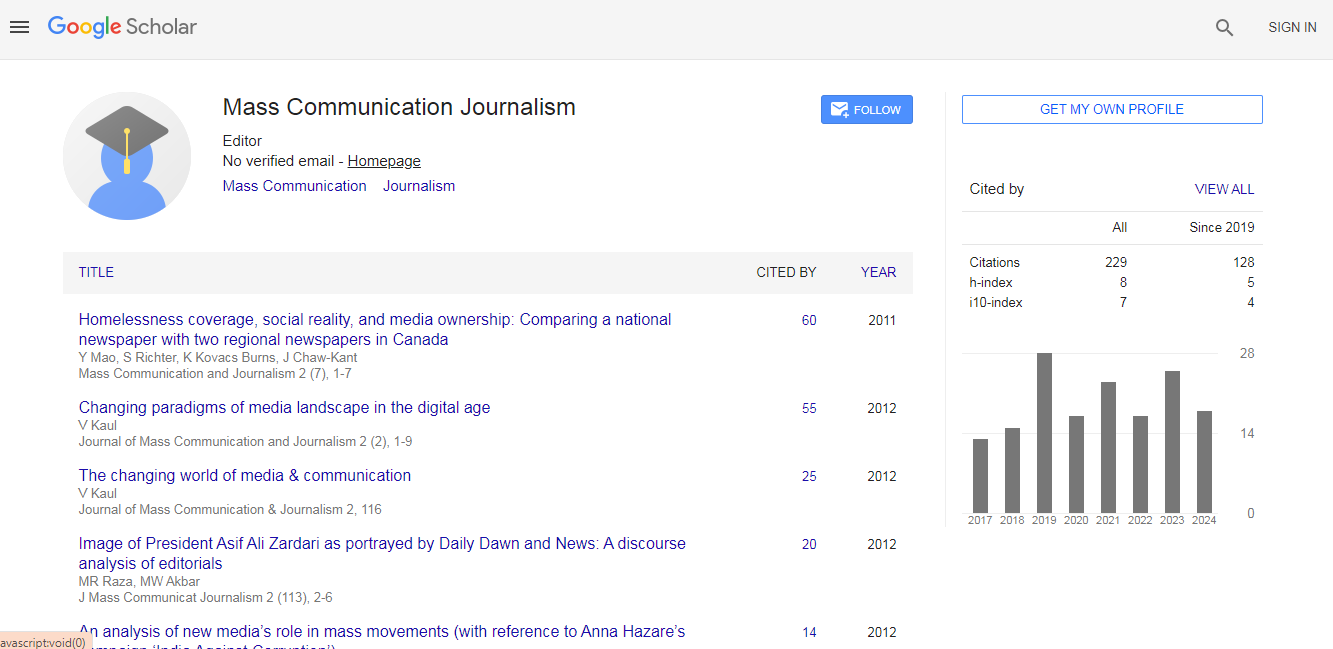
Journal of Mass Communication & Journalism received 205 citations as per Google Scholar report