Commentary - (2025) Volume 14, Issue 5
Received: 02-Oct-2025, Manuscript No. jeom-26-188188;
Editor assigned: 06-Oct-2025, Pre QC No. P-188188;
Reviewed: 20-Oct-2025, QC No. Q-188188;
Revised: 23-Oct-2025, Manuscript No. R-188188;
Published:
30-Oct-2025
, DOI: 10.37421/2169-026X.2025.14.549
Citation: Haddad, Leila. ”Green Entrepreneurship: Driving Sustainable Development and Competitive Advantage.” J Entrepren Organiz Manag 14 (2025):549.
Copyright: © 2025 Haddad L. This is an open-access article distributed under the terms of the Creative Commons Attribution License, which permits unrestricted use, distribution and reproduction in any medium, provided the original author and source are credited.
Green entrepreneurship is fundamentally important for achieving sustainable development by embedding environmental awareness into the core of business operations. This strategic integration fosters innovation in eco-friendly products and services, thereby unlocking new market opportunities and building a competitive edge for businesses [1].
The adoption of sustainable business practices has been demonstrated to positively influence a firm's overall performance. By incorporating environmental and social considerations into their daily operations, companies can achieve better financial results, enhance their brand image, and improve their risk management strategies, signifying the strategic value of sustainability beyond simple compliance [2].
Within the context of small and medium-sized enterprises (SMEs), green innovation plays a critical role in establishing sustainable competitive advantages. SMEs that invest in eco-innovations, both in their products and processes, often reap benefits such as reduced costs, expanded market access, and increased customer loyalty, highlighting the entrepreneurial need for sustainable innovation [3].
Corporate social responsibility (CSR) is intrinsically linked to financial performance, with strong commitments to sustainability initiatives contributing to superior financial returns. This is often a result of factors like an enhanced reputation, improved employee morale, and a reduction in operational risks, reinforcing the business rationale for embracing sustainability [4].
The circular economy model presents a viable and sustainable alternative to conventional linear production methods. Businesses can transition to circular practices by focusing on waste reduction, the reuse of resources, and extending product lifespans, creating entrepreneurial avenues in closed-loop systems that benefit both the environment and economic growth [5].
Consumer adoption of green products is significantly influenced by several key factors, including the perception of consumer effectiveness, personal environmental concern, and prevailing social norms. Businesses that effectively communicate the environmental benefits and value proposition of their green offerings are better positioned for success in this market [6].
Engaging stakeholders is crucial for the successful implementation of sustainable business practices. Active involvement of employees, customers, and communities in sustainability initiatives leads to more effective strategies and greater long-term impact, fostering legitimacy and driving innovation through collaborative approaches [7].
The renewable energy sector presents a landscape of entrepreneurial opportunities shaped by supportive policies, technological advancements, and growing market demand. Navigating the transition to a low-carbon economy requires a strong entrepreneurial spirit to overcome the inherent complexities of this field [8].
Green marketing strategies have a tangible impact on consumer purchase intentions. Transparent and credible green claims, combined with a clear articulation of environmental advantages, significantly influence consumer choices, underscoring the importance of strategic communication in sustainable business models [9].
Social entrepreneurs face the distinct challenge of balancing financial viability with their social and environmental missions. This necessitates innovative business models and funding strategies that support ventures aiming for both profit and positive societal impact, reflecting the unique entrepreneurial journey of those committed to social and environmental well-being [10].
Green entrepreneurship is a vital component of sustainable development, necessitating the integration of environmental consciousness into business models. This approach stimulates innovation in eco-friendly products and services, opening up new market opportunities and enhancing competitive advantage through sustainable practices like resource efficiency and circular economy principles [1].
Research indicates that the adoption of sustainable business practices can significantly improve firm performance. By embedding environmental and social considerations into their core operations, companies can achieve better financial outcomes, strengthen their brand reputation, and enhance their risk management, demonstrating the strategic importance of sustainability [2].
In the realm of small and medium-sized enterprises (SMEs), green innovation is a key driver for developing sustainable competitive advantages. SMEs that invest in product and process innovations with an environmental focus often experience benefits such as cost savings, improved market access, and increased customer loyalty, underlining the entrepreneurial imperative for sustainability [3].
Corporate social responsibility (CSR) is closely associated with positive financial performance. Firms with robust CSR commitments tend to exhibit stronger financial returns, attributed to factors like improved reputation, enhanced employee morale, and reduced operational risks, thereby validating the business case for sustainability [4].
The circular economy model offers a sustainable alternative to traditional linear production systems. Businesses can adopt circular practices by focusing on waste reduction, resource reuse, and enhancing product longevity, which presents entrepreneurial opportunities in developing closed-loop systems that benefit both the environment and economic growth [5].
Consumer choices regarding green products are influenced by perceived consumer effectiveness, environmental concern, and social norms. Effective communication of environmental benefits and value propositions by businesses is crucial for success in the market for sustainable goods [6].
Stakeholder engagement plays a critical role in the successful implementation of sustainable business practices. Collaboration with stakeholders such as employees, customers, and communities leads to more effective sustainability initiatives and a greater long-term impact, boosting legitimacy and innovation [7].
Entrepreneurs in the renewable energy sector face a dynamic environment shaped by policy support, technological progress, and market demand. Success in this sector requires entrepreneurial drive to navigate the transition towards a low-carbon economy [8].
Green marketing strategies significantly influence consumer purchase intentions. Transparent and credible communication of environmental benefits is essential for businesses seeking to attract consumers who prioritize sustainability [9].
Social entrepreneurs strive to balance financial sustainability with their social and environmental objectives. This often requires innovative business models and funding mechanisms to support ventures that aim for both profit and positive impact, highlighting the unique entrepreneurial path of impact-driven ventures [10].
Green entrepreneurship is essential for sustainable development, driving innovation and competitive advantage through eco-friendly business models. Adopting sustainable practices enhances firm performance, reputation, and risk management, particularly for SMEs. The circular economy offers a sustainable alternative, while green marketing and consumer demand shape the market. Stakeholder engagement and entrepreneurial spirit are crucial for navigating the transition to a low-carbon economy and balancing profit with purpose in social entrepreneurship.
None
None
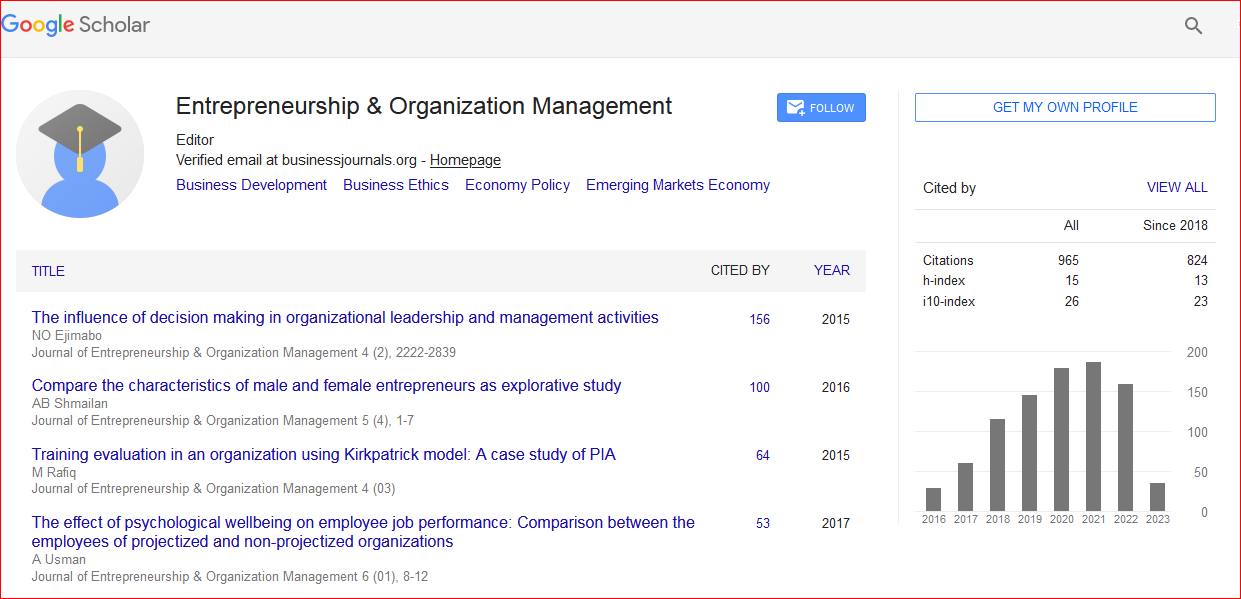
Entrepreneurship & Organization Management received 1115 citations as per Google Scholar report