Opinion - (2025) Volume 12, Issue 2
Received: 01-Apr-2025, Manuscript No. jreac-26-185800;
Editor assigned: 03-Apr-2025, Pre QC No. P-185800;
Reviewed: 17-Apr-2025, QC No. Q-185800;
Revised: 22-Apr-2025, Manuscript No. R-185800;
Published:
29-Apr-2025
, DOI: 10.37421/2380-2391.2025.12.419
Citation: Martinez, Sofia. ”Green Analytical Chemistry For Environmental Monitoring Innovations.” J Environ Anal Chem 12 (2025):419.
Copyright: © 2025 Martinez S. This is an open-access article distributed under the terms of the Creative Commons Attribution License, which permits unrestricted use, distribution and reproduction in any medium, provided the original author and source are credited.
The imperative for sustainable practices in environmental analysis has become increasingly prominent, driving the evolution of Green Analytical Chemistry (GAC) into a critical discipline for safeguarding planetary health. GAC principles, such as minimizing waste, employing less hazardous solvents, and optimizing energy efficiency, are foundational to reducing the environmental footprint of analytical processes. Novel GAC approaches are continually being developed to enhance the detection capabilities for pollutants, thereby facilitating more effective and responsible environmental stewardship. This foundational work on GAC in environmental monitoring sets the stage for a paradigm shift in how analytical chemistry contributes to sustainability efforts. [1] In parallel, the field of biosensing has seen significant advancements, particularly in their adaptation to GAC principles for detecting environmental contaminants. Biosensors offer remarkable sensitivity and selectivity, often requiring minimal sample preparation and reduced solvent usage, aligning perfectly with green chemistry objectives. Their inherent sustainability advantages, including portability and the potential for on-site analysis, are crucial for reducing logistical burdens and associated emissions in environmental surveillance. These developments highlight a promising avenue for efficient and eco-friendly contaminant detection. [2] The search for greener alternatives to traditional organic solvents is another vital area within GAC. Ionic liquids and deep eutectic solvents have emerged as promising replacements in analytical extraction and chromatography for environmental samples. These novel solvent systems not only improve extraction efficiency but also reduce toxicity and enable greener separation techniques, offering substantial environmental benefits and enhanced analytical performance. Their application in analyzing persistent organic pollutants and heavy metals underscores their practical utility. [3] The integration of microfluidic devices and lab-on-a-chip technology with GAC principles represents a significant leap forward for on-site environmental monitoring. These miniaturized analytical systems drastically reduce reagent consumption, energy usage, and waste generation, making them highly sustainable. The development of portable devices for rapid pollutant detection has the potential to revolutionize environmental surveillance by enabling immediate data acquisition and minimizing the need for sample transportation. [4] Innovative green chromatographic techniques, such as supercritical fluid chromatography (SFC) and ultra-high-performance liquid chromatography (UHPLC) utilizing sustainable mobile phases, are being increasingly applied in environmental analysis. These methods offer faster separations, reduced solvent consumption, and lower energy requirements compared to conventional techniques. Their effectiveness in analyzing complex environmental matrices for a range of emerging contaminants is well-documented, showcasing their value. [5] Sample preparation, often a bottleneck in terms of waste generation and reagent consumption, is also benefiting from GAC approaches. The use of heterogeneous catalysis in sample preparation for environmental monitoring exemplifies this trend. Developing efficient and recyclable heterogeneous catalysts can replace harsh chemical reagents, leading to reduced waste and improved safety. Their application in pre-treating environmental samples for pesticide and pharmaceutical analysis demonstrates practical benefits. [6] Greener extraction techniques, including microwave-assisted extraction (MAE) and ultrasound-assisted extraction (UAE), are proving to be sustainable alternatives for environmental sample analysis. These methods significantly reduce extraction times, solvent consumption, and energy input while often improving extraction efficiency. Their effectiveness in extracting various classes of contaminants from both solid and liquid environmental matrices highlights their broad applicability. [7] The development of nanomaterial-based sensors aligned with GAC principles is another exciting area for environmental monitoring. Nanomaterials can enhance sensor performance, leading to increased sensitivity and selectivity for pollutant detection. Furthermore, they enable miniaturization and reduced reagent use, contributing to the overall sustainability of sensing platforms. The application of green nanobiosensors for detecting heavy metals and organic contaminants showcases their potential. [8] A comprehensive review of green analytical methodologies for detecting emerging contaminants in environmental matrices reveals the latest advancements in GAC. This includes methods that minimize waste, utilize renewable resources, and reduce energy consumption. The overview of techniques such as greener extraction, chromatography, and sensing emphasizes their crucial role in sustainable environmental protection and regulatory compliance. [9] Finally, the integration of chemometrics with GAC offers powerful tools for optimizing environmental monitoring strategies. Multivariate data analysis can refine green analytical methods, leading to more efficient and informative environmental assessments. The synergy between GAC principles and chemometric tools enhances sample throughput, reduces method development time, and maximizes information extraction while minimizing the environmental footprint. [10]
Green Analytical Chemistry (GAC) is revolutionizing environmental monitoring by prioritizing sustainability in analytical processes. The core tenets of GACâ??reducing waste, using safer solvents, and developing energy-efficient methodsâ??are essential for minimizing the environmental impact of analytical procedures. Novel GAC approaches are continuously being explored to boost the sensitivity, selectivity, and speed of pollutant detection, thereby facilitating more robust and environmentally responsible management practices. The focus on specific GAC techniques applied to water and soil analysis demonstrates their superiority over conventional, less sustainable methods, marking a significant advancement in the field. [1] Biosensors, when designed and applied with GAC principles in mind, present a highly sustainable solution for detecting environmental contaminants. These devices offer superior sensitivity and selectivity while requiring less sample preparation and solvent usage. The sustainability advantages of biosensor technology, including their portability and suitability for on-site analysis, are paramount. By reducing the need for sample transportation and complex laboratory infrastructure, they significantly cut down on logistical costs and environmental emissions, paving the way for more efficient and eco-friendly monitoring. [2] The exploration of novel solvent systems is a cornerstone of GAC. Ionic liquids and deep eutectic solvents are emerging as environmentally benign alternatives to conventional organic solvents used in analytical extraction and chromatography. These advanced solvent systems not only enhance extraction efficiency but also mitigate toxicity concerns and enable the development of greener separation techniques. Their successful application in the analysis of persistent organic pollutants and heavy metals underscores their significant contribution to both analytical performance and environmental protection. [3] Microfluidic devices and lab-on-a-chip technologies, when integrated with GAC, are transforming on-site environmental monitoring. These miniaturized analytical platforms are designed to drastically reduce the consumption of reagents and energy, while simultaneously minimizing waste generation. The development of portable systems for the rapid detection of water pollutants is particularly noteworthy, offering the potential to revolutionize environmental surveillance by providing immediate data and alleviating the reliance on extensive sample transportation and elaborate laboratory setups. [4] In chromatography, the adoption of green techniques such as supercritical fluid chromatography (SFC) and ultra-high-performance liquid chromatography (UHPLC) with sustainable mobile phases is gaining traction for environmental analysis. These methods are characterized by their faster separation times, reduced solvent requirements, and lower energy consumption compared to traditional chromatographic approaches. Their proven efficacy in analyzing complex environmental samples for a variety of emerging contaminants highlights their importance in sustainable analytical practices. [5] Sample preparation, an often resource-intensive step, is being made greener through innovations like heterogeneous catalysis. The development of efficient and recyclable heterogeneous catalysts offers a sustainable alternative to conventional, harsher chemical reagents. This approach leads to a significant reduction in waste generation and an improvement in operational safety. The successful application of these catalytic methods in the pre-treatment of environmental samples for the analysis of pesticides and pharmaceuticals demonstrates their practical value in a GAC context. [6] Advanced extraction methodologies, specifically greener techniques such as microwave-assisted extraction (MAE) and ultrasound-assisted extraction (UAE), are providing sustainable solutions for environmental sample analysis. These methods are recognized for their ability to shorten extraction times, decrease solvent usage, and lower energy demands, frequently accompanied by enhanced extraction yields. Their demonstrated effectiveness across a range of contaminant classes and environmental matrices highlights their versatility. [7] The integration of nanomaterials into sensor development for environmental monitoring, guided by GAC principles, is yielding highly effective analytical tools. Nanomaterials are instrumental in boosting sensor performance, leading to enhanced sensitivity and specificity in pollutant detection, while also facilitating miniaturization and reduced reagent usage. The design and application of green nanobiosensors for identifying heavy metals and organic contaminants in water samples exemplify the sustainability benefits of this approach. [8] A comprehensive review of green analytical methodologies for the detection of emerging contaminants in environmental matrices provides valuable insights into the latest GAC advancements. The focus is on techniques that minimize waste production, leverage renewable resources, and reduce energy intensity. The overview of greener extraction, chromatography, and sensing techniques underscores their indispensable role in promoting sustainable environmental protection and ensuring regulatory compliance. [9] Chemometrics plays a crucial role in advancing GAC for environmental monitoring by enabling the optimization of analytical methods. Multivariate data analysis techniques can significantly enhance the efficiency and informativeness of environmental assessments conducted using green analytical approaches. The synergistic combination of GAC principles and chemometric tools leads to improvements in sample throughput, reductions in method development timelines, and the extraction of maximum analytical insight, all while minimizing the environmental footprint. [10]
This collection of research explores the multifaceted applications of Green Analytical Chemistry (GAC) in environmental monitoring. Key areas include the development of sustainable analytical processes, the use of biosensors and nanomaterial-based sensors for contaminant detection, and the implementation of greener solvents and extraction techniques. Innovations in microfluidics, lab-on-a-chip technology, and heterogeneous catalysis are also highlighted as ways to reduce waste, energy consumption, and the use of hazardous materials. Advanced chromatographic methods and the integration of chemometrics further enhance the efficiency and sustainability of environmental analysis, crucial for detecting emerging contaminants and ensuring regulatory compliance. The overarching goal is to achieve more effective and responsible environmental management through eco-friendly analytical practices.
None
None
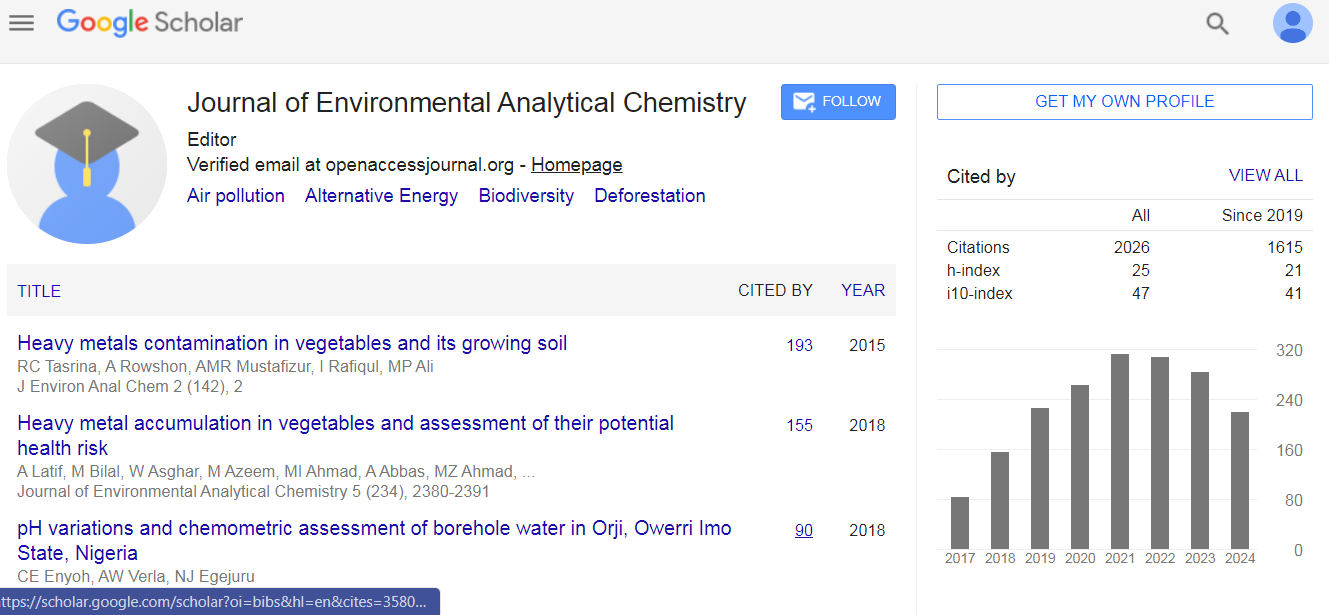
Journal of Environmental Analytical Chemistry received 1781 citations as per Google Scholar report