Short Communication - (2025) Volume 16, Issue 6
Received: 01-Dec-2025, Manuscript No. jar-25-177637;
Editor assigned: 03-Dec-2025, Pre QC No. P-177637;
Reviewed: 17-Dec-2025, QC No. Q-177637;
Revised: 22-Dec-2025, Manuscript No. R-177637;
Published:
29-Dec-2025
, DOI: 10.37421/2155-6113.2025.16.1099
Citation: Pappas, George. ”Government Policies and Funding
Drive HIV Prevention.” J AIDS Clin Res 16 (2025):1099.
Copyright: © 2025 Pappas G. This is an open-access article distributed under the terms of the Creative Commons Attribution License, which permits unrestricted use,
distribution and reproduction in any medium, provided the original author and source are credited.
This article examines the critical role of national health policies and government funding in driving HIV prevention efforts across sub-Saharan Africa. It highlights how robust policy frameworks and sustained financial commitments are essential for effective program implementation, influencing resource allocation and ultimately impacting public health outcomes in the region[1].
This paper explores how the governance of the global HIV response is changing, focusing on the dynamic interaction between international health initiatives and national accountability mechanisms. It unpacks the implications of these shifts for effective HIV prevention and care, emphasizing the need for adaptable governance structures to meet evolving challenges[2].
This analysis details state-level funding allocations for HIV prevention across the United States between 2018 and 2020. It reveals disparities in financial commitment among states and underscores the critical impact of government investment on the reach and effectiveness of local HIV prevention programs[3].
This article provides an overview of global advancements and persistent obstacles in the policy and implementation of HIV pre-exposure prophylaxis (PrEP). It emphasizes how governmental decisions, funding, and regulatory frameworks are pivotal in determining PrEP access and uptake worldwide, especially in high-burden settings[4].
This systematic review assesses the effectiveness of national HIV prevention programs in reducing HIV incidence in low- and middle-income countries. It highlights that well-designed and adequately resourced government-led programs are crucial, but their impact varies significantly based on contextual factors and implementation fidelity[5].
This case study from India investigates the essential role of government funding in ensuring the long-term sustainability of HIV services, particularly for key populations. It argues that consistent and dedicated government financial support is indispensable for maintaining and scaling up effective prevention and care interventions[6].
This scoping review examines methodologies used to evaluate the impact of national HIV prevention policies on health outcomes. It identifies gaps in current evaluation practices and emphasizes the need for more rigorous, government-supported research to truly understand and improve policy effectiveness[7].
This systematic review analyzes governmental approaches, including policy and legislative frameworks, used to address HIV-related stigma and discrimination. It underscores that strong governmental commitment through legal and policy measures is fundamental for creating supportive environments crucial for effective HIV prevention[8].
This systematic review and meta-analysis quantifies the economic benefits of investing in HIV prevention programs. It demonstrates that governmental and public health investments in prevention yield substantial returns, making a strong economic case for continued and increased funding to avert future healthcare costs and improve societal well-being[9].
This paper discusses the critical role of policy and governance in achieving the ambitious 95-95-95 targets set to end the HIV epidemic. It argues that effective government leadership, comprehensive policies, and robust governance structures are indispensable for translating global targets into tangible prevention and treatment successes on the ground[10].
National health policies and government funding play a critical role in driving HIV prevention efforts, particularly across sub-Saharan Africa, where robust policy frameworks and sustained financial commitments prove essential for effective program implementation, influencing resource allocation and ultimately impacting public health outcomes in the region [1]. Similarly, an analysis of state-level funding for HIV prevention in the United States between 2018 and 2020 detailed disparities in financial commitment among states. This work underscored the critical impact of government investment on the reach and effectiveness of local prevention programs [3]. Studies also confirm the importance of national HIV prevention programs in low- and middle-income countries. These highlight that well-designed and adequately resourced government-led programs are crucial, though their impact varies significantly based on contextual factors and implementation fidelity [5].
The governance of the global HIV response is continually shifting, with a dynamic interaction between international health initiatives and national accountability mechanisms [2]. These shifts have implications for effective HIV prevention and care, emphasizing the need for adaptable governance structures to meet evolving challenges [2]. Concurrently, global advancements and persistent obstacles exist in the policy and implementation of HIV pre-exposure prophylaxis (PrEP). Governmental decisions, funding, and regulatory frameworks are pivotal in determining PrEP access and uptake worldwide, especially in high-burden settings, demonstrating the direct influence of policy on intervention success [4].
The long-term sustainability of HIV services, particularly for key populations, relies heavily on government funding. A case study from India highlighted that consistent and dedicated government financial support is indispensable for maintaining and scaling up effective prevention and care interventions [6]. Beyond sustainability, there's a strong economic argument for governmental investment. A systematic review and meta-analysis quantified the economic benefits of investing in HIV prevention programs, demonstrating that these public health investments yield substantial returns. This evidence builds a robust economic case for continued and increased funding to avert future healthcare costs and improve societal well-being [9].
Evaluating the impact of national HIV prevention policies on health outcomes is an ongoing area of focus. Methodologies for this evaluation have been examined, identifying gaps in current practices and emphasizing the need for more rigorous, government-supported research to truly understand and improve policy effectiveness [7]. Moreover, governmental approaches, including policy and legislative frameworks, are crucial for addressing HIV-related stigma and discrimination. Strong governmental commitment through legal and policy measures creates supportive environments, which are fundamental for effective HIV prevention efforts [8].
Ultimately, policy and governance hold a critical role in achieving ambitious targets like the 95-95-95 goals set to end the HIV epidemic. Effective government leadership, comprehensive policies, and robust governance structures are indispensable for translating global targets into tangible prevention and treatment successes on the ground [10].
Governmental policies and funding are paramount for the effectiveness and sustainability of HIV prevention efforts globally. Robust national health policies and sustained financial commitments, as seen in sub-Saharan Africa, are essential for implementing programs, allocating resources, and achieving positive public health outcomes [1]. Disparities in state-level funding, such as those observed in the United States, directly impact the reach and success of local HIV prevention initiatives [3]. The evolving landscape of global HIV governance requires adaptable structures to interact effectively with national accountability mechanisms, ensuring relevant prevention and care [2]. Governmental decisions and regulatory frameworks are also pivotal for the global access and uptake of interventions like pre-exposure prophylaxis (PrEP), especially in high-burden areas [4]. Well-designed and adequately resourced government-led programs significantly reduce HIV incidence in low- and middle-income countries, though context and implementation fidelity matter [5]. Consistent government funding is indispensable for the long-term sustainability of HIV services, particularly for key populations, as shown by studies in India [6]. Critically, economic analyses confirm that investments in HIV prevention yield substantial returns, making a strong case for increased funding to avert future healthcare costs and improve societal well-being [9]. Efforts to evaluate national policies and address HIV-related stigma through strong governmental legal and policy measures are fundamental for creating supportive environments and improving effectiveness [7, 8]. Ultimately, effective government leadership and comprehensive governance structures are vital for achieving global targets to end the HIV epidemic [10].
Indexed at, Google Scholar, Crossref
Indexed at, Google Scholar, Crossref
Indexed at, Google Scholar, Crossref
Indexed at, Google Scholar, Crossref
Indexed at, Google Scholar, Crossref
Indexed at, Google Scholar, Crossref
Indexed at, Google Scholar, Crossref
Indexed at, Google Scholar, Crossref
Indexed at, Google Scholar, Crossref
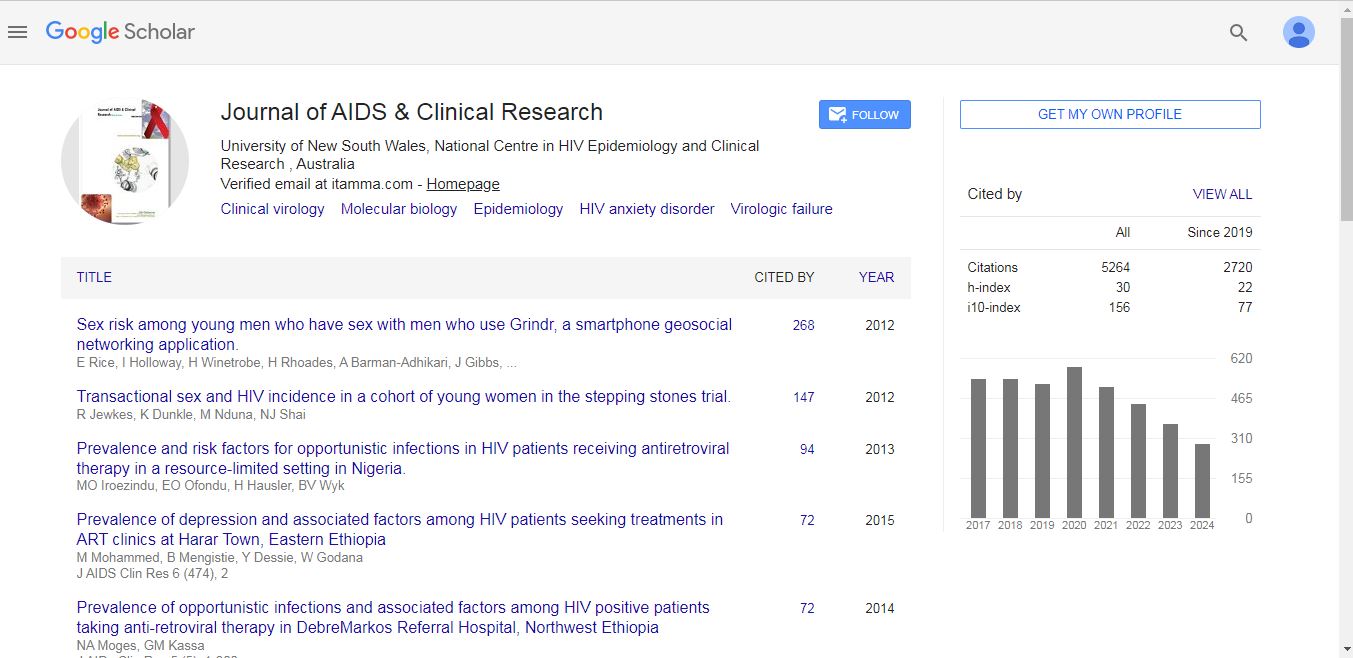
Journal of AIDS & Clinical Research received 5264 citations as per Google Scholar report