Short Communication - (2025) Volume 16, Issue 4
Received: 01-Jul-2025, Manuscript No. hycr-25-174945;
Editor assigned: 03-Jul-2025, Pre QC No. P-174945;
Reviewed: 17-Jul-2025, QC No. Q-174945;
Revised: 22-Jul-2025, Manuscript No. R-174945;
Published:
29-Jul-2025
, DOI: 10.37421/2157-7587.2025.16.611
Citation: Klein, Tobias. ”Global River Flows: Climate, Humans, Adaptive Management.” Hydrol Current Res 16 (2025):611.
Copyright: © 2025 Klein T. This is an open-access article distributed under the terms of the Creative Commons Attribution License, which permits unrestricted use, distribution
and reproduction in any medium, provided the original author and source are credited.
Understanding the intricate dynamics of global river flow is paramount for environmental sustainability and human well-being. Rivers, as vital components of the Earth's hydrological cycle, are highly susceptible to changes driven by both natural processes and anthropogenic pressures. Recent scholarly works have significantly advanced our comprehension of the various factors influencing river regimes, from large-scale climatic shifts to localized human interventions and innovative measurement techniques. A comprehensive review highlights how global river flow responds to climate change, including shifts in precipitation and temperature affecting snowmelt, alongside human activities such as dam construction, irrigation, and land use practices. Both factors significantly alter hydrological regimes, leading to increased flow variability, which emphasizes the need for integrated water management strategies and advanced modeling to predict future river flow dynamics under evolving global change scenarios [1].
Further regional assessments provide specific insights into these impacts. For example, a study focusing on the Dongjiang River basin in China employs hydrological models and climate projections to evaluate how future climate change could alter river flow and sediment transport. Findings reveal significant changes in flow regimes and increased sediment loads under various climate scenarios, underscoring the necessity for robust water resource management and erosion control strategies to mitigate ecological and socio-economic impacts in the region [2].
Beyond climate change, the rapid pace of urbanization exerts substantial pressure on river systems. A global review synthesizes the effects of urban expansion on river flow patterns and associated aquatic ecosystems, demonstrating that it often leads to increased peak flows, reduced base flows, and altered hydrological connectivity. These alterations profoundly impact biodiversity, water quality, and ecosystem services, emphasizing the urgent need for sustainable urban planning and green infrastructure solutions to mitigate these adverse hydrological and ecological consequences [3].
Advancements in observational techniques are also transforming our ability to monitor river systems globally. A novel global dataset for river discharge derived from satellite observations offers unprecedented spatial and temporal coverage. This research details the methodology for processing satellite altimetry and imagery data to estimate river flow, validating the dataset against in-situ measurements. It highlights the dataset's utility for hydrological modeling, water resource management, and climate change studies, especially in ungauged basins where conventional measurements are scarce [4].
The consequences of global warming are particularly evident in the increased intensity and frequency of extreme hydrological events. One study investigates the projected shifts in global extreme river flow events, such as floods and droughts, under 1.5 °C and 2.0 °C global warming scenarios. The findings suggest a significant increase in the frequency and intensity of both extreme high and low flows across many regions, posing severe challenges to water security, infrastructure, and ecosystems. This research underscores the critical need for proactive adaptation strategies to manage these intensifying hydrological extremes [5].
To refine our understanding of causative factors, specific analyses quantify the separate and combined effects of climate change and human activities on river flow in different hydroclimatic regions. Research from China, utilizing advanced decomposition methods, attributes observed flow alterations to factors like altered precipitation patterns, temperature increases, and direct human interventions such as reservoir operations and irrigation. The study often points to the dominant role of human activities in many regions, emphasizing the need for targeted water management policies that consider regional specificities [6].
Beyond quantifying impacts, there is a growing recognition of the importance of maintaining ecological integrity. A global synthesis provides a comprehensive overview of ecological flow regimes and their application in river restoration and management. It highlights how maintaining natural flow variability, including characteristic magnitudes, frequencies, durations, timing, and rates of change, is crucial for preserving riverine biodiversity and ecosystem functions. The article advocates for adaptive management frameworks that integrate socio-economic considerations with scientific understanding of hydrological processes to achieve sustainable river health [7].
The hidden dynamics beneath the surface also play a critical role. A global assessment of groundwater-surface water interactions reveals their importance in shaping river flow regimes, particularly baseflow and recession limbs. It demonstrates how subsurface hydrological processes buffer extreme events and maintain river flow during dry periods, influencing stream temperature, water chemistry, and ecological health. This research underscores the need to integrate groundwater dynamics into hydrological models and water resource management strategies for a holistic understanding of river systems [8].
Large-scale infrastructure projects, while serving human needs, often have profound ecological consequences. The extensive reservoir operations in the Mekong River Basin exemplify such impacts, demonstrating how upstream dams significantly alter natural flow regimes, reduce sediment loads, and change water levels. This leads to downstream delta degradation, altered ecosystems, and negative impacts on local livelihoods. The research calls for transboundary cooperation and integrated water resource planning to mitigate the cumulative effects of hydropower development [9].
Finally, innovative solutions are being explored to counter the adverse effects of urbanization. A review investigates the effectiveness of green infrastructure (GI) in mitigating alterations to urban river flow regimes. It synthesizes findings on how GI elements like green roofs, permeable pavements, and rain gardens can reduce stormwater runoff, increase infiltration, and restore more natural hydrological pathways, thereby decreasing peak flows and improving water quality in urban rivers. The paper advocates for wider implementation of GI as a sustainable solution for urban water management and ecological restoration [10].
River systems globally face unprecedented challenges as they respond to a combination of climate change and intensified human activities. These multifaceted pressures lead to significant alterations in hydrological regimes, impacting not only water quantity but also quality, sediment transport, and ecosystem health. Understanding these complex interactions is crucial for developing effective management and adaptation strategies.
A key focus of current research involves discerning the primary drivers of these changes. Climate change, with its direct influence on precipitation patterns, temperature, and snowmelt, is a major factor altering global river flows, often increasing their variability. Concurrently, human activities like dam construction, extensive irrigation, and diverse land use practices contribute significantly to these hydrological shifts [1]. In particular, studies in China have successfully quantified the distinct and combined effects of climate change and human activities, revealing that human interventions frequently play a dominant role in reshaping regional river flows, thereby necessitating specific, localized water management policies [6]. The Dongjiang River basin serves as a regional example where future climate change is projected to dramatically alter both flow regimes and sediment transport, underscoring the urgent need for robust water resource and erosion control strategies [2].
The impacts of these alterations are far-reaching, affecting both natural ecosystems and human societies. Urbanization, for instance, demonstrably leads to increased peak flows and reduced base flows in rivers, disrupting natural hydrological connectivity and negatively affecting aquatic biodiversity, water quality, and critical ecosystem services. This highlights a pressing need for sustainable urban planning and the integration of green infrastructure [3]. Moreover, the increasing frequency and intensity of extreme river flow events, such as floods and droughts, are a direct consequence of global warming, even under modest 1.5 °C and 2.0 °C warming scenarios. These extremes pose severe risks to water security, infrastructure, and ecological stability, emphasizing the immediate need for proactive adaptation strategies [5]. Large-scale infrastructure like reservoirs also profoundly impact river systems; the Mekong River Basin, for example, illustrates how dam operations drastically modify natural flow regimes, reduce crucial sediment loads, and alter water levels, resulting in delta degradation and impacts on local livelihoods. This situation calls for enhanced transboundary cooperation and integrated planning [9].
To better address these challenges, advancements in both data collection and modeling are critical. A novel global dataset for river discharge, derived from satellite observations, offers invaluable spatial and temporal coverage. This dataset, processed from altimetry and imagery data, proves particularly useful for hydrological modeling and water resource management in ungauged basins, which are traditionally difficult to monitor [4]. Furthermore, a holistic understanding of river systems requires integrating overlooked components, such as groundwater-surface water interactions. Global analyses reveal that these subsurface processes are essential for shaping baseflow and recession limbs, buffering extreme events, and maintaining flow during dry periods, while also influencing stream temperature and water chemistry. Incorporating groundwater dynamics into hydrological models is therefore crucial [8].
In response to these pervasive issues, a range of management and restoration strategies are being explored. The concept of ecological flow regimes is gaining prominence, emphasizing the importance of maintaining natural flow variabilityâ??including magnitudes, frequencies, durations, timing, and rates of changeâ??to preserve riverine biodiversity and ecosystem functions. Adaptive management frameworks that consider both socio-economic factors and scientific hydrological understanding are advocated for achieving sustainable river health [7]. Crucially, for urban areas, green infrastructure offers a promising solution. Review findings indicate that elements like green roofs, permeable pavements, and rain gardens can effectively mitigate urban river flow changes by reducing stormwater runoff and enhancing infiltration, thereby decreasing peak flows and improving water quality. Promoting wider implementation of green infrastructure represents a sustainable approach for urban water management and ecological restoration [10]. Collectively, these studies underscore a global imperative for integrated, adaptive, and technologically informed approaches to sustain our vital river systems in the face of ongoing environmental change.
Global river flow dynamics are undergoing significant transformations due to a complex interplay of climate change and human activities. Climate change, characterized by shifts in precipitation and temperature, impacts snowmelt and leads to increased variability in river flows, including more frequent and intense extreme events like floods and droughts. These changes pose substantial challenges to water security, infrastructure, and ecosystems worldwide. Simultaneously, human interventions such as dam construction, irrigation, and land use modifications profoundly alter hydrological regimes. Urbanization, in particular, contributes to increased peak flows and reduced base flows, negatively affecting aquatic ecosystems. Efforts to understand and manage these changes are diverse. Researchers are using advanced hydrological models and climate projections to assess regional impacts, for example, in the Dongjiang River basin, highlighting the need for robust water resource management and erosion control. Studies in China have quantified the relative contributions of climate change and human activities, often finding a dominant role for human interventions in altering regional flow patterns, necessitating targeted water policies. The importance of maintaining natural flow variability is emphasized for preserving riverine biodiversity and ecosystem functions, advocating for adaptive management strategies. New data sources, such as global river discharge datasets derived from satellite observations, are proving crucial for hydrological modeling and management, especially in areas lacking traditional measurements. Furthermore, understanding groundwater-surface water interactions is vital, as these subsurface processes buffer extreme events and sustain flows during dry periods. Sustainable solutions include the widespread implementation of green infrastructure in urban areas to mitigate altered urban river flows, restoring more natural hydrological pathways. The collective understanding from these studies underscores an urgent need for integrated, adaptive, and regionally specific approaches to address the evolving challenges in river management.
None
None
Indexed at, Google Scholar, Crossref
Indexed at, Google Scholar, Crossref
Indexed at, Google Scholar, Crossref
Indexed at, Google Scholar, Crossref
Indexed at, Google Scholar, Crossref
Indexed at, Google Scholar, Crossref
Indexed at, Google Scholar, Crossref
Indexed at, Google Scholar, Crossref
Indexed at, Google Scholar, Crossref
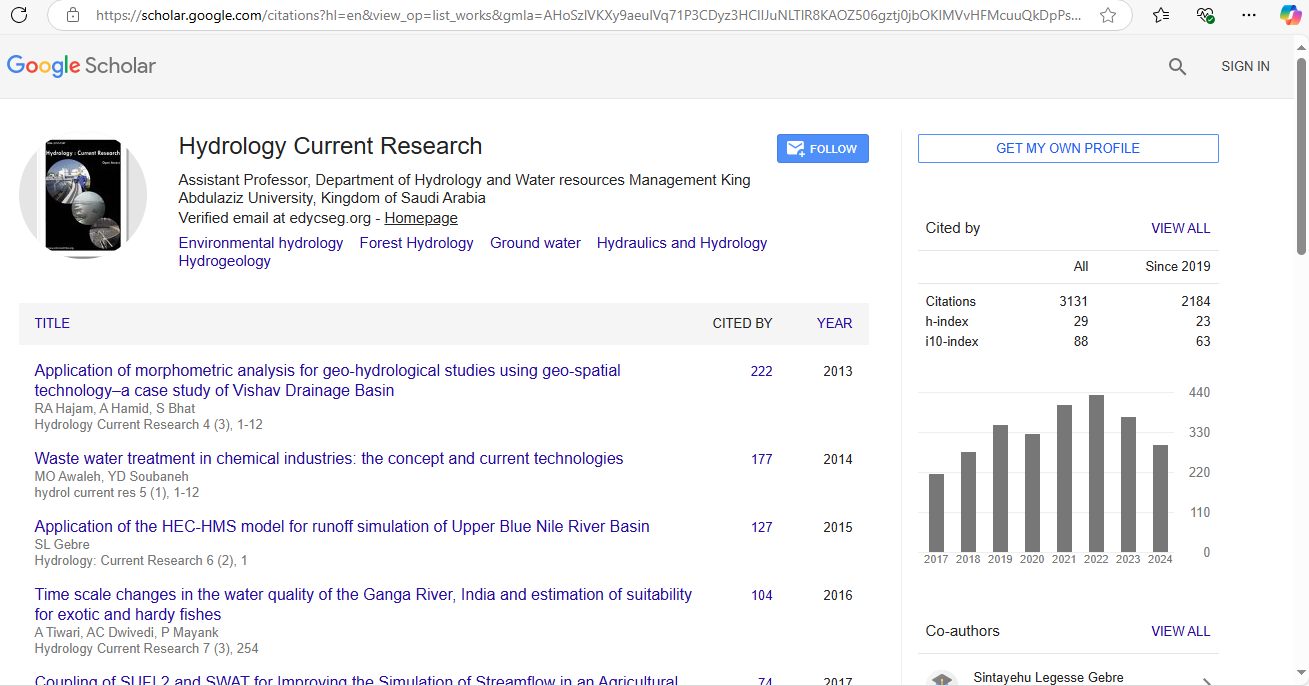
Hydrology: Current Research received 2843 citations as per Google Scholar report