Opinion - (2025) Volume 16, Issue 4
Received: 01-Jul-2025, Manuscript No. hycr-25-174942;
Editor assigned: 03-Jul-2025, Pre QC No. P-174942;
Reviewed: 17-Jul-2025, QC No. Q-174942;
Revised: 22-Jul-2025, Manuscript No. R-174942;
Published:
29-Jul-2025
, DOI: 10.37421/2157-7587.2025.16.609
Citation: Yusuf, Lina. ”Global River Flows: Changing Regimes, Urgent Management.” Hydrol Current Res 16 (2025):609.
Copyright: © 2025 Yusuf L. This is an open-access article distributed under the terms of the Creative Commons Attribution License, which permits unrestricted use, distribution
and reproduction in any medium, provided the original author and source are credited
The Earth's river flow regimes are undergoing profound transformations, driven by a complex interplay of climate variability and pervasive human activities. Understanding these changes is crucial for sustainable water resource management and preserving ecological integrity. Across the Tibetan Plateau, for example, research shows that climate change primarily dictates shifts in peak flow timing and magnitude, while human interventions such as dam construction and extensive irrigation significantly alter base flow conditions and overall water availability, resulting in intricate and geographically diverse impacts on regional water resources [1].
This global perspective on river discharge trends from 1950 to 2018 reinforces that both climate variability and human actions are key drivers of observed changes. Significant regional disparities exist; some basins experience increased discharge due to heightened precipitation, whereas others see declines largely attributed to rising water consumption for agricultural and industrial purposes [4].
In many river basins globally, human activities often exert a more dominant and localized influence on hydrological patterns than climate change alone. This leads to altered flood frequencies, reduced low flows, and widespread ecosystem degradation [8].
A critical consequence of these shifts is the global trend toward more intensified short-term extreme rainfall and streamflow events. Rising global temperatures contribute to more frequent and intense hydrological extremes, presenting substantial challenges for effective flood management and strategic water resource planning, particularly in densely populated regions worldwide [2].
Looking ahead, projections for global river flow components under CMIP6 climate scenarios reveal substantial shifts across various regions. These future conditions indicate increased hydrological variability, with certain areas experiencing higher extreme flows while others face reduced water availability, underscoring the necessity for adaptive water management strategies [7].
Urbanization further exacerbates these natural changes by fundamentally altering river flow regimes. The proliferation of impervious surfaces accelerates runoff and diminishes groundwater recharge. This global review highlights how these urban-induced modifications lead to more frequent and intense flash floods, lower base flows, and degraded aquatic habitats, emphasizing the urgent need for integrated urban water management strategies that prioritize ecological integrity [3].
Moreover, specific regional vulnerabilities, such as drought propagation in the Yellow River Basin, show that severe and prolonged meteorological droughts are intensified by soil moisture deficits. This results in significant reductions in river flow and worsens water scarcity, clearly indicating the need for robust drought monitoring and mitigation strategies in such sensitive regions [6].
Maintaining river ecosystem health in the face of these changes requires a deep understanding of ecological flow requirements. A global meta-analysis reveals how altered flow regimes detrimentally affect biodiversity, water quality, and habitat structure. It strongly advocates for integrating ecological flow considerations into water resource management to effectively preserve riverine ecosystems [5].
To this end, an environmental flow assessment framework has been developed, exemplified by a case study in the Han River Basin, China. This framework integrates hydrological modeling with ecological requirements to define minimum flow thresholds, proving crucial for balancing human water demands with the preservation of aquatic biodiversity and essential ecosystem functions under evolving climatic conditions [9].
Addressing these complex challenges necessitates advanced tools for monitoring and forecasting. Here's the thing, deep learning techniques are now proving superior to traditional methods for daily river flow forecasting, effectively capturing complex hydrological patterns. This advancement holds promise for improving accuracy, interpretability, and operational implementation in real-time flood prediction and water resource management [10].
The collective insights from these studies underscore the urgent global need for comprehensive, integrated, and adaptive approaches to manage river systems in a rapidly changing world.
The dynamics of global river flow regimes are undergoing significant transformations, primarily driven by the dual pressures of climate variability and extensive human activities. Evidence from various studies consistently points to these two factors as the dominant forces reshaping hydrological patterns worldwide. For instance, research conducted on the Tibetan Plateau highlights a clear distinction: climate change largely influences the timing and magnitude of peak flows, while human interventions, such as dam construction and irrigation, are responsible for altering base flow conditions and overall water availability. This leads to complex and regionally varied impacts on water resources [1]. Similarly, a comprehensive analysis of global river discharge trends from 1950 to 2018 confirms that both climate variability and human consumption are crucial drivers. This analysis revealed distinct regional differences, where some basins experienced increased discharge due to greater precipitation, while others saw declines driven primarily by agricultural and industrial water consumption [4]. Globally, human activities often exert a more localized and dominant influence on hydrological patterns, leading to altered flood frequencies, reduced low flows, and degradation of riverine ecosystems [8].
Climate change is profoundly impacting the intensity and frequency of hydrological events. There's a global trend of intensified short-term extreme rainfall and streamflow events directly attributable to warming temperatures. These changes result in more frequent and intense hydrological extremes, creating significant challenges for flood management and water resource planning across the globe, especially in densely populated areas [2]. Projections based on CMIP6 climate scenarios indicate substantial future shifts in global river flow components, including streamflow, baseflow, and quickflow, across diverse regions. These findings suggest increased hydrological variability, with some areas facing higher extreme flows and others experiencing reduced water availability, necessitating proactive and adaptive water management strategies to mitigate these future conditions [7]. The propagation of droughts, as studied in the Yellow River Basin, further illustrates the climate's impact, showing that severe meteorological droughts are amplified by soil moisture deficits, leading to significant reductions in river flow and exacerbating water scarcity [6].
Beyond climate, human development, particularly urbanization, fundamentally alters natural river flow regimes. The expansion of impervious surfaces in urban areas accelerates runoff and reduces the natural recharge of groundwater. This global review emphasizes how these urban changes contribute to more frequent and intense flash floods, diminished low flows, and degraded aquatic habitats. This highlights an urgent need for integrated urban water management strategies that specifically prioritize ecological integrity alongside human needs [3]. The construction of dams and extensive water withdrawals represent other direct human interventions that significantly modify river systems, leading to altered flood frequencies and reduced low flows, with broad implications for river health [8].
Recognizing these profound impacts, there is a critical and growing emphasis on maintaining river ecosystem health. Ecological flow requirements are essential for this purpose, and a global meta-analysis synthesizes how altered flow regimes negatively affect biodiversity, water quality, and habitat structure. The findings strongly advocate for incorporating ecological flow considerations into water resource management to preserve vital riverine ecosystems [5]. To address these challenges under changing climatic conditions, an environmental flow assessment framework has been developed. A case study in the Han River Basin demonstrates how combining hydrological modeling with ecological requirements can establish minimum flow thresholds. These thresholds are vital for striking a balance between human water demands and the preservation of aquatic biodiversity and ecosystem functions [9].
To effectively manage and respond to these dynamic changes, advanced analytical tools are becoming indispensable. Here's how: deep learning techniques are proving superior for daily river flow forecasting compared to traditional methods. These advanced models, including LSTMs and GRUs, are better equipped to capture the complex, non-linear patterns inherent in hydrological data. This breakthrough promises enhanced accuracy, improved interpretability, and more effective operational implementation in critical areas such as real-time flood prediction and overall water resource management. The advancement represents a crucial step towards more resilient water systems [10].
River flow regimes globally are undergoing significant changes driven by a complex interplay of climate variability and human activities. Climate change intensifies extreme rainfall and streamflow events, leading to more frequent floods and altered peak flow dynamics [2, 7]. Human interventions, including urbanization, dam construction, and water withdrawals, profoundly modify base flow conditions, accelerate runoff, and reduce groundwater recharge, resulting in diminished low flows, increased flash floods, and degraded aquatic habitats [1, 3, 4, 8]. These changes are regionally varied, with some basins experiencing increased discharge due to precipitation while others face declines from increased water consumption [4]. Drought propagation, amplified by soil moisture deficits, further exacerbates water scarcity in vulnerable regions like the Yellow River Basin [6]. Preserving river ecosystem health necessitates understanding and integrating ecological flow requirements into water resource management, balancing human demands with biodiversity preservation [5, 9]. Advanced tools like deep learning are enhancing daily river flow forecasting, offering improved accuracy for flood prediction and water resource management [10]. This collective body of research underscores the urgent need for adaptive and integrated strategies to manage global river systems amidst these profound environmental and anthropogenic pressures.
None
None
Indexed at, Google Scholar, Crossref
Indexed at, Google Scholar, Crossref
Indexed at, Google Scholar, Crossref
Indexed at, Google Scholar, Crossref
Indexed at, Google Scholar, Crossref
Indexed at, Google Scholar, Crossref
Indexed at, Google Scholar, Crossref
Indexed at, Google Scholar, Crossref
Indexed at, Google Scholar, Crossref
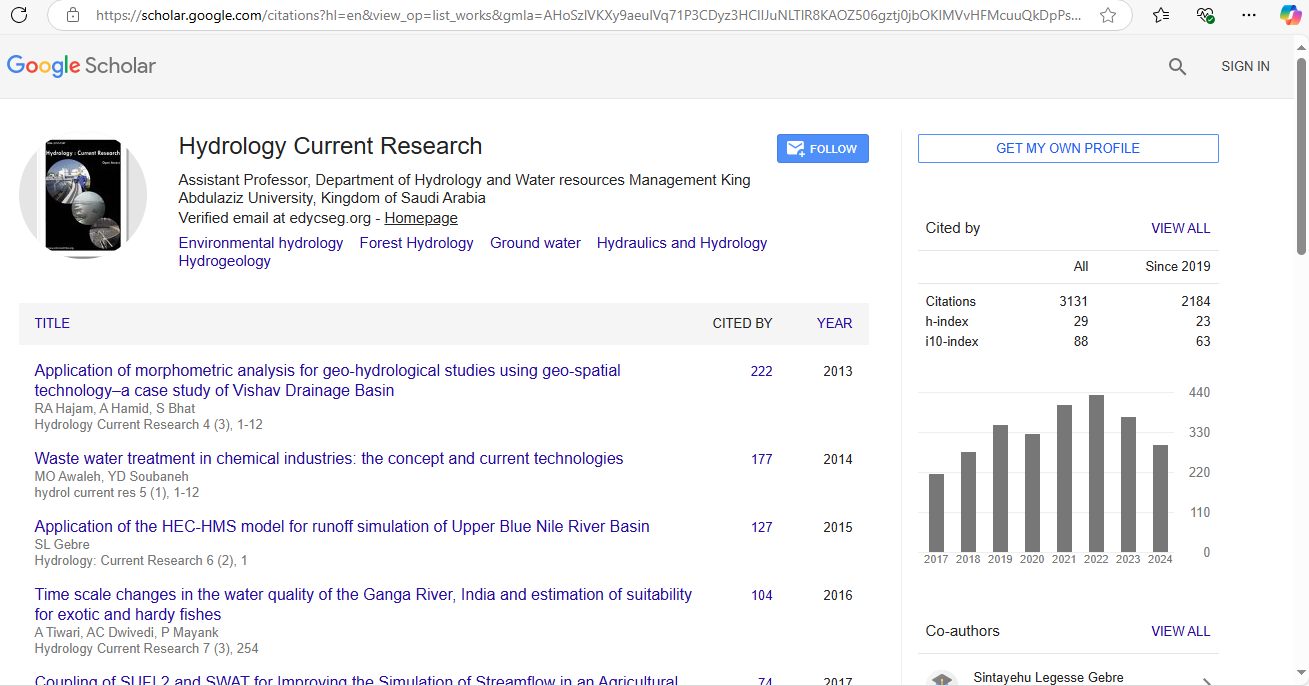
Hydrology: Current Research received 2843 citations as per Google Scholar report