Short Communication - (2025) Volume 16, Issue 6
Received: 01-Nov-2025, Manuscript No. hycr-25-175055;
Editor assigned: 03-Nov-2025, Pre QC No. P-175055;
Reviewed: 17-Nov-2025, QC No. Q-175055;
Revised: 24-Nov-2025, Manuscript No. R-175055;
Published:
01-Dec-2025
, DOI: 10.37421/2157-7587.2025.16.634
Citation: Jafari, Hassan. ”Global River Discharge: Climate, Humans, Management.” Hydrol Current Res 16 (2025):634.
Copyright: © 2025 Jafari H. This is an open-access article distributed under the terms of the Creative Commons Attribution License, which permits unrestricted use, distribution
and reproduction in any medium, provided the original author and source are credited.
Research into river discharge and its contributing factors reveals the intricate and often dramatic changes occurring in aquatic ecosystems worldwide. For instance, investigations into the Yangtze River Estuary and the nearby East China Sea show how climate change and expanding urban areas are rapidly influencing river discharge and water quality. These studies highlight significant shifts in environmental parameters, emphasizing the severe combined pressures on these crucial ecosystems [1].
Similarly, a multi-decadal analysis of the Chesapeake Bay details how variations in estuarine freshwater discharge profoundly shape the spatial distribution of various species. This work points to a critical, long-term connection between riverine flow and the biodiversity patterns within this important estuary [2].
Further south, in Greece, studies on the large Mediterranean Evrotas River basin explore the spatial and seasonal changes in suspended sediment concentration and river discharge. These findings reveal notable variability patterns, offering essential insights for effective river management and ecological understanding in similar climatic zones [3].
Looking ahead, research utilizes CMIP6 climate models alongside the SWAT hydrological model to project future flood and drought occurrences within the Mahanadi River Basin. The outcomes indicate significant alterations in extreme river discharge patterns, providing vital insights for developing robust water resource management strategies in the face of a changing climate [4].
In China, explorations into the Dongjiang River Basin demonstrate the profound impact of climate change on streamflow and the complex trade-offs among various ecosystem services. This study makes it clear that shifts in river discharge patterns have considerable consequences for essential services like water supply, regulation, and other crucial environmental benefits [5].
Innovations in streamflow prediction are also making waves, with studies showcasing the effectiveness of integrating machine learning models with remote sensing inputs for areas like the Upper Blue Nile Basin in Ethiopia. This approach has led to improved accuracy in forecasting river discharge, offering a vital tool for water resource management, especially in regions with data limitations [6].
The intricate interplay of environmental factors is further clarified by research successfully separating the individual impacts of climate change and various human activities on river discharge within the Beijiang River Basin in South China. This work clearly shows how human interventions, including water abstraction and dam operations, significantly modify natural flow regimes, working in conjunction with broader climate shifts [7].
A deeper understanding of hydrological systems is emerging through the employment of coupled surface-groundwater models to assess river discharge and associated groundwater contributions, particularly in data-scarce areas like the upper Blue Nile Basin in Ethiopia. Such studies underscore the intricate interactions between surface water and groundwater systems, providing crucial insights for comprehensive, integrated water resource management strategies [8].
Complementing this, an innovative method for estimating streamflow involves integrating Artificial Neural Networks with satellite rainfall products, global land surface data, and topographic attributes. This offers a critical solution for monitoring river discharge in ungauged or data-scarce basins, significantly advancing remote hydrological assessment capabilities [9].
Finally, global warming scenarios are under close scrutiny, with research examining the projected impacts of 1.5°C and 2.0°C global warming on river discharge within the upper Indus River basin. The findings here provide crucial insights into future water availability for this glacier-fed region, emphasizing the significant sensitivity of river discharge to anticipated climate change [10].
These diverse studies collectively underscore the critical importance of understanding and predicting river discharge dynamics in a world grappling with climate change and increasing human pressures.
River discharge, a fundamental component of the global water cycle, is under increasing pressure from both climatic shifts and human interventions across various geographical scales. Research highlights that in critical estuarine environments, such as the Yangtze River Estuary and the nearby East China Sea, rapid changes in river discharge are directly linked to climate change and expanding urban areas, consequently affecting water quality. This creates significant combined pressures on these vital aquatic ecosystems [1]. Similarly, in the Chesapeake Bay, long-term analyses spanning multiple decades reveal that variations in estuarine freshwater discharge profoundly dictate the spatial distribution of numerous species, underscoring a crucial connection between riverine flow and regional biodiversity [2]. The Mediterranean Evrotas River basin in Greece also experiences significant spatial and seasonal variability in suspended sediment concentration and river discharge, offering key insights for river management in similar climatic zones [3].
The broader implications of climate change on river systems are extensively explored through modeling and scenario analysis. For example, the Mahanadi River Basin is projected to face significant alterations in extreme river discharge patterns, including floods and droughts, when assessed using CMIP6 climate models and the SWAT hydrological model. Such projections are vital for developing proactive water resource management strategies [4]. In the Dongjiang River Basin in China, climate change is shown to exert a profound impact on streamflow, leading to complex trade-offs among essential ecosystem services like water supply and regulation. Changes in discharge patterns here carry substantial consequences for environmental benefits [5]. Furthermore, the upper Indus River basin, a glacier-fed region, demonstrates significant sensitivity to anticipated climate change, with projections under 1.5°C and 2.0°C global warming scenarios offering crucial insights into future water availability and river discharge dynamics [10].
Human activities represent another dominant driver of changes in river discharge, often acting in concert with climatic shifts. A compelling study from the Beijiang River Basin in South China successfully decouples the individual impacts of climate change and human activities. It clearly shows how interventions such as water abstraction and dam operations significantly modify natural flow regimes, impacting the overall river discharge [7]. This human footprint is a critical consideration for sustainable water management alongside the natural variability exacerbated by climate change [1, 7].
Advancements in hydrological modeling and prediction are proving instrumental in understanding and managing these complex systems, especially in data-scarce regions. The Upper Blue Nile Basin in Ethiopia has seen improved accuracy in streamflow prediction through the integration of machine learning models with remote sensing inputs, providing a vital approach for water resource management where data might be limited [6]. Another study in the same upper Blue Nile Basin employed a coupled surface-groundwater model to assess river discharge and groundwater contributions, highlighting the intricate interactions between surface water and groundwater systems and emphasizing the need for integrated management strategies [8]. Moreover, innovative methods for estimating streamflow, such as those utilizing Artificial Neural Networks combined with satellite rainfall products, global land surface data, and topographic attributes, offer critical solutions for monitoring river discharge in ungauged or data-scarce basins, advancing remote hydrological assessment capabilities globally [9]. These diverse methodologies contribute significantly to our collective ability to anticipate and respond to evolving river discharge patterns.
This collection of research highlights the pervasive and complex challenges facing river systems globally, with a strong emphasis on changes in river discharge driven by climate change and human activities. Studies from the Yangtze River Estuary [1] and the Chesapeake Bay [2] demonstrate how these factors profoundly affect water quality, species distribution, and overall ecosystem health in estuarine environments. Regional analyses from the Evrotas River in Greece [3] and the Mahanadi River Basin [4] further illustrate significant spatial and seasonal variabilities, alongside projected alterations in extreme flood and drought events under future climate scenarios. A recurrent theme is the impact of climate change on streamflow and the subsequent trade-offs in ecosystem services, as seen in the Dongjiang River Basin [5] and the upper Indus River basin, where future water availability is highly sensitive to warming scenarios [10]. Critically, research also distinguishes between the impacts of climate change and human activities, such as water abstraction and dam operations, on river discharge in basins like the Beijiang River [7], emphasizing the dual pressures on these systems. To address these challenges, advanced modeling techniques are being deployed. Machine learning and remote sensing inputs are enhancing streamflow prediction in areas like the Upper Blue Nile Basin [6], while coupled surface-groundwater models provide crucial insights into water system interactions, particularly in data-scarce regions [8]. The development of Artificial Neural Networks for streamflow estimation using satellite data represents a significant step forward for hydrological assessment in ungauged basins [9]. Collectively, these studies underscore the urgent need for integrated water resource management strategies to adapt to and mitigate the escalating impacts on global river discharge.
None
None
Indexed at, Google Scholar, Crossref
Indexed at, Google Scholar, Crossref
Indexed at, Google Scholar, Crossref
Indexed at, Google Scholar, Crossref
Indexed at, Google Scholar, Crossref
Indexed at, Google Scholar, Crossref
Indexed at, Google Scholar, Crossref
Indexed at, Google Scholar, Crossref
Indexed at, Google Scholar, Crossref
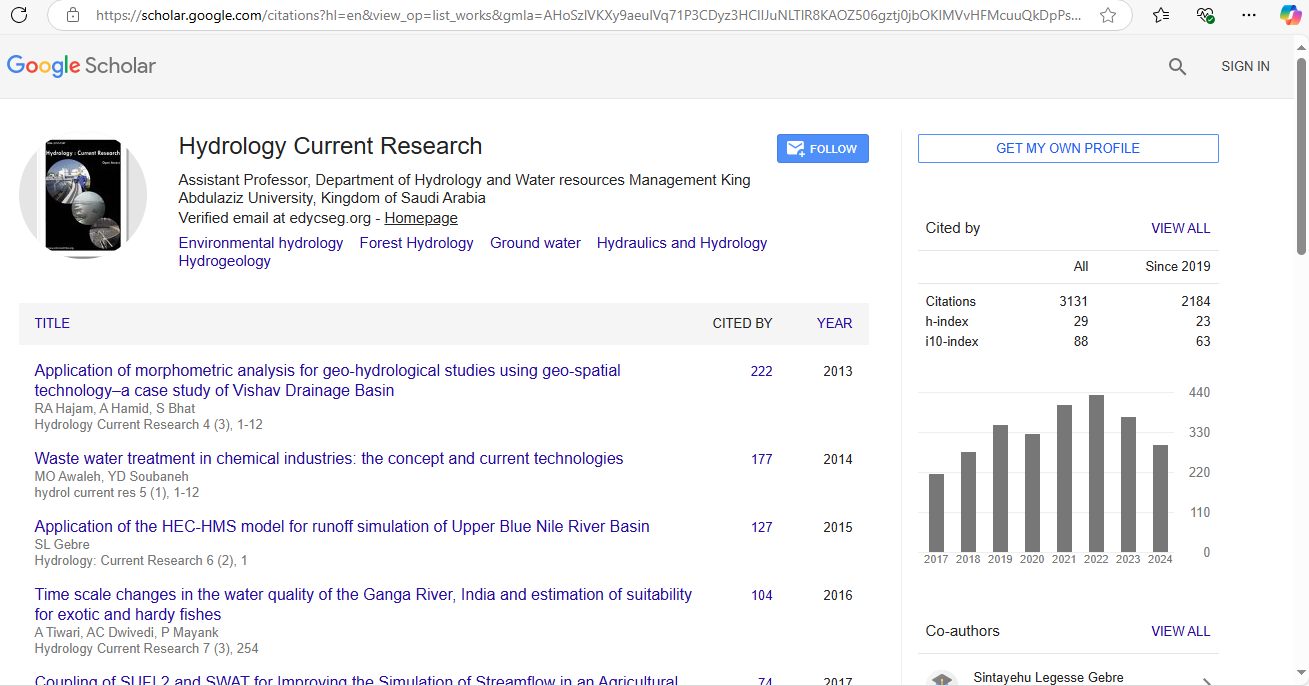
Hydrology: Current Research received 2843 citations as per Google Scholar report