Commentary - (2025) Volume 16, Issue 4
Received: 01-Jul-2025, Manuscript No. hycr-25-174941;
Editor assigned: 03-Jul-2025, Pre QC No. P-174941;
Reviewed: 17-Jul-2025, QC No. Q-174941;
Revised: 22-Jul-2025, Manuscript No. R-174941;
Published:
29-Jul-2025
, DOI: 10.37421/2157-7587.2025.16.608
Citation: Bennett, Kairos. ”Global River Alterations: Causes, Impacts, Solutions.” Hydrol Current Res 16 (2025):608
Copyright: © 2025 Bennett K. This is an open-access article distributed under the terms of the Creative Commons Attribution License, which permits unrestricted use,
distribution and reproduction in any medium, provided the original author and source are credited.
River systems globally face increasing pressures from both human activities and a changing climate, leading to significant alterations in their natural flow regimes. A comprehensive global assessment highlights that hydropower dams extensively regulate river flow, with over 20,000 dams causing substantial flow alteration, especially in developed and densely populated regions. This regulation profoundly impacts downstream aquatic ecosystems, signaling a need for more sustainable dam management that balances energy production with ecological preservation[1].
Further investigation into river flow regulation, specifically by structures like the Three Gorges Dam, reveals an increase in water residence time. This change enhances the river's capacity for pollutant retention, which, while aiding localized degradation, also raises concerns about long-term ecological risks to downstream areas and within reservoirs due to prolonged contaminant exposure[2].
Projected future global river flow changes under various Shared Socioeconomic Pathways point to significant regional variations. Climatic and anthropogenic drivers, particularly precipitation shifts and temperature increases, are expected to lead to both increases and decreases in streamflow. This underscores a critical need for adaptive water resource management strategies to address future water scarcity and flood risks, considering both climate change and human actions[3].
A multi-model ensemble approach has helped to clearly distinguish the complex influences of climate change and human activities on river flow. While climate change stands out as a primary driver, human interventions such as irrigation and reservoir operations significantly modify natural flow regimes, often worsening water stress or altering flood patterns. This emphasizes the importance of integrated assessment frameworks for sustainable water management[4].
The Nile River Basin provides a critical regional case study, where climate models and hydrological simulations project substantial alterations in streamflow patterns. These changes carry significant implications for water security across riparian countries, highlighting the region's vulnerability to increased water stress. Transboundary cooperation and adaptive management are essential for securing sustainable water resources in such vital basins[5].
Changes in land use and land cover also profoundly influence river flow, as demonstrated by studies using models like the Soil and Water Assessment Tool (SWAT) in mountainous watersheds. Urbanization, deforestation, and agricultural expansion are shown to significantly alter hydrological processes, affecting streamflow volume and timing. This points to the crucial role of sustainable land management in maintaining natural flow regimes and mitigating water-related hazards[6].
Looking to the future, projections using Coupled Model Intercomparison Project Phase 6 (CMIP6) models forecast considerable changes in extreme river flow events across Australia. Regional variations are expected in the frequency and intensity of both floods and droughts, indicating heightened risks in specific areas. These insights are vital for developing robust adaptation strategies and improving disaster preparedness in a continent highly susceptible to hydro-climatic extremes[7].
A global meta-analysis reinforces these concerns by synthesizing literature on how altered river flow regimes affect aquatic biodiversity. Changes in flow magnitude, frequency, duration, and timing, largely due to human activities and climate change, negatively impact fish, invertebrate, and plant communities. This widespread decline in biodiversity and ecosystem function makes environmental flow management a critical tool for conservation and restoration efforts[8].
In response to these challenges, advancements in seasonal river flow forecasting using machine learning models offer promising solutions. Comparative studies show that advanced algorithms like Long Short-Term Memory (LSTM) networks and Random Forests outperform traditional statistical methods in predictive capabilities. These models have the potential to significantly enhance water resource management, improve flood prediction, and strengthen drought early warning systems by providing more accurate and timely information for decision-makers[9].
Finally, research highlights the impactful role of glacier retreat on river flow in high mountain regions globally. While initial glacier melt can temporarily increase streamflow, ongoing retreat ultimately leads to reduced water availability. This particularly affects downstream communities dependent on glacial water sources and stresses the urgency of addressing climate change to manage these hydrological shifts and protect water resources in glacier-fed basins[10].
Global river systems are under immense pressure from both direct human intervention and the pervasive effects of climate change, leading to widespread alterations in natural flow patterns. Hydropower dams, numbering over 20,000 globally, are a primary driver of flow regulation, causing significant changes, particularly in densely populated and developed areas. These alterations have profound implications for downstream aquatic ecosystems, necessitating a shift towards more sustainable dam management practices that consciously balance energy needs with ecological preservation[1]. Beyond physical regulation, such as by the Three Gorges Dam, changes in river flow can also impact water quality. Dam operations can increase water residence time, which in turn enhances the river's capacity for pollutant retention. While this might offer some localized pollutant degradation, it also raises serious ecological concerns for downstream environments and within reservoirs due to extended exposure to contaminants[2].
The future trajectory of global river flow indicates significant variability driven by both climatic and anthropogenic factors. Projections under various Shared Socioeconomic Pathways suggest that precipitation changes and rising temperatures will lead to diverse regional impacts, with some basins experiencing increased streamflow while others face decreases[3]. This complexity is further explored through multi-model ensemble approaches, which disentangle the contributions of climate change and human activities to observed streamflow changes. The consensus is that although climate change is a dominant force, human interventions like irrigation and reservoir operations significantly modify natural flow regimes, often intensifying water stress or altering flood patterns. This underscores the need for integrated assessment frameworks for effective water resource management[4]. Regionally, the Nile River Basin offers a compelling example, where climate models predict substantial alterations in streamflow, posing direct threats to water security for riparian nations. This situation highlights the region's heightened vulnerability to water stress and emphasizes the critical need for transboundary cooperation and adaptive management strategies to ensure water sustainability[5]. Similarly, in Australia, advanced climate models project future changes in extreme river flow events, indicating significant regional variations in the frequency and intensity of both floods and droughts, which demands robust adaptation and disaster preparedness[7].
Other human activities also contribute significantly to altered river flow regimes. Land use and land cover changes, such as urbanization, deforestation, and agricultural expansion in mountainous watersheds, have been shown to fundamentally alter hydrological processes, affecting both streamflow volume and timing. Research using models like the Soil and Water Assessment Tool (SWAT) stresses the importance of sustainable land management practices to preserve natural flow regimes and mitigate water-related hazards[6]. These altered flow regimes, whether from dams, climate shifts, or land use changes, have severe consequences for aquatic biodiversity. A global meta-analysis confirms that changes in flow magnitude, frequency, duration, and timing negatively impact fish, invertebrate, and plant communities, leading to widespread decline in biodiversity and ecosystem function. This situation makes environmental flow management an indispensable tool for conservation and restoration efforts[8]. Furthermore, the retreat of glaciers in high mountain regions, a direct consequence of climate change, initially contributes to increased streamflow but ultimately leads to a decline in water availability. This shift critically affects downstream communities reliant on glacial water sources, highlighting the urgency of addressing climate change to manage these hydrological impacts and water resources in glacier-fed basins[10].
Addressing these complex challenges requires innovative approaches and tools. For instance, seasonal river flow forecasting has seen significant advancements with the application of machine learning models. Comparative studies demonstrate that advanced algorithms like Long Short-Term Memory (LSTM) networks and Random Forests offer superior predictive capabilities compared to traditional statistical methods. The potential of these models to enhance water resource management, improve flood prediction, and bolster drought early warning systems by providing more accurate and timely information for decision-makers is considerable[9]. Ultimately, the collective findings emphasize a universal need for adaptive and integrated water resource management strategies that account for the interwoven impacts of human development and climate change, ensuring both ecological integrity and water security for communities worldwide.
None
None
Indexed at, Google Scholar, Crossref
Indexed at, Google Scholar, Crossref
Indexed at, Google Scholar, Crossref
Indexed at, Google Scholar, Crossref
Indexed at, Google Scholar, Crossref
Indexed at, Google Scholar, Crossref
Indexed at, Google Scholar, Crossref
Indexed at, Google Scholar, Crossref
Indexed at, Google Scholar, Crossref
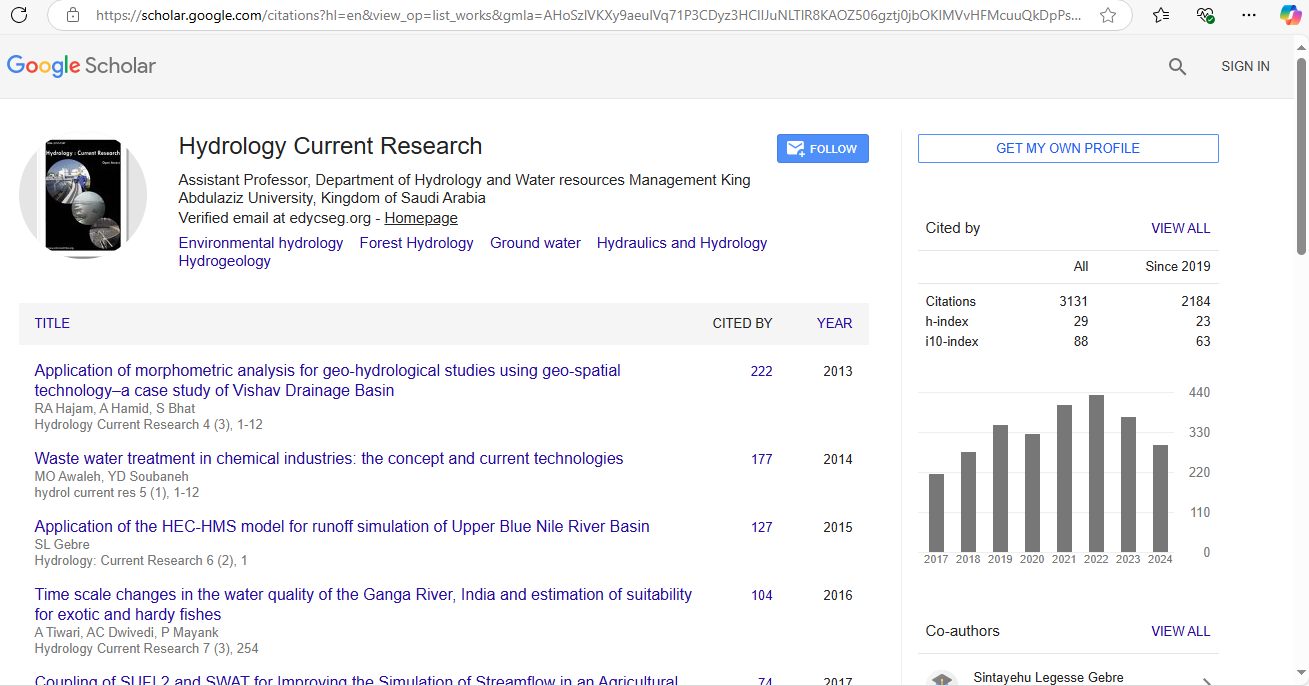
Hydrology: Current Research received 2843 citations as per Google Scholar report