Commentary - (2025) Volume 16, Issue 3
Received: 01-Apr-2025, Manuscript No. hycr-25-172517;
Editor assigned: 03-Apr-2025, Pre QC No. P-172517;
Reviewed: 17-Apr-2025, QC No. Q-172517;
Revised: 22-Apr-2025, Manuscript No. R-172517;
Published:
29-May-2025
, DOI: 10.37421/2157-7587.2025.16.578
Citation: Wu, Mei-Ling. ”Global Groundwater Challenges, Solutions, and Integrated Strategies.” Hydrol Current Res 16(2025):578.
Copyright: © 2025 Wu M. This is an open-access article distributed under the terms of the Creative Commons Attribution License, which permits unrestricted use, distribution
and reproduction in any medium, provided the original author and source are credited.
Groundwater and surface water systems exhibit complex interactions, encompassing hydrological, biogeochemical, and ecological processes. Integrated management strategies are critically needed to address challenges like water quality degradation, ecosystem health decline, and water resource depletion, particularly under changing climate and land use scenarios [1].
Recent advances in sustainable groundwater remediation offer promising solutions, with novel permeable reactive barriers (PRBs) detailing advancements in materials, design, and applications. These demonstrate effectiveness in removing a wide range of contaminants, emphasizing their potential for cost-effective and environmentally friendly solutions in addressing groundwater pollution [2].
Machine Learning (ML) models are increasingly developed to forecast future groundwater levels, considering climate change impacts. These models prove effective in providing valuable insights for sustainable water resource management and adaptation strategies in vulnerable regions like the Eastern Nile Basin [3].
Managed Aquifer Recharge (MAR) stands as a crucial tool for enhancing global water security. Overviews of MAR highlight its diverse roles in sustainable water management, outlining significant opportunities and key challenges for its widespread and effective implementation worldwide [4].
The application of machine learning models is also expanding in assessing groundwater quality. Comprehensive reviews highlight various algorithms and techniques used to predict and monitor water quality parameters. These applications effectively identify pollution sources and support informed decision-making for groundwater protection and management [5].
A critical examination of the primary drivers and far-reaching impacts of groundwater depletion across major global aquifer systems reveals significant concerns. Factors like agricultural irrigation, urbanization, and climate change contribute to declining groundwater levels, leading to severe consequences for water security, land subsidence, and ecological balance worldwide [6].
Addressing the complex challenges and promising opportunities in governing transboundary aquifers is vital for regional water security. Effective international cooperation, shared legal frameworks, and adaptive management strategies are essential to ensure the equitable and sustainable use of these vital, often invisible, groundwater resources across national borders [7].
The understanding of groundwater recharge processes and hydrochemical evolution, particularly in arid regions like Northwest China, is greatly enhanced by the utilization of isotopic tracers. Stable isotopes and tritium provide critical insights into the origin, age, and flow paths of groundwater, which is indispensable for managing scarce water resources in arid environments [8].
A systematic review synthesizing global trends and challenges in studying groundwater-dependent ecosystems (GDEs) underscores their vital ecological roles. This review identifies critical research gaps, especially concerning climate change impacts and the sustainable management strategies necessary to protect these vulnerable ecosystems [9].
The critical water-energy-food (WEF) nexus is particularly relevant for sustainable groundwater management in agricultural settings. It emphasizes the interconnectedness of these sectors, advocating for integrated approaches to optimize resource use, reduce groundwater over-extraction, and ensure food security while mitigating environmental impacts [10].
Understanding groundwater dynamics is paramount for addressing global water challenges, as research comprehensively reviews the complex interactions between groundwater and surface water [1]. These interactions, involving hydrological, biogeochemical, and ecological processes, necessitate integrated management strategies to combat water quality degradation, ecosystem health decline, and resource depletion, particularly under evolving climate and land use scenarios. Compounding these issues is the pervasive problem of groundwater depletion across major global aquifer systems [6]. Key drivers like extensive agricultural irrigation, rapid urbanization, and ongoing climate change severely contribute to declining groundwater levels, leading to widespread consequences such as compromised water security, land subsidence, and ecological imbalance. Moreover, the vital ecological roles of groundwater-dependent ecosystems (GDEs) are often overlooked, yet they are increasingly threatened by global trends and climate change impacts, highlighting critical research gaps in their sustainable management [9].
Effective management strategies are crucial for sustainable groundwater resources. Novel permeable reactive barriers (PRBs) represent a significant advancement in sustainable groundwater remediation, offering cost-effective and environmentally friendly solutions for removing a wide array of contaminants [2]. Alongside remediation, Managed Aquifer Recharge (MAR) emerges as a vital tool for enhancing global water security, playing diverse roles in sustainable water management and presenting both substantial opportunities and significant implementation challenges [4]. Furthermore, the governance of transboundary aquifers poses complex challenges but also offers promising opportunities for regional water security. This requires effective international cooperation, robust shared legal frameworks, and adaptive management strategies to ensure equitable and sustainable use of these vital, often invisible, resources across national borders [7].
Technological innovations, particularly in the realm of machine learning, are profoundly impacting groundwater management. Machine learning models are being developed to accurately forecast future groundwater levels, especially under climate change scenarios, as demonstrated in the Eastern Nile Basin [3]. These models provide invaluable insights for proactive water resource management and adaptation strategies in vulnerable regions. Similarly, machine learning models are extensively applied for groundwater quality assessment [5]. Through various algorithms and techniques, these models predict and monitor water quality parameters, proving effective in identifying pollution sources and supporting informed decision-making for protecting groundwater.
Specific regional studies and conceptual frameworks further refine our understanding of groundwater systems. For instance, the utilization of isotopic tracers has provided critical insights into groundwater recharge processes and hydrochemical evolution in arid zones, such as Northwest China [8]. These isotopic signatures reveal crucial information about the origin, age, and flow paths of groundwater, essential for managing scarce water resources in such environments. Additionally, the critical water-energy-food (WEF) nexus has significant implications for sustainable groundwater management, particularly in agricultural settings [10]. It underscores the profound interconnectedness of these sectors and advocates for integrated approaches to optimize resource use, reduce groundwater over-extraction, ensure food security, and mitigate environmental impacts concurrently.
In essence, the collective body of research emphasizes a multidisciplinary approach to groundwater. This includes understanding its complex interactions with surface water, mitigating depletion, remediating pollution, utilizing advanced forecasting and quality assessment technologies, and establishing effective governance structures. Ultimately, a balanced approach encompassing ecological preservation, technological advancement, and international collaboration is essential for ensuring global water security and sustainable management of this invaluable resource for future generations.
The current body of research profoundly addresses the multifaceted challenges and innovative solutions in groundwater management worldwide. Studies comprehensively review the intricate interactions between groundwater and surface water, stressing the need for integrated management to combat water quality degradation and resource depletion under climate change [1]. Critical issues like global groundwater depletion are examined, attributing declines to agricultural irrigation, urbanization, and climate change, leading to severe impacts on water security and ecosystems [6]. Concurrently, the vital ecological roles of groundwater-dependent ecosystems (GDEs) are highlighted, along with research gaps concerning climate change impacts and sustainable management [9]. In response to these challenges, advancements in sustainable groundwater remediation, particularly novel permeable reactive barriers (PRBs), offer cost-effective and environmentally friendly solutions for contaminant removal [2]. Managed Aquifer Recharge (MAR) is also recognized as a crucial tool for enhancing global water security, presenting significant opportunities despite implementation challenges [4]. Technological innovations play a key role, with machine learning models developed to forecast future groundwater levels [3] and assess groundwater quality [5], providing insights for informed decision-making and adaptation strategies. Furthermore, the governance of transboundary aquifers requires effective international cooperation [7], and understanding specific processes like groundwater recharge through isotopic tracers is crucial for arid regions [8]. The interconnected water-energy-food (WEF) nexus is also explored, advocating for integrated approaches to optimize resource use and ensure sustainable groundwater management in agriculture [10]. Overall, this research underscores the urgency for holistic, technology-driven, and collaborative strategies to secure groundwater resources globally.
None
None
Indexed at, Google Scholar, Crossref
Indexed at, Google Scholar, Crossref
Indexed at, Google Scholar, Crossref
Indexed at, Google Scholar, Crossref
Indexed at, Google Scholar, Crossref
Indexed at, Google Scholar, Crossref
Indexed at, Google Scholar, Crossref
Indexed at, Google Scholar, Crossref
Indexed at, Google Scholar, Crossref
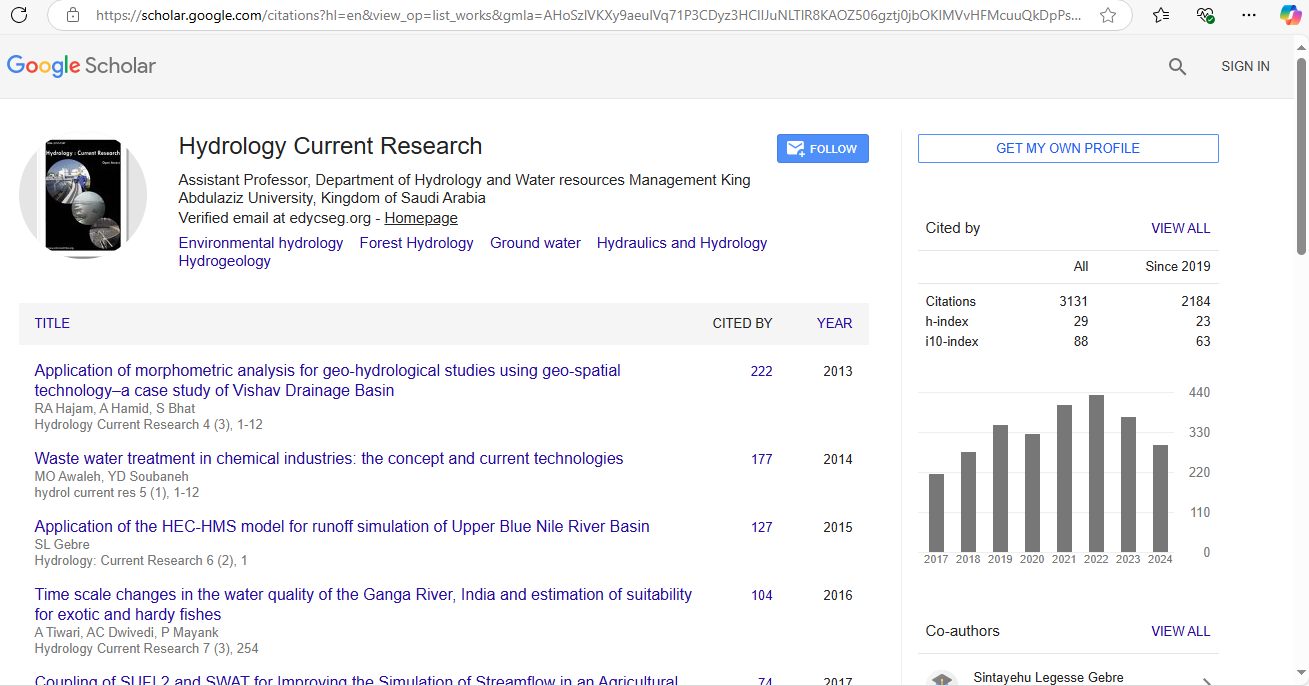
Hydrology: Current Research received 2843 citations as per Google Scholar report