Commentary - (127) Volume 15, Issue 5
Received: 30-Sep-2025, Manuscript No. jmcj-25-176912;
Editor assigned: 02-Oct-2025, Pre QC No. P-176912;
Reviewed: 14-Oct-2025, QC No. Q-176912;
Revised: 21-Oct-2025, Manuscript No. R-176912;
Published:
28-Oct-2025
, DOI: 10.37421/2165-7912.2025.15.640
Citation: Fontaine, Elise R.. ”Global Data Journalism: Evolution, Application, Challenges.” J Mass Communicat Journalism 15(2025):640.
Copyright: © 2025 Fontaine R. Elise This is an open-access article distributed under the terms of the Creative Commons Attribution License, which permits unrestricted use, distribution and reproduction in any medium, provided the original author and source are credited.
The landscape of modern journalism is rapidly evolving, driven significantly by the integration of data and automated tools. This dynamic shift necessitates a comprehensive understanding of how these practices are deployed, perceived, and taught across different geographical and cultural contexts. Research, for instance, has closely examined how data journalism and automated journalism were strategically utilized by RTÉ News in Ireland during the intense period of the COVID-19 pandemic. This particular study highlights not only the practical application of these forms but also the inherent challenges and their potential to meaningfully inform public discourse during times of crisis, underscoring the deep integration of data-driven approaches into conventional news workflows.[1] Delving into another European context, a qualitative study offers valuable insights into German newsrooms. Here, the focus is on the intricate intersection of data journalism with long-established journalistic norms and the ever-advancing technical capabilities available today. This research brings to light the inherent tensions and the powerful synergies that emerge between traditional editorial values and the increasing demands of data-driven reporting, thereby shedding light on how journalists skillfully navigate these complex dynamics in their daily professional lives.[2] Moreover, the broader German media landscape has been a subject of review, providing an overview of current data journalism practices and exploring its future prospects. This discussion encompasses how German newsrooms are adopting data-driven methods, the specific challenges they encounter, and potential trajectories for the ongoing growth and integration of data journalism within the country.[9] The pedagogical aspects of data journalism are equally vital in shaping its future. A mixed-methods study, specifically focusing on U.S. journalism educators, offers an investigation into the current panorama of teaching data journalism. This work identifies the prevalent teaching methodologies, essential curriculum components, and the perceived obstacles in effectively preparing future journalists for what is increasingly becoming a data-intensive reporting environment. It notably emphasizes the critical need for robust pedagogical approaches within this rapidly evolving field.[3] Complementing this, another significant study probes the ethical perceptions surrounding data journalism, surveyed among U.S. journalism educators and students. This inquiry pinpoints crucial ethical dilemmas, which include sensitive issues like data privacy, ensuring accuracy, and addressing the potential for misinterpretation, thereby underscoring the vital requirement for strong ethical frameworks and continuous discussions both in the education and the practical application of data-driven reporting.[10] Beyond developed nations, the practice of data journalism is also gaining traction and facing distinct challenges in other regions. Research has explored the state of data journalism practice in Ghana, detailing both the significant opportunities it presents for enhancing news reporting and the substantial challenges journalists encounter during its implementation. This investigation illuminates resource constraints, existing skill gaps, and the undeniable potential for data journalism to contribute significantly to public accountability within the Ghanaian media landscape.[4] Similarly, a mixed-methods study specifically investigates the adoption of data journalism and innovation within Chilean media outlets. It meticulously explores how these organizations are integrating data-driven approaches into their reporting, pinpointing key drivers and barriers to innovation, and powerfully highlighting the evolving role of data within Latin American newsrooms.[7] Comparative analyses offer a broader perspective on the global adoption and adaptation of data journalism. One such comparative study meticulously analyzes how news organizations in Finland and Norway leveraged data journalism in their extensive coverage of the COVID-19 pandemic. This research examines the varied responses to the crisis, clearly revealing how journalistic practices adapted to effectively incorporate data-driven narratives and compelling visualizations to keep the public well-informed during an unprecedented global health emergency.[6] Another insightful study compares the practices of data journalism in news organizations across Sweden and the United States. This comparison uncovers both differences and striking similarities in how data is sourced, rigorously analyzed, and ultimately presented. It provides a nuanced and rich understanding of how distinct cultural contexts and underlying technological infrastructures profoundly influence the adoption and ongoing evolution of data-driven reporting techniques.[8] Finally, the profound connection between data journalism and civic engagement is a critical area of exploration. One study utilizes a mixed-methods approach to meticulously analyze this connection through the lens of data-driven news applications. It thoroughly examines how these innovative applications effectively foster public participation and enhance understanding of complex societal issues, clearly showcasing the immense potential for data journalism to empower citizens and, in turn, deepen democratic processes through informed participation.[5] Collectively, these studies paint a comprehensive picture of data journalism as a global phenomenon, navigating technological advancements, ethical considerations, educational requirements, and its profound societal impact.
Data journalism and automated reporting have fundamentally reshaped the media landscape, prompting diverse adaptations and challenges across the globe. During the COVID-19 pandemic, news organizations rapidly integrated these techniques to inform the public. For instance, RTÉ News in Ireland deployed data journalism and automated systems to navigate the crisis, demonstrating their practical application and potential to inform public discourse amidst significant challenges [1]. Similarly, news outlets in Finland and Norway adapted their journalistic practices, using data-driven narratives and visualizations to cover the pandemic, showcasing varied yet effective responses in crisis communication [6]. This highlights the critical role of data in facilitating public understanding during unprecedented times.
The integration of data journalism within established newsroom environments often creates a dynamic interplay between traditional values and new technical demands. Qualitative research in German newsrooms reveals both the tensions and synergies involved, illustrating how journalists navigate these evolving dynamics [2]. This perspective is further enriched by an overview of data journalism in Germany, detailing current practices, challenges, and future trajectories for its growth and deeper integration into the national media landscape [9]. These insights underscore the ongoing negotiation between journalistic integrity, technical innovation, and the imperative to deliver data-informed news.
Beyond newsroom operations, the pedagogical and ethical dimensions of data journalism are crucial for its sustainable development. U.S. journalism educators have been the focus of studies investigating the methods and curriculum components currently used to teach data journalism, alongside the perceived challenges in preparing future journalists for data-intensive roles [3]. This research emphasizes the need for robust educational frameworks to equip the next generation. Concurrently, the ethical implications of data journalism are a significant concern. Studies examining U.S. journalism educators and students have identified key ethical dilemmas, including issues of data privacy, ensuring accuracy, and the potential for misinterpretation. This highlights the indispensable need for ongoing ethical discussions and the development of clear frameworks in both the teaching and practice of data-driven reporting [10].
The global adoption of data journalism also presents unique opportunities and challenges in various national contexts. In Ghana, for example, the practice of data journalism faces resource constraints and skill gaps, yet offers substantial potential for enhancing news reporting and fostering public accountability within the media landscape [4]. Meanwhile, Chilean media outlets are actively exploring data journalism and innovation, integrating data-driven approaches while navigating local drivers and barriers. This demonstrates the evolving role of data in Latin American newsrooms and the regional specificities of its adoption [7]. Understanding these varied contexts is essential for appreciating the full spectrum of data journalism's impact.
Comparative studies provide a broader lens through which to view these developments. A comparison of data journalism practices in news organizations across Sweden and the United States reveals both differences and commonalities in how data is sourced, analyzed, and presented. This research offers a nuanced understanding of how cultural contexts and existing technological infrastructures significantly influence the adoption and evolution of data-driven reporting techniques [8]. Ultimately, data journalism's ability to foster civic engagement through data-driven news applications is a powerful outcome. Studies analyze how these applications can boost public participation and understanding of complex issues, demonstrating data journalism’s capacity to empower citizens and deepen democratic processes [5]. This collective body of research paints a vivid picture of a field continuously adapting, innovating, and confronting its responsibilities.
These studies collectively offer a deep dive into the global evolution and application of data journalism, often alongside automated journalism, across various newsroom contexts. Research from Ireland details the use of data and automated journalism by RTÉ News during the COVID-19 pandemic, focusing on practical deployment, challenges, and public discourse impact. Similarly, a comparative study highlights how Finnish and Norwegian news organizations adapted data journalism during the same crisis, showcasing diverse responses and data-driven narratives. The intersection of data journalism with established journalistic norms and technical capabilities is a key theme, explored through qualitative studies in German newsrooms. These reveal the tensions and synergies journalists face. Further insight into the German landscape covers current practices and future prospects. Challenges and opportunities are also examined in specific national contexts. Ghana's experience with data journalism details resource constraints and skill gaps, while also identifying its potential for public accountability. Chilean media outlets show their adoption of data journalism and innovation, highlighting local drivers and barriers. Comparative studies between Sweden and the United States offer a nuanced understanding of how cultural contexts and technological infrastructures shape data-driven reporting practices. Education plays a crucial role, with U.S. studies investigating teaching methods, curriculum, and challenges for future journalists. Relatedly, ethical dimensions are explored, focusing on perceptions among U.S. journalism educators and students regarding data privacy, accuracy, and potential misinterpretation. The connection between data journalism and civic engagement is also analyzed, through data-driven news applications designed to foster public participation and understanding.
None
None
Kevin M, Neil O, Rebecca R. "Data journalism, automated journalism, and the COVID-19 pandemic: A case study of RTÉ News in Ireland".Journalism Practice 17 (2023):296-313.
Indexed at, Google Scholar, Crossref
Wiebke L, Eike O, Jonas R. "Data journalism between journalistic norms and technical capabilities: A qualitative study on German newsrooms".Journalism 23 (2022):115-131.
Indexed at, Google Scholar, Crossref
Josh Y, Vincent D, Seth CL. "Teaching Data Journalism: A Mixed-Methods Study of U.S. Journalism Educators".Journalism & Mass Communication Educator 76 (2021):213-229.
Indexed at, Google Scholar, Crossref
Dennis A, Christian KA, Ernest T. "The practice of data journalism in Ghana: opportunities and challenges".Journal of Applied Journalism & Media Studies 9 (2020):299-317.
Indexed at, Google Scholar, Crossref
Luca P, Jan JK, Melanie H. "Data journalism and civic engagement: A mixed-methods study of data-driven news applications".New Media & Society 21 (2019):1969-1988.
Indexed at, Google Scholar, Crossref
Mervi T, Martin L, Arne HK. "Data journalism in crisis times: A comparative study of news organizations' responses to the COVID-19 pandemic in Finland and Norway".Journalism Studies 21 (2020):1435-1453.
Indexed at, Google Scholar, Crossref
Valentina R, Pamela V, Sebastián V. "Data journalism and innovation in Chilean media outlets: A mixed-methods study".Journalism 23 (2022):677-694.
Indexed at, Google Scholar, Crossref
Oscar W, Seth CL, Mark C. "The practices of data journalism: A study of news organizations in Sweden and the United States".Digital Journalism 9 (2021):329-346.
Indexed at, Google Scholar, Crossref
Daniel F, Heidi RH, Helmut S. "Data Journalism in Germany: Current Practices and Future Prospects".Journalism Practice 13 (2019):143-160.
Indexed at, Google Scholar, Crossref
Vincent D, Seth CL, Josh Y. "Data Journalism Ethics: Perceptions of U.S. Journalism Educators and Students".Journalism & Mass Communication Educator 77 (2022):93-108.
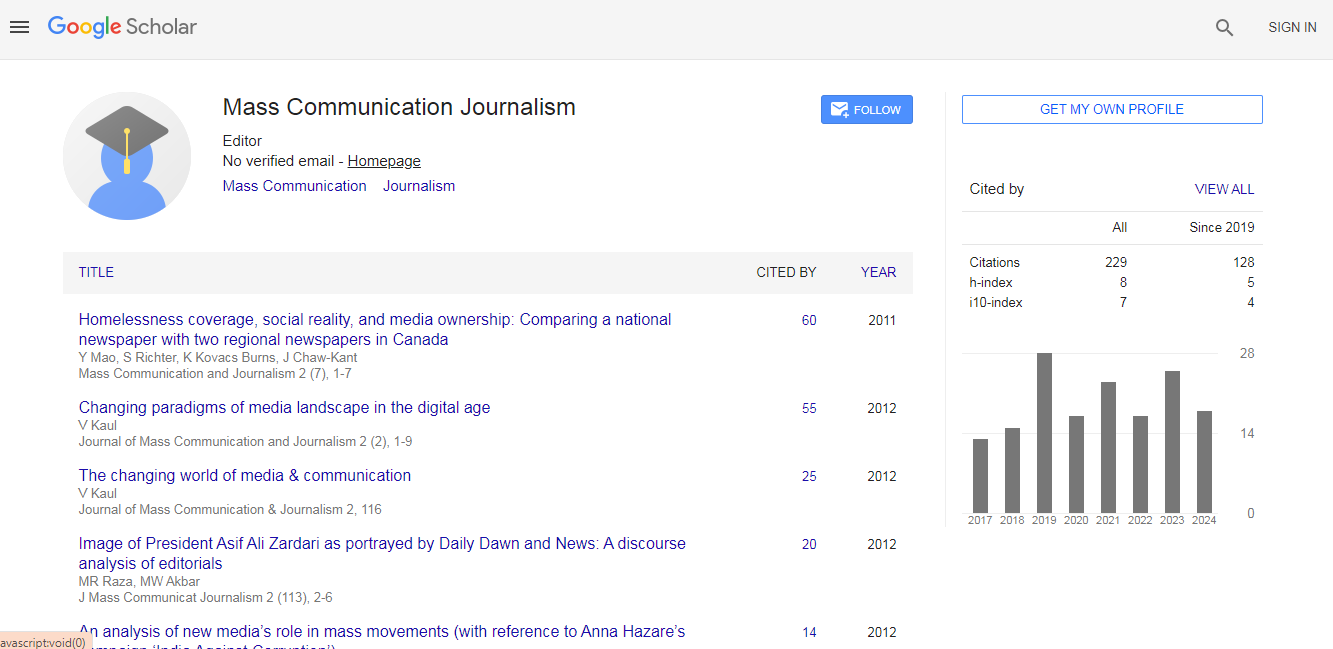
Journal of Mass Communication & Journalism received 205 citations as per Google Scholar report