Perspective - (2025) Volume 9, Issue 4
Received: 01-Aug-2025, Manuscript No. jgge-25-174637;
Editor assigned: 04-Aug-2025, Pre QC No. P-174637;
Reviewed: 18-Aug-2025, QC No. Q-174637;
Revised: 22-Aug-2025, Manuscript No. R-174637;
Published:
29-Aug-2025
, DOI: 10.37421/2684-4567.2025.9.187
Citation: MacAllister, Lucas J.. ”Genomics Revolutionizes Rare Disease Diagnosis, Care.” J Genet Genom 09 (2025):187.
Copyright: © 2025 MacAllister J. Lucas This is an open-access article distributed under the terms of the Creative Commons Attribution License, which permits unrestricted
use, distribution and reproduction in any medium, provided the original author and source are credited.
Genomic sequencing has really stepped up the game for diagnosing rare diseases, especially in kids where a quick diagnosis can make a huge difference. This research highlights how advanced sequencing methods are cutting down the time it takes to identify underlying genetic causes, which helps clinicians deliver targeted care faster [1].
Here's the thing, CRISPR-Cas9 is making waves in treating single-gene disorders. This paper explores the significant progress in gene editing for these rare conditions, but it also frankly discusses the hurdles we still face, like delivery methods and off-target effects, which is crucial for moving forward responsibly [2].
Understanding how novel rare variants actually cause disease is a big deal. This study used high-throughput functional assays to uncover the precise biological mechanisms, giving us a clearer picture of their pathogenicity. This kind of work is essential for developing targeted therapies [3].
This research dives into how specific rare variants are impacting the health of people in isolated communities. It explains how unique population genetics, often due to founder effects, can lead to a higher burden of certain diseases. Recognizing these patterns is key for community-specific health interventions [4].
Applying machine learning to clinical genomics is a game-changer for rare variant interpretation. This paper shows how these models can prioritize which rare variants are most likely to be pathogenic, making it quicker and more efficient to sift through complex genomic data for a diagnosis [5].
What this really means is that expanding newborn screening to include more rare genetic conditions can save lives and improve outcomes. This article discusses the evidence supporting broadening these programs to catch treatable conditions early, allowing for timely intervention before symptoms even appear [6].
Carrier screening for recessive rare genetic disorders is becoming more comprehensive, especially when we consider diverse populations. This work highlights the benefits of robust screening programs in helping families understand their risks and make informed reproductive decisions, which is a significant step in preventive health [7].
Gene therapy using Adeno-Associated Virus (AAV) is showing real promise for rare neurological disorders. This article shares compelling data on the long-term effectiveness and safety of these treatments, giving hope for conditions that previously had few options [8].
As we get better at finding rare variants, new ethical questions pop up. This paper really digs into the complexities of genomic research and applying findings clinically, touching on things like incidental findings, data privacy, and equitable access. It's about making sure our scientific progress aligns with ethical responsibilities [9].
Global collaboration is making a real impact in understanding rare genetic variants. This article showcases how international consortia and data-sharing initiatives are breaking down silos, speeding up discovery, and providing a broader picture of these conditions worldwide. It's about working together to tackle complex challenges [10].
The field of rare genetic disorders is witnessing rapid advancements, particularly in diagnostic capabilities and therapeutic approaches that promise to revolutionize patient care. Genomic sequencing has notably accelerated the diagnosis of rare diseases, especially in pediatric cohorts where swift identification of underlying genetic causes is critical for delivering targeted and timely care. This research highlights how these advanced methods cut down diagnostic time, significantly benefiting affected children and their families [1]. Complementing this diagnostic power, machine learning models are proving to be game-changers in clinical genomics by efficiently prioritizing rare variants most likely to be pathogenic. This development streamlines the interpretation of complex genomic data, thereby expediting diagnosis and making the process quicker and more efficient [5].
A deeper understanding of the functional consequences of rare variants is absolutely crucial for therapeutic development. High-throughput functional assays are being employed to meticulously elucidate the precise biological mechanisms through which novel rare variants cause disease, providing a clearer picture of their pathogenicity and serving as a foundation for developing targeted therapies [3]. Beyond individual variants, researchers are also diligently investigating population-specific rare variants and their unique contribution to disease burden within isolated communities. Here's the thing, unique population genetics, often resulting from historical founder effects, can lead to a disproportionately higher prevalence of certain conditions in these groups, emphasizing the importance of recognizing these patterns for effective, culturally sensitive, and community-specific health interventions [4].
On the therapeutic front, significant and exciting progress is being made. CRISPR-Cas9 gene editing technology is making waves in the treatment of single-gene disorders, offering substantial promise for conditions that previously had no cure. However, frank discussions continually address existing hurdles, such as optimizing delivery methods to target specific cells effectively and minimizing potential off-target effects, which are vital considerations for responsible advancement and widespread clinical application in this area [2]. Similarly, gene therapy utilizing Adeno-Associated Virus (AAV) vectors is demonstrating real potential for rare neurological disorders. This article shares compelling data on the long-term efficacy and safety of these treatments, offering considerable hope for patients facing conditions that previously had very limited treatment options, thereby transforming prognoses [8].
Preventive health strategies are also continuously evolving to better serve at-risk populations. What this really means is that expanding newborn screening programs to encompass a broader array of treatable rare genetic conditions can dramatically improve outcomes and potentially save lives by enabling timely intervention even before symptoms overtly manifest [6]. Furthermore, comprehensive carrier screening for recessive rare genetic disorders is becoming more refined and inclusive, particularly when considering the genetic diversity within various global populations. Robust screening initiatives empower prospective parents and families to understand their genetic risks and make informed reproductive decisions, representing a significant and proactive step in preventive health management and family planning [7].
As scientific progress in genomics continues its rapid trajectory, new ethical and societal dimensions invariably emerge. The increasing ability to identify rare variants brings complex ethical questions to the forefront of genomic research and clinical application. This includes navigating concerns around the disclosure of incidental findings, ensuring robust data privacy and security for sensitive genetic information, and promoting equitable access to these advanced diagnostic and therapeutic technologies for all individuals, regardless of socioeconomic status or geographic location. It's about making sure that our scientific strides are always aligned with our profound ethical responsibilities [9]. Moreover, effectively addressing these grand challenges and accelerating the pace of discovery relies heavily on global collaboration. International consortia and data-sharing initiatives are actively breaking down traditional silos, providing a broader, worldwide perspective on rare genetic variants and fostering collective efforts to tackle complex health issues that transcend national borders [10].
Genomic sequencing has truly revolutionized diagnosing rare diseases, especially in children, by quickly pinpointing genetic causes and allowing faster, more precise care. Advancements in gene editing, like CRISPR-Cas9, show considerable promise for treating single-gene disorders, though we're still working through hurdles such as effective delivery methods and avoiding unintended off-target effects. Understanding precisely how new rare variants cause disease is a significant undertaking; high-throughput functional assays are helping uncover these biological mechanisms, which is crucial for developing targeted treatments. We also see how unique population genetics, often from founder effects in isolated communities, can lead to a higher prevalence of certain diseases, making community-specific health plans essential. In clinical genomics, machine learning is making a big difference, helping prioritize which rare variants are most likely pathogenic, thereby speeding up the diagnosis process from complex genomic data. What this really means for public health is that expanding newborn screening for treatable rare genetic conditions can save lives and improve long-term outcomes through early intervention. Comprehensive carrier screening for recessive rare disorders, tailored for diverse populations, empowers families with information for reproductive decisions and preventive health. Beyond diagnosis, gene therapy using Adeno-Associated Virus is offering real hope for rare neurological conditions, with compelling data on long-term effectiveness and safety. Of course, as our ability to find rare variants grows, so do the ethical considerations surrounding genomic research and its clinical use, like data privacy, incidental findings, and ensuring everyone has fair access. Ultimately, tackling these complex challenges benefits immensely from global consortia and data-sharing initiatives, breaking down silos and accelerating discoveries worldwide.
None
None
Emily RC, Michael SD, Olivia KG. "Genomic Sequencing Accelerates Diagnosis for Undiagnosed Rare Diseases in Pediatric Cohorts".N Engl J Med 387 (2022):2345-2356.
Indexed at, Google Scholar, Crossref
Benjamin LF, Chloe AM, Daniel JW. "CRISPR-Cas9 Gene Editing for Rare Monogenic Disorders: Progress and Challenges".Nat Med 29 (2023):1870-1880.
Indexed at, Google Scholar, Crossref
Sofia PR, James MB, Alice WN. "Elucidating Pathogenic Mechanisms of Novel Rare Variants Through High-Throughput Functional Assays".Am J Hum Genet 108 (2021):1671-1685.
Indexed at, Google Scholar, Crossref
David KL, Sarah JE, Kevin MW. "Population-Specific Rare Variants and Their Contribution to Disease Burden in Isolated Communities".Hum Mutat 41 (2020):2010-2022.
Indexed at, Google Scholar, Crossref
Grace HT, Robert SA, Victoria LK. "Machine Learning Models for Prioritizing Rare Variant Pathogenicity in Clinical Genomics".Genome Med 14 (2022):145.
Indexed at, Google Scholar, Crossref
Paul RG, Laura FH, Christopher TA. "Expanding Newborn Screening Programs to Detect Treatable Rare Genetic Conditions".Pediatrics 144 (2019):e20183567.
Indexed at, Google Scholar, Crossref
Nicole BC, Thomas EW, Jessica RP. "Comprehensive Carrier Screening for Recessive Rare Genetic Disorders in Diverse Populations".Genet Med 23 (2021):1010-1021.
Indexed at, Google Scholar, Crossref
William SD, Karen MY, Andrew PH. "Long-Term Efficacy and Safety of Adeno-Associated Virus Gene Therapy for a Rare Neurological Disorder".Lancet Neurol 22 (2023):780-791.
Indexed at, Google Scholar, Crossref
Rebecca LS, Mark DF, Emily SW. "Navigating Ethical Challenges in Genomic Research and Clinical Application of Rare Variant Findings".J Med Ethics 46 (2020):450-456.
Indexed at, Google Scholar, Crossref
George RE, Maria TL, Julian CC. "Global Consortia and Data Sharing Initiatives Advance Understanding of Rare Genetic Variants".Cell Genom 2 (2022):100123.
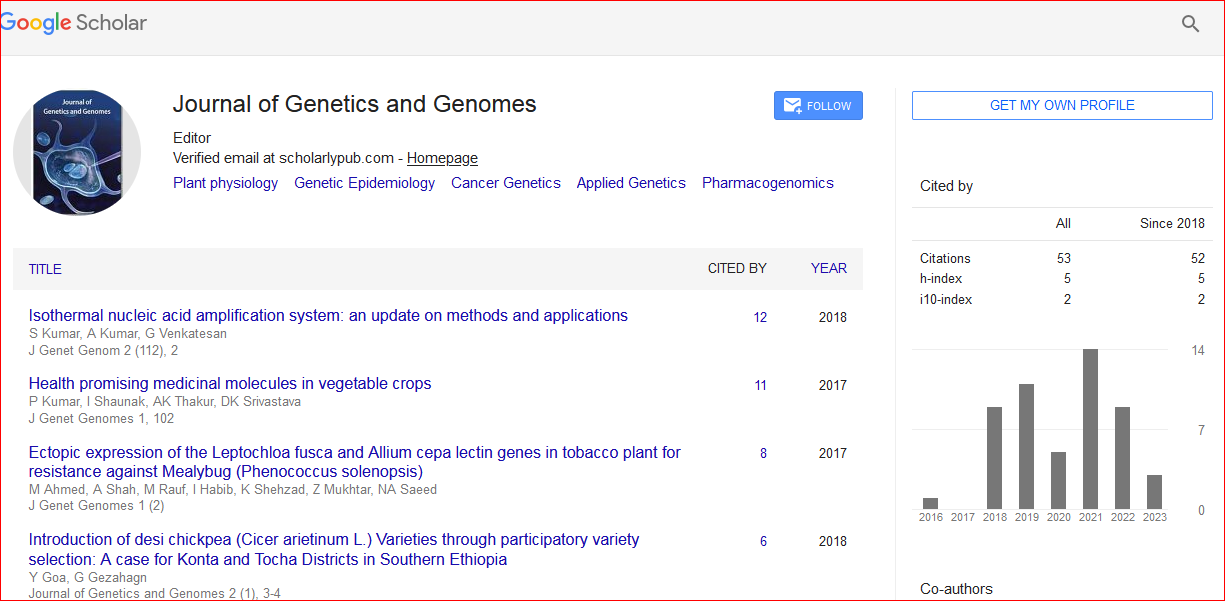
Journal of Genetics and Genomes received 65 citations as per Google Scholar report