Commentary - (2025) Volume 11, Issue 2
Received: 02-May-2025, Manuscript No. jotr-25-175579;
Editor assigned: 05-May-2025, Pre QC No. P-175579;
Reviewed: 19-May-2025, QC No. Q-175579;
Revised: 23-May-2025, Manuscript No. R-175579;
Published:
30-May-2025
, DOI: 10.37421/2476-2261. 2025.11.308
Citation: Roy, Claire. ”Genomics, AI: Revolutionizing Precision Cancer Research.” J Oncol Transl Res 11 (2025):308.
Copyright: © 2025 Roy C. This is an open-access article distributed under the terms of the Creative Commons Attribution License, which permits unrestricted use, distribution and reproduction in any medium, provided the original author and source are credited.
Precision oncology is evolving beyond traditional targeted therapies. It integrates comprehensive genomic profiling, liquid biopsies, and spatial transcriptomics to reveal complex tumor biology, opening new avenues for patient stratification and therapeutic strategies. Focus is on next-generation approaches addressing heterogeneity and resistance mechanisms [1].
Spatial multi-omics technologies show significant advancements in cancer research, providing an unprecedented view of tumor microenvironments, cellular interactions, and heterogeneity in their native tissue context. This is crucial for understanding disease progression and developing novel therapies [2].
Liquid biopsies have transformed cancer diagnosis and precision medicine. Recent innovations utilize circulating tumor DNA, cells, and extracellular vesicles for early detection, monitoring treatment response, and identifying minimal residual disease, offering a less invasive, more dynamic approach to cancer management [3].
Artificial Intelligence (AI) plays an increasing role in cancer research and clinical oncology. AI algorithms enhance interpretation of complex genomic data, improve diagnostic accuracy, predict treatment outcomes, and accelerate drug discovery, reshaping approaches to cancer challenges [4].
Understanding cancer immunogenomics is crucial for effective immunotherapies. This involves tracing basic immunogenomic insights to clinical practice, where genomic analysis of tumors and their microenvironment informs patient selection and personalized immunotherapeutic strategies [5].
Single-cell and spatial multi-omics present challenges and opportunities in cancer research. These techniques characterize tumor heterogeneity and cellular interactions with unprecedented resolution, offering insights that bulk sequencing cannot provide for therapeutic advancement [6].
Germline genetic testing for cancer risk has advanced significantly. This involves identifying inherited genetic variants that predispose individuals to cancer, with genomic testing increasingly informing preventive strategies and personalized surveillance programs [7].
Genomic approaches are critical for understanding and overcoming drug resistance in cancer. Various genomic strategies, including high-throughput sequencing and functional genomics, identify resistance mechanisms and guide development of new therapies or combination regimens to restore drug sensitivity [8].
Advances in cancer epigenetics and epigenomics reshape understanding of cancer development and progression. Epigenetic modifications, such as DNA methylation and histone modifications, contribute to oncogenesis. Targeting these alterations offers promising avenues for novel therapeutic interventions [9].
Genomic medicine and health equity in cancer are crucial topics. This highlights disparities in access to genomic technologies across populations, discussing challenges and solutions to ensure equitable distribution of advances and improved outcomes for all patients [10].
This article explores the evolving landscape of precision oncology, moving beyond traditional targeted therapies. It highlights how integrating comprehensive genomic profiling, liquid biopsies, and spatial transcriptomics is revealing complex tumor biology and opening new avenues for patient stratification and therapeutic strategies. The focus is on next-generation approaches that address heterogeneity and resistance mechanisms [1]. Understanding cancer immunogenomics is key to unlocking more effective immunotherapies. This review traces the journey from basic immunogenomic insights to their translation into clinical practice, explaining how genomic analysis of tumors and their microenvironment informs patient selection and the development of personalized immunotherapeutic strategies [5].
This review delves into the significant advancements and future prospects of spatial multi-omics technologies in cancer research. It details how these approaches provide an unprecedented view of tumor microenvironments, cellular interactions, and heterogeneity in their native tissue context, which is crucial for understanding disease progression and developing novel therapies [2]. This article looks at the challenges and opportunities presented by single-cell and spatial multi-omics in cancer research. What this really means is that these cutting-edge techniques are allowing scientists to characterize tumor heterogeneity and cellular interactions with unprecedented resolution, offering insights that bulk sequencing simply cannot provide for therapeutic advancement [6].
Here's the thing about liquid biopsies: they've transformed cancer diagnosis and precision medicine. This article summarizes recent innovations in using circulating tumor DNA, cells, and extracellular vesicles for early detection, monitoring treatment response, and identifying minimal residual disease, offering a less invasive and more dynamic approach to cancer management [3].
This article focuses on how genomic approaches are critical for both understanding and ultimately overcoming drug resistance in cancer. It outlines various genomic strategies, including high-throughput sequencing and functional genomics, used to identify resistance mechanisms and guide the development of new therapies or combination regimens to restore drug sensitivity [8]. Here's the deal: recent advances in cancer epigenetics and epigenomics are reshaping our understanding of cancer development and progression. This review discusses how epigenetic modifications, like DNA methylation and histone modifications, contribute to oncogenesis and how targeting these alterations offers promising avenues for novel therapeutic interventions [9].
This paper discusses the increasing role of Artificial Intelligence (AI) in both cancer research and clinical oncology. It covers how AI algorithms are enhancing our ability to interpret complex genomic data, improve diagnostic accuracy, predict treatment outcomes, and accelerate drug discovery, essentially reshaping how we approach cancer challenges [4]. Let's break down germline genetic testing for cancer risk: it's come a long way. This paper reviews the historical context, current state, and future directions of identifying inherited genetic variants that predispose individuals to cancer. It emphasizes how genomic testing is increasingly informing preventive strategies and personalized surveillance programs [7]. This piece addresses a crucial topic: genomic medicine and health equity in cancer. It highlights the disparities in access to and benefits from genomic technologies across different populations, discussing the challenges and potential solutions to ensure that advances in cancer genomics are equitably distributed and improve outcomes for all patients [10].
Cancer research is rapidly advancing, moving beyond traditional approaches to integrate sophisticated genomic and multi-omics technologies. Precision oncology now leverages comprehensive genomic profiling, liquid biopsies, and spatial transcriptomics to understand complex tumor biology, address heterogeneity, and overcome resistance mechanisms. Liquid biopsies, for example, have revolutionized diagnosis and monitoring by utilizing circulating tumor DNA and cells, providing less invasive, dynamic insights into disease progression. Advanced spatial multi-omics and single-cell technologies offer unprecedented resolution to characterize tumor microenvironments and cellular interactions, which bulk sequencing often misses. This deeper understanding is crucial for developing novel therapies and personalized immunotherapeutic strategies, informed by cancer immunogenomics. Researchers are also using genomic approaches to identify and overcome drug resistance, and exploring how epigenetic modifications contribute to oncogenesis, presenting new therapeutic targets. Artificial Intelligence (AI) is enhancing interpretation of complex genomic data, improving diagnostics, predicting outcomes, and accelerating drug discovery. Meanwhile, germline genetic testing is evolving to better identify inherited cancer risks, guiding preventive strategies. A critical aspect of these advances is ensuring health equity, addressing disparities in access to genomic medicine for all patients.
None
None
Sangjoon H, Chang HL, Hyoyoung D. "Precision oncology beyond targeted therapy: current landscape and future directions".Exp Mol Med 56 (2024):618-636.
Indexed at, Google Scholar, Crossref
Pengcheng L, Shuai L, Qi Z. "Spatial multi-omics in cancer: recent advances and future perspectives".Oncogene 42 (2023):3825-3837.
Indexed at, Google Scholar, Crossref
Lin X, Xinyu Z, Ying M. "Recent advances in liquid biopsy for cancer diagnosis and precision medicine".Theranostics 13 (2023):5544-5569.
Indexed at, Google Scholar, Crossref
Kai-Hung Y, Andrew LB, Isaac SK. "Artificial intelligence in cancer research and clinical oncology".Nat Med 29 (2023):9-22.
Indexed at, Google Scholar, Crossref
Xueying W, Xuan W, Shengli H. "Cancer immunogenomics: from basic understanding to clinical translation".J Exp Clin Cancer Res 42 (2023):210.
Indexed at, Google Scholar, Crossref
Meng L, Zhaoyu J, Jiasheng M. "Single-cell and spatial multi-omics in cancer: Challenges and opportunities".Trends Cancer 9 (2023):594-607.
Indexed at, Google Scholar, Crossref
Fergus JC, Katherine LN, Kenneth O. "Germline genetic testing for cancer risk: past, present, and future".Cell 184 (2021):1481-1491.
Indexed at, Google Scholar, Crossref
Dror R, Roni G, Raya Y. "Genomic approaches to understanding and overcoming drug resistance in cancer".Nat Rev Genet 24 (2023):831-849.
Indexed at, Google Scholar, Crossref
Wanling L, Mian J, Xiaoli S. "Recent advances in cancer epigenetics and epigenomics".Cancer Cell Int 23 (2023):185.
Indexed at, Google Scholar, Crossref
Noura SA, Lisa MH, Jennifer MO. "Genomic Medicine and Health Equity in Cancer".Clin Cancer Res 29 (2023):1395-1402.
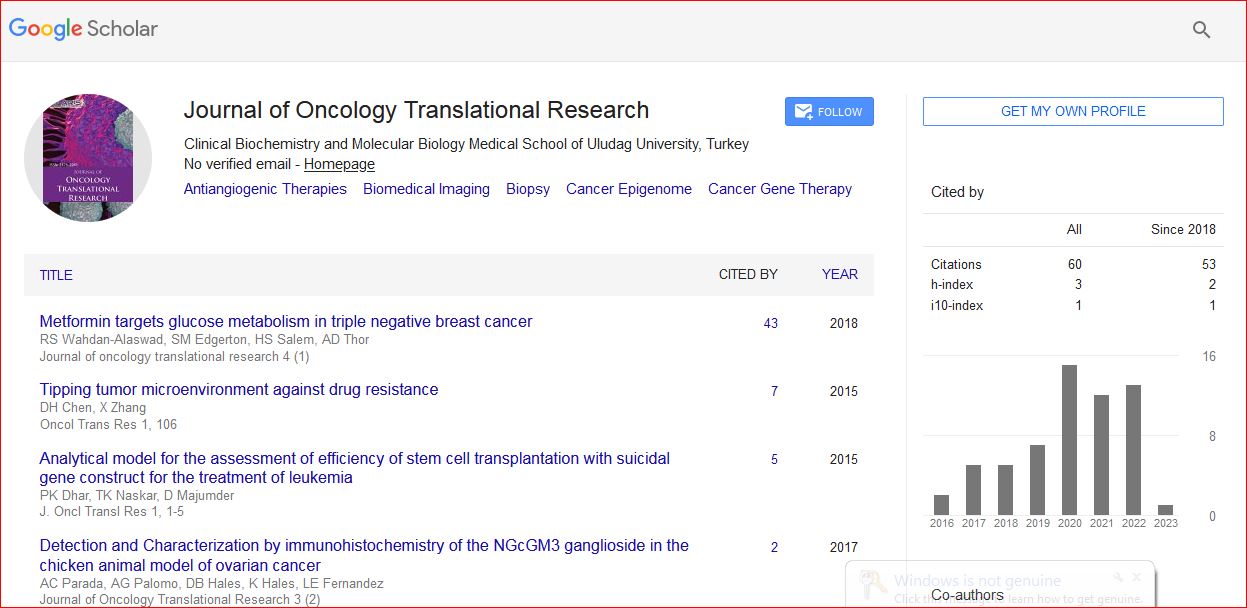
Journal of Oncology Translational Research received 93 citations as per Google Scholar report