Commentary - (2025) Volume 9, Issue 2
Received: 02-Apr-2025, Manuscript No. jgge-25-173720;
Editor assigned: 04-Apr-2025, Pre QC No. P-173720;
Reviewed: 18-Apr-2025, QC No. Q-173720;
Revised: 23-Apr-2025, Manuscript No. R-173720;
Published:
30-Apr-2025
, DOI: 10.37421/2684-4567.2025.9.158
Citation: Chen, Laura M.. ”Genomic Technologies: Transforming Health, Agriculture, Science.” J Genet Genom 09 (2025):158.
Copyright: © 2025 Chen M. Laura This is an open-access article distributed under the terms of the Creative Commons Attribution License, which permits unrestricted use,
distribution and reproduction in any medium, provided the original author and source are credited.
This review sheds light on the rapid advancements in tumor genomic sequencing, detailing how these technologies are actively shaping the move toward precision oncology. It emphasizes how understanding a tumor's genetic makeup directly guides tailored treatment strategies, aiming for more effective patient care. Essentially, it's about using the tumor's own blueprint to fight cancer smarter[1].
Here's the thing, single-cell omics technologies are fundamentally transforming how we investigate human diseases. This article explores their technical evolution, highlighting how these methods allow for an unprecedented granular view of biological systems, offering deeper insights into disease mechanisms and potential therapeutic targets. What this really means is we can now analyze individual cells, not just bulk tissues, which gives us a much clearer picture of disease heterogeneity[2].
This review focuses on the current evidence supporting whole-genome sequencing (WGS) for diagnosing rare diseases in children. It's clear that WGS is becoming a game-changer, improving diagnostic yield and reducing diagnostic odysseys for young patients. The paper essentially consolidates what we know about WGS's practical diagnostic power in this critical area[3].
Let's break it down: circulating tumor DNA (ctDNA) is a powerful tool in cancer management, and this paper highlights its growing clinical applications. It discusses how ctDNA-based genomic sequencing offers a non-invasive way to detect cancer early, monitor treatment response, and track disease progression. This represents a significant shift towards less invasive and more precise cancer care[4].
This article explores how genomic selection and gene editing are being applied to develop climate-resilient crops. It discusses the theoretical underpinnings and practical applications, showcasing how genomic sequencing is crucial for accelerating crop improvement to address global food security challenges. We're talking about using genetics to help plants adapt to our changing world[5].
This review delves into the genomics of common diseases, giving us a snapshot of the current understanding and future directions. It highlights how large-scale genomic sequencing efforts are unraveling the complex genetic architecture underlying prevalent conditions, pushing us closer to preventive and personalized medicine. Essentially, we are using genomic data to decode widespread health issues[6].
Here's an important insight: genomic epidemiology has been pivotal, especially with SARS-CoV-2, demonstrating its power in tracking and understanding infectious disease outbreaks. This article illustrates how genomic sequencing enables rapid pathogen identification, phylogenetic analysis, and informed public health responses. It's about using genetic data to trace outbreaks and guide interventions in real-time[7].
This review delves into the use of circulating tumor DNA (ctDNA) in clinical oncology, highlighting both its immense promise and the challenges that still need addressing. It emphasizes ctDNA's potential as a non-invasive diagnostic and monitoring tool, while also discussing the technical and clinical hurdles for its widespread integration. What this really means is we're excited about this approach, but there's still work to do to make it universally effective[8].
This paper offers a critical look at the current state of epigenomic sequencing technologies in clinical oncology. It highlights how these methods are crucial for understanding epigenetic changes in cancer, which can provide insights beyond just DNA sequence. Knowing this helps us discover new biomarkers and develop therapies that target these epigenetic modifications, essentially adding another layer to our understanding of cancer[9].
Pharmacogenomics is really about personalizing medicine by using an individual's genetic profile to predict drug responses. This review discusses the recent advances and challenges in implementing pharmacogenomic sequencing into routine clinical practice. The idea is to move beyond trial-and-error prescribing and use genomic insights to optimize drug selection and dosage, making treatments more effective and safer for everyone[10].
Rapid advancements in tumor genomic sequencing are actively shaping the move toward precision oncology, emphasizing how understanding a tumor's genetic makeup directly guides tailored treatment strategies, aiming for more effective patient care [1]. Here's the thing, single-cell omics technologies are fundamentally transforming how we investigate human diseases, allowing for an unprecedented granular view of biological systems and offering deeper insights into disease mechanisms and potential therapeutic targets. What this really means is we can now analyze individual cells, not just bulk tissues, which gives us a much clearer picture of disease heterogeneity [2]. This review focuses on the current evidence supporting whole-genome sequencing (WGS) for diagnosing rare diseases in children. It's clear that WGS is becoming a game-changer, improving diagnostic yield and reducing diagnostic odysseys for young patients. The paper essentially consolidates what we know about WGS's practical diagnostic power in this critical area [3].
Let's break it down: circulating tumor DNA (ctDNA) is a powerful tool in cancer management, and this paper highlights its growing clinical applications. It discusses how ctDNA-based genomic sequencing offers a non-invasive way to detect cancer early, monitor treatment response, and track disease progression. This represents a significant shift towards less invasive and more precise cancer care [4]. This review also delves into the use of circulating tumor DNA (ctDNA) in clinical oncology, highlighting both its immense promise and the challenges that still need addressing. It emphasizes ctDNA's potential as a non-invasive diagnostic and monitoring tool, while also discussing the technical and clinical hurdles for its widespread integration. What this really means is we're excited about this approach, but there's still work to do to make it universally effective [8]. This paper offers a critical look at the current state of epigenomic sequencing technologies in clinical oncology. It highlights how these methods are crucial for understanding epigenetic changes in cancer, which can provide insights beyond just DNA sequence. Knowing this helps us discover new biomarkers and develop therapies that target these epigenetic modifications, essentially adding another layer to our understanding of cancer [9].
This review delves into the genomics of common diseases, giving us a snapshot of the current understanding and future directions. It highlights how large-scale genomic sequencing efforts are unraveling the complex genetic architecture underlying prevalent conditions, pushing us closer to preventive and personalized medicine. Essentially, we are using genomic data to decode widespread health issues [6]. Pharmacogenomics is really about personalizing medicine by using an individual's genetic profile to predict drug responses. This review discusses the recent advances and challenges in implementing pharmacogenomic sequencing into routine clinical practice. The idea is to move beyond trial-and-error prescribing and use genomic insights to optimize drug selection and dosage, making treatments more effective and safer for everyone [10].
This article explores how genomic selection and gene editing are being applied to develop climate-resilient crops. It discusses the theoretical underpinnings and practical applications, showcasing how genomic sequencing is crucial for accelerating crop improvement to address global food security challenges. We're talking about using genetics to help plants adapt to our changing world [5]. Here's an important insight: genomic epidemiology has been pivotal, especially with SARS-CoV-2, demonstrating its power in tracking and understanding infectious disease outbreaks. This article illustrates how genomic sequencing enables rapid pathogen identification, phylogenetic analysis, and informed public health responses. It's about using genetic data to trace outbreaks and guide interventions in real-time [7].
Genomic sequencing technologies are rapidly changing how we approach diverse challenges, from healthcare to agriculture. These advancements are central to precision oncology, using a tumor's genetic blueprint to guide tailored cancer treatments and improve patient care. We're also seeing breakthroughs with single-cell omics, allowing scientists to investigate human diseases at an unprecedented granular level, uncovering deeper insights into disease mechanisms and potential therapeutic targets by analyzing individual cells. Whole-genome sequencing is proving to be a game-changer for diagnosing rare diseases in children, significantly improving diagnostic yield and reducing prolonged diagnostic journeys. In cancer management, circulating tumor DNA (ctDNA) offers a non-invasive method for early detection, monitoring treatment response, and tracking disease progression, representing a major shift towards more precise cancer care. Beyond medicine, genomic selection and gene editing are being harnessed to develop climate-resilient crops, addressing global food security challenges by helping plants adapt to a changing world. Large-scale genomic efforts are also decoding the complex genetic architecture of common diseases, pushing us closer to preventive and personalized medicine. Genomic epidemiology has shown its critical role, especially with SARS-CoV-2, by enabling rapid pathogen identification and guiding real-time public health responses. Furthermore, epigenomic sequencing provides crucial insights into epigenetic changes in cancer, helping identify new biomarkers and therapies. Finally, pharmacogenomics is advancing personalized medicine, using genetic profiles to predict drug responses and optimize drug selection and dosage for safer, more effective treatments.
None
None
1. Dong JO, Jae SK, Tae JK. "Recent advances in tumor genomic sequencing to guide precision oncology".J Korean Med Sci 38 (2023):e146.
Indexed at, Google Scholar, Crossref
2. Xiaorong X, Zihao L, Chao MZ. "Single-cell omics: a technological evolution in human disease research".Front Cell Dev Biol 10 (2022):1009028.
Indexed at, Google Scholar, Crossref
3. Essi KS, Aino KT, Peter T. "Whole-genome sequencing for rare disease diagnosis in children: A review of the current evidence".Clin Genet 102 (2022):353-360.
Indexed at, Google Scholar, Crossref
4. Davina CSL, Raymond MCC, Cho JK. "Clinical applications of circulating tumor DNA in cancer management".Nat Rev Clin Oncol 19 (2022):513-529.
Indexed at, Google Scholar, Crossref
5. Yuan SH, Yu KW, Chun XL. "Genomic selection for climate-resilient crops: from theory to application".Theor Appl Genet 135 (2022):3183-3199.
Indexed at, Google Scholar, Crossref
6. Hamish JB, Michael ND, David JP. "Current Opinion in Genetics & Development: Genomics of common disease".Curr Opin Genet Dev 69 (2021):11-16.
Indexed at, Google Scholar, Crossref
7. Nicholas JL, Christopher EAB, M. CC. "Genomic epidemiology in action: SARS-CoV-2 and beyond".Genome Med 12 (2020):75.
Indexed at, Google Scholar, Crossref
8. Dong HH, Ling RL, Man CJ. "Circulating tumor DNA in clinical oncology: promises and challenges".J Hematol Oncol 14 (2021):75.
Indexed at, Google Scholar, Crossref
9. Dong HK, Jung SL, Sang KP. "Current status of epigenomic sequencing technologies in clinical oncology".Cancers (Basel) 13 (2021):4883.
Indexed at, Google Scholar, Crossref
10. Joshua SJ, Theresa HE, Amber EE. "Pharmacogenomics in precision medicine: advances and implementation".Pharmacogenomics 22 (2021):299-308.
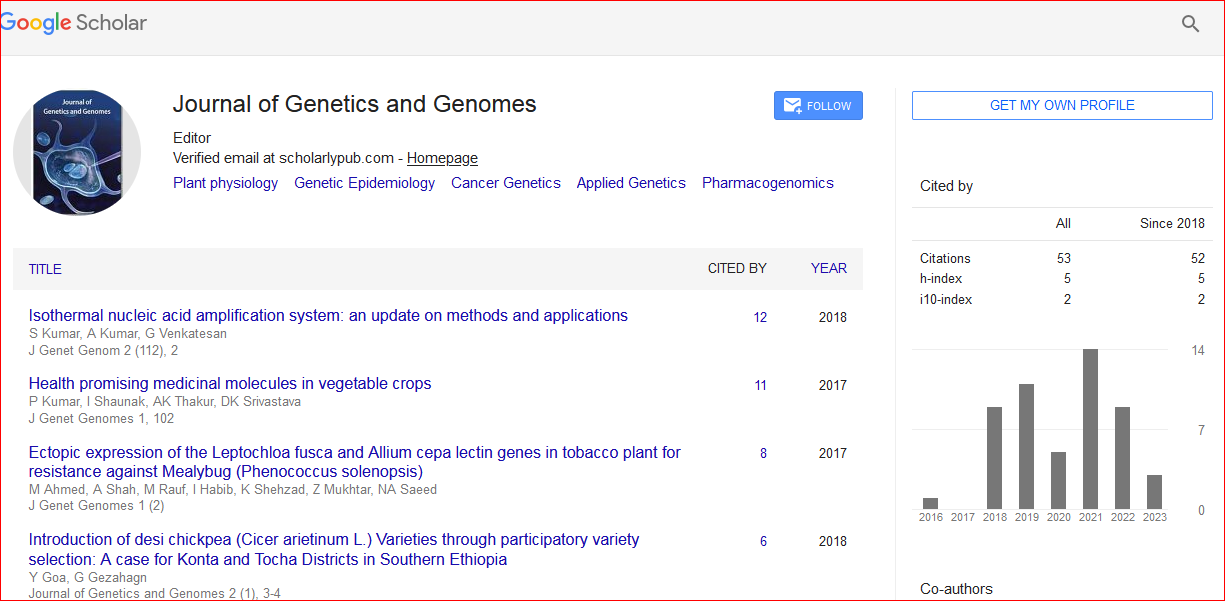
Journal of Genetics and Genomes received 65 citations as per Google Scholar report