Opinion - (2025) Volume 15, Issue 3
Received: 01-May-2025, Manuscript No. jnt-26-178934;
Editor assigned: 05-May-2025, Pre QC No. P-178934;
Reviewed: 18-May-2025, QC No. Q-178934;
Revised: 22-May-2025, Manuscript No. R-178934;
Published:
29-May-2025
, DOI: 10.37421/2161-0959.2025.15.564
Citation: Salem, Amira Ben. ”Genetics Driving Advances in Kidney Disease Understanding.” J Nephrol Ther 15 (2025):564.
Copyright: © 2025 Salem B. Amira This is an open-access article distributed under the terms of the Creative Commons Attribution License, which permits unrestricted use, distribution and reproduction in any medium, provided the original author and source are credited.
The profound influence of genetic factors on the development and progression of inherited kidney disorders cannot be overstated. These conditions, often complex and multifactorial, present a significant challenge to both clinicians and researchers seeking to unravel their underlying mechanisms and develop effective therapeutic strategies. This review aims to synthesize current knowledge by examining key contributions from recent literature, offering a comprehensive overview of this critical area of nephrology. The foundational role of genetics in inherited kidney diseases is clearly articulated in recent research. Investigations into the molecular underpinnings of various conditions have highlighted the intricate pathways involved, underscoring the necessity of genetic screening and dedicated counseling for affected families. The rapid advancements in gene identification have opened promising avenues for the development of highly targeted therapies, offering new hope for patients and their relatives [1].
Furthermore, the transformative impact of modern genomic technologies on the diagnostic landscape of rare inherited kidney diseases is a pivotal aspect of ongoing research. Tools such as whole-exome and whole-genome sequencing have revolutionized the ability to pinpoint novel genetic mutations and elucidate complex genotype-phenotype correlations. This enhanced understanding is directly translating into improved patient management and the refinement of potential therapeutic strategies, marking a significant leap forward in precision nephrology [2].
A prominent example of an inherited kidney disorder with a well-defined genetic basis is Polycystic Kidney Disease (PKD). This prevalent condition, a leading cause of inherited kidney failure, is the subject of extensive study focusing on its genetic and molecular underpinnings. Research delves into the distinct genetic etiologies of autosomal dominant PKD (ADPKD) and autosomal recessive PKD (ARPKD), with a particular emphasis on the critical roles of polycystin proteins in the formation of renal cysts and explorations into emerging therapeutic interventions [3].
Nephrotic syndrome, a complex clinical entity characterized by significant proteinuria, can also arise from a variety of inherited genetic defects that impair podocyte function. Significant progress has been made in mapping the genetic landscape of congenital and infantile forms of nephrotic syndrome. Key genes such as NPHS1, NPHS2, and INF2 have been identified, with their critical functions in maintaining the integrity of the glomerular filtration barrier being increasingly understood. This knowledge is vital for accurate diagnosis and tailored management [4].
Alport syndrome, a debilitating inherited disorder, is primarily attributed to mutations in genes encoding collagen IV, specifically COL4A3, COL4A4, and COL4A5. Research in this area continues to explore the diverse clinical manifestations associated with different mutation types and critically examines recent advancements in therapeutic strategies aimed at slowing or halting disease progression. The genetic insights are paving the way for more effective interventions [5].
Beyond the more commonly recognized conditions, a spectrum of genetic tubulointerstitial diseases exists, representing a heterogeneous group of disorders affecting kidney function. Recent work has illuminated the genetic causes, biochemical pathways involved, and clinical consequences of inherited tubular disorders, including Dent's disease and Bartter syndrome. This understanding is crucial for differentiating and managing these complex conditions [6].
Cystic kidney diseases constitute a broad category where genetic factors are central to their pathogenesis. While Polycystic Kidney Disease is a major focus, ongoing research also investigates other inherited cystic conditions, such as medullary cystic kidney disease (MCKD) and fibrocystic disease. These studies are vital for distinguishing their distinct genetic etiologies and clinical trajectories, broadening our understanding of cystic kidney pathology [7].
The integration of genetic knowledge into the clinical management of inherited kidney disorders is revolutionizing patient care. Current strategies increasingly leverage genetic testing for risk stratification and the development of personalized medicine approaches. This includes the exploration of innovative therapies such as gene therapy and small molecule inhibitors, promising more effective and individualized treatment plans for these complex diseases [8].
Familial focal segmental glomerulosclerosis (FSGS) represents a significant proportion of inherited glomerular diseases, with its genetic basis being a key area of investigation. Research has identified critical genes, including NPHS1, NPHS2, and INF2, which play essential roles in the structure and function of podocytes. Understanding these genetic determinants is paramount for developing targeted interventions for familial FSGS and related glomerular pathologies [9].
The diagnostic and prognostic utility of identifying genetic variants in inherited kidney disorders is profound and continues to evolve. Genetic testing serves as an indispensable tool in diagnostic workups, aiding in prognostication and informing family planning decisions. This systematic approach ultimately enhances the comprehensive management and care provided to patients and their at-risk relatives, marking a new era in nephrological practice [10].
The significant role of genetic factors in the pathogenesis of inherited kidney disorders is a cornerstone of current nephrological research. Studies are meticulously detailing the molecular mechanisms that underpin various inherited conditions, highlighting the critical importance of genetic screening and comprehensive counseling for affected families. The continuous progress in identifying specific genes involved offers substantial potential for the development of targeted therapeutic interventions that can address the root causes of these diseases [1].
Advancements in sophisticated genomic technologies, including whole-exome and whole-genome sequencing, have profoundly reshaped the diagnostic landscape for rare inherited kidney diseases. These powerful tools are being effectively utilized to identify novel genetic mutations and to gain a deeper understanding of genotype-phenotype correlations. This improved diagnostic capability directly leads to more effective patient management strategies and opens new pathways for developing innovative therapeutic approaches [2].
Polycystic kidney disease (PKD), a condition that stands as a leading cause of inherited kidney failure, is a prime example of the intricate genetic architecture of kidney disorders. Extensive research is dedicated to understanding the genetic underpinnings of both autosomal dominant PKD (ADPKD) and autosomal recessive PKD (ARPKD). Focus is placed on elucidating the functions of polycystin proteins and their direct implications in the complex process of cyst formation, alongside explorations into emerging therapeutic avenues that target these pathways [3].
Nephrotic syndrome, a debilitating clinical manifestation of kidney disease, can frequently stem from a variety of inherited genetic defects that specifically affect podocyte function. Significant efforts are being directed towards characterizing the genetic landscape of congenital and infantile nephrotic syndromes. Key genes such as NPHS1, NPHS2, and INF2 have been identified as crucial players in maintaining the integrity of the glomerular filtration barrier, a vital component of healthy kidney function [4].
Alport syndrome, a well-defined inherited disorder characterized by hematuria, proteinuria, and progressive renal failure, is predominantly caused by mutations within the collagen IV genes, namely COL4A3, COL4A4, and COL4A5. Current research meticulously discusses the diverse clinical manifestations that can arise from different types of mutations and critically highlights recent therapeutic strategies that are being developed to mitigate the progression of this devastating disease [5].
Inherited tubulointerstitial diseases encompass a heterogeneous group of disorders that affect the kidney tubules and the surrounding interstitium. This area of research focuses on elucidating the genetic causes of inherited tubular disorders such as Dent's disease and Bartter syndrome, detailing the specific biochemical pathways that are disrupted and the resultant clinical consequences for overall kidney function [6].
Cystic kidney diseases represent a broad and complex category of renal disorders where genetic factors play a central and often defining role. Beyond the more extensively studied Polycystic Kidney Disease, ongoing research is actively exploring other inherited cystic conditions, including medullary cystic kidney disease (MCKD) and fibrocystic disease. These investigations aim to clarify their distinct genetic etiologies and divergent clinical trajectories, providing a more complete picture of cystic kidney pathologies [7].
The clinical management of inherited kidney disorders is being increasingly informed and guided by a deeper genetic understanding. This evolving landscape includes a thorough examination of the current state of genetic testing, the refinement of risk stratification methodologies, and the active development of precision medicine approaches. These advanced strategies encompass promising interventions like gene therapy and the use of small molecule inhibitors, tailored for the specific genetic profiles of these complex conditions [8].
Familial focal segmental glomerulosclerosis (FSGS) stands out as a significant subset of inherited glomerular diseases, with its genetic basis being a critical area of ongoing research. This work delves into the specific genetic underpinnings of familial FSGS, spotlighting key genes such as NPHS1, NPHS2, and INF2. The crucial roles these genes play in the structure and function of podocytes are being further elucidated, offering vital insights into disease mechanisms [9].
The clinical implications stemming from the identification of genetic variants in inherited kidney disorders are far-reaching and transformative. This area of study emphasizes the practical utility of genetic testing in comprehensive diagnostic workups, its role in accurate prognostication, and its significant value in guiding reproductive and family planning decisions. Ultimately, this comprehensive approach enhances the overall management and care provided to patients and their relatives [10].
Inherited kidney disorders are significantly influenced by genetic factors, with ongoing research revealing intricate molecular mechanisms and the importance of genetic screening and counseling. Genomic technologies like whole-exome and whole-genome sequencing are revolutionizing diagnosis by identifying novel mutations and improving patient management. Polycystic kidney disease (PKD), Alport syndrome, and nephrotic syndrome are prominent examples where specific genes and their roles in kidney function are being elucidated. Research also covers genetic tubulointerstitial and other cystic kidney diseases, broadening the understanding of renal pathologies. The field of precision medicine is advancing, with genetic insights guiding the development of targeted therapies such as gene therapy and small molecule inhibitors. Genetic testing plays a crucial role in diagnosis, prognosis, and family planning, leading to improved care for patients and their families.
None
None
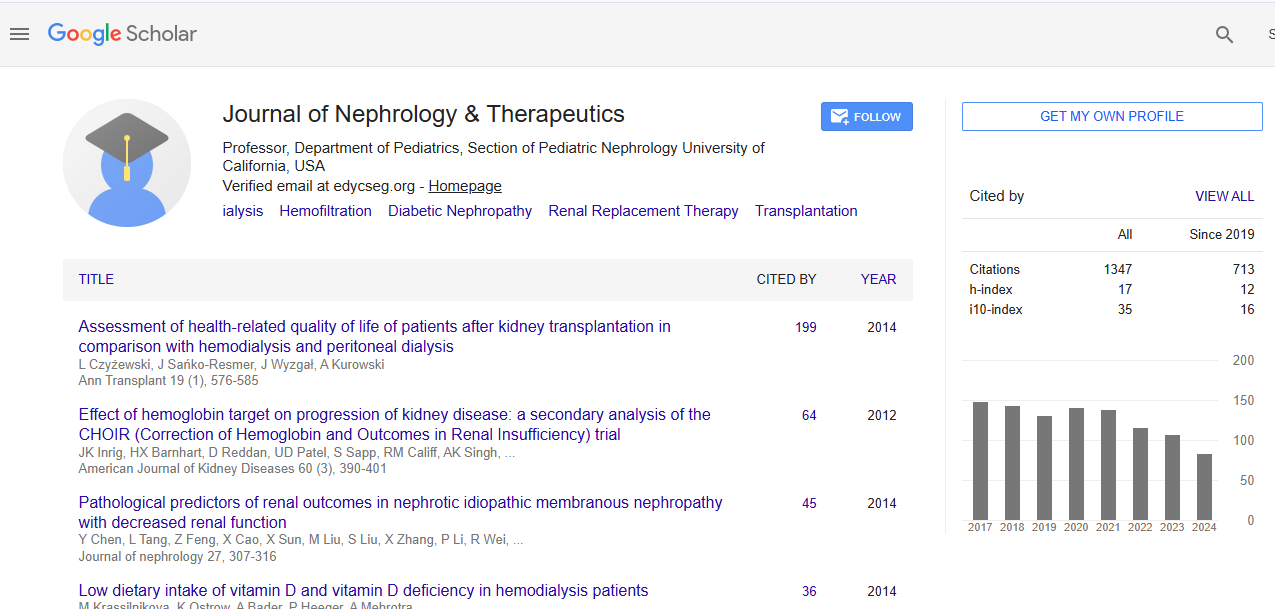
Journal of Nephrology & Therapeutics received 784 citations as per Google Scholar report