Brief Report - (2025) Volume 14, Issue 5
Received: 02-Oct-2025, Manuscript No. jsp-26-182272;
Editor assigned: 06-Oct-2025, Pre QC No. P-182272;
Reviewed: 20-Oct-2025, QC No. Q-182272;
Revised: 23-Oct-2025, Manuscript No. R-182272;
Published:
30-Oct-2025
, DOI: 10.37421/2165-7939.2025.14.741
Citation: Rahman, Noor A.. ”Genetics: A Major Driver Of Spine Disease.” J Spine 14 (2025):741.
Copyright: © 2025 Rahman A. Noor This is an open-access article distributed under the terms of the Creative Commons Attribution License, which permits unrestricted use, distribution and reproduction in any medium, provided the original author and source are credited.
Genetics plays a significant role in the development and progression of degenerative spine diseases, influencing factors such as disc degeneration, osteoarthritis, and osteoporosis. Polymorphisms in genes involved in matrix synthesis and degradation, inflammation, and bone metabolism are associated with an increased risk and severity of these conditions. Understanding these genetic underpinnings can pave the way for personalized treatment strategies and potential gene-based therapies [1].
Genetic susceptibility to lumbar spinal stenosis is influenced by several gene variants. Studies have identified associations between specific polymorphisms in genes related to inflammation, extracellular matrix remodeling, and vitamin D metabolism and the risk and severity of this condition. This highlights the complex interplay of genetic factors in the pathogenesis of spinal stenosis [2].
Osteoporosis, a key factor in vertebral compression fractures, has a strong genetic component. Genome-wide association studies (GWAS) have identified numerous loci associated with bone mineral density and fracture risk. Genes involved in bone formation, resorption, and hormonal regulation are implicated, underscoring the genetic influence on skeletal integrity [3].
The heritability of low back pain, often linked to degenerative spine conditions, is substantial. Genetic factors influence pain perception, inflammatory responses, and tissue susceptibility. Research into specific gene variants affecting neurotransmitter systems and inflammatory pathways provides insights into why some individuals are more prone to chronic low back pain [4].
Intervertebral disc degeneration (IVDD) has a significant genetic contribution. Polymorphisms in genes encoding matrix metalloproteinases (MMPs) and their inhibitors (TIMPs), as well as genes involved in collagen and aggrecan synthesis, are associated with IVDD. These findings highlight the molecular mechanisms by which genetic variations impact disc health [5].
Facet joint osteoarthritis (FJOA) is a common cause of spinal pain, and genetic factors play a role in its development. Variations in genes involved in cartilage homeostasis, inflammation, and bone remodeling are linked to increased FJOA susceptibility. This suggests that genetic predisposition can accelerate the degenerative process in spinal facet joints [6].
Familial clustering of degenerative spine diseases suggests a significant hereditary component. Studies examining family histories and twin studies consistently show that genetics influences the risk and age of onset of conditions like degenerative disc disease and spinal stenosis [7].
The role of epigenetics, such as DNA methylation and microRNA expression, is emerging in the context of degenerative spine diseases. Environmental factors can interact with genetic predispositions through epigenetic modifications, influencing gene expression and contributing to disease development and progression [8].
Genetic variations in genes involved in ossification and bone formation are implicated in the development of diffuse idiopathic skeletal hyperostosis (DISH), a common degenerative spinal condition. Understanding these genetic pathways can help identify individuals at risk and potentially inform therapeutic interventions [9].
The impact of genetic factors on the response to surgical treatment for degenerative spine diseases is an area of active research. Individual genetic profiles may influence healing, inflammatory responses post-surgery, and the likelihood of successful outcomes, suggesting a future role for pharmacogenomics in spinal surgery [10].
The development and progression of degenerative spine diseases are significantly influenced by genetic factors, impacting conditions such as disc degeneration, osteoarthritis, and osteoporosis. Polymorphisms within genes crucial for matrix synthesis and degradation, inflammation, and bone metabolism have been identified as contributors to the increased risk and severity of these spinal conditions. A comprehensive understanding of these genetic underpinnings is essential for the advancement of personalized treatment strategies and the development of potential gene-based therapeutic approaches [1].
Lumbar spinal stenosis exhibits genetic susceptibility influenced by various gene variants. Research has established associations between specific gene polymorphisms, particularly those involved in inflammatory processes, extracellular matrix remodeling, and vitamin D metabolism, and the overall risk and severity of this condition. This underscores the intricate genetic mechanisms contributing to the pathogenesis of spinal stenosis [2].
Osteoporosis, a critical factor in the occurrence of vertebral compression fractures, possesses a substantial genetic component. Genome-wide association studies (GWAS) have successfully identified numerous genetic loci linked to bone mineral density and fracture susceptibility. Genes implicated in bone formation, resorption, and hormonal regulation are demonstrably involved, highlighting the pervasive genetic influence on skeletal integrity [3].
The heritability of low back pain, frequently associated with degenerative spine disorders, is considerable. Genetic factors exert influence over pain perception thresholds, inflammatory cascade responses, and tissue vulnerability. Investigations into specific gene variants that affect neurotransmitter systems and inflammatory pathways offer valuable insights into the predisposition of certain individuals to chronic low back pain [4].
Intervertebral disc degeneration (IVDD) is characterized by a significant genetic contribution. Polymorphisms found in genes responsible for encoding matrix metalloproteinases (MMPs) and their inhibitors (TIMPs), as well as genes integral to collagen and aggrecan synthesis, are consistently associated with IVDD. These findings illuminate the molecular pathways through which genetic variations can adversely affect disc health [5].
Facet joint osteoarthritis (FJOA), a prevalent source of spinal pain, is also influenced by genetic factors in its pathogenesis. Variations in genes that regulate cartilage homeostasis, inflammation, and bone remodeling processes have been linked to an increased susceptibility to FJOA. This association suggests that a genetic predisposition can serve to accelerate the degenerative cascade within spinal facet joints [6].
Evidence from the familial clustering of degenerative spine diseases strongly indicates a significant hereditary basis. Studies that have systematically examined family histories and conducted twin studies consistently demonstrate that genetic factors play a crucial role in determining both the risk and the age of onset for conditions such as degenerative disc disease and spinal stenosis [7].
The emerging role of epigenetics, encompassing mechanisms like DNA methylation and microRNA expression, is becoming increasingly recognized within the context of degenerative spine diseases. Environmental factors have the capacity to interact with inherent genetic predispositions through these epigenetic modifications, thereby altering gene expression patterns and contributing to disease initiation and progression [8].
Genetic variations affecting genes involved in ossification and bone formation processes are implicated in the etiology of diffuse idiopathic skeletal hyperostosis (DISH), a common degenerative spinal condition. A thorough understanding of these genetic pathways is paramount for identifying individuals at elevated risk and for informing the development of targeted therapeutic interventions [9].
The influence of genetic factors on the efficacy and outcomes of surgical interventions for degenerative spine diseases represents a dynamic area of ongoing research. Individual genetic profiles have the potential to modulate factors such as tissue healing rates, post-operative inflammatory responses, and the overall probability of successful surgical results, pointing towards a future where pharmacogenomics plays a vital role in spinal surgery [10].
Degenerative spine diseases, including disc degeneration, osteoarthritis, and osteoporosis, are significantly influenced by genetic factors. Gene polymorphisms related to matrix synthesis, inflammation, and bone metabolism are linked to increased risk and severity. Lumbar spinal stenosis and facet joint osteoarthritis also show genetic predispositions. Osteoporosis, a key factor in vertebral fractures, has a strong genetic basis, with identified loci affecting bone density. Low back pain heritability is substantial, influenced by genetic impacts on pain perception and inflammation. Intervertebral disc degeneration is linked to variations in MMPs and collagen synthesis genes. Familial studies confirm a hereditary component. Epigenetic modifications also play a role. Genetic factors may even influence surgical outcomes, suggesting a future for pharmacogenomics in spinal surgery.
None
None
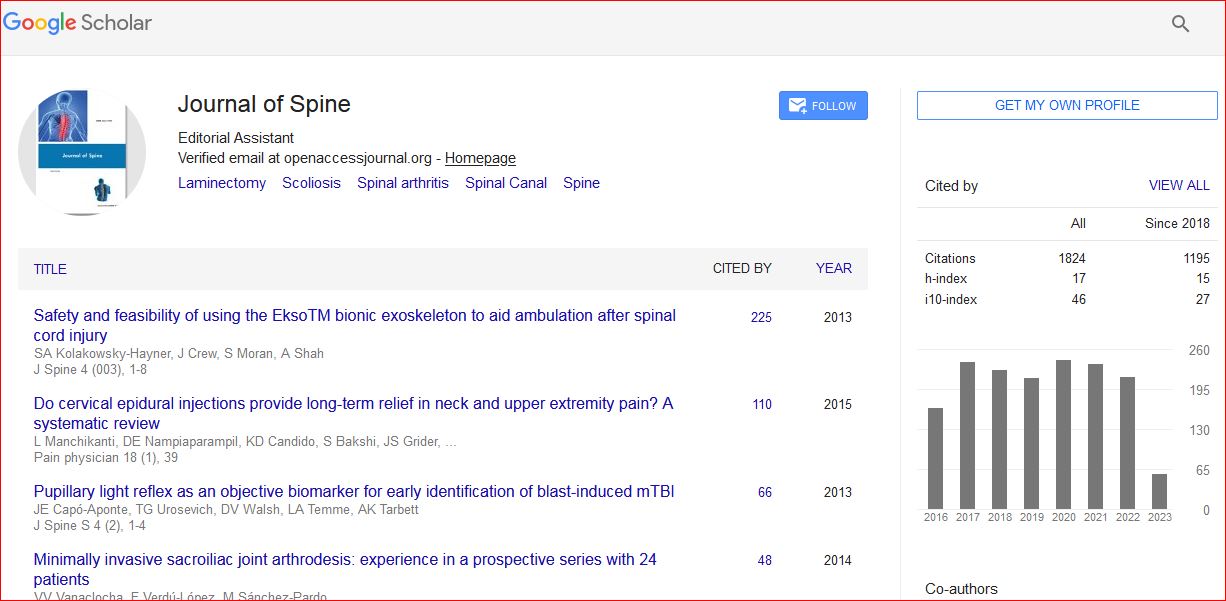
Journal of Spine received 2022 citations as per Google Scholar report