Short Communication - (2025) Volume 16, Issue 2
Received: 01-May-2025, Manuscript No. hgec-25-174733;
Editor assigned: 05-May-2025, Pre QC No. P-174733;
Reviewed: 19-May-2025, QC No. Q-174733;
Revised: 22-May-2025, Manuscript No. R-174733;
Published:
29-May-2025
, DOI: 10.37421/2161-0436.2025.16.288
Citation: Larsen, Sofia. ”Genetic Markers: Powering Precision & Personalized Solutions.” Human Genet Embryol 16 (2025):288.
Copyright: © 2025 Larsen S. This is an open-access article distributed under the terms of the Creative Commons Attribution License, which permits unrestricted use, distribution and reproduction in any medium, provided the original author and source are credited.
Genetic markers are revolutionizing various fields, from medicine to agriculture and forensics, by providing unprecedented insights into complex biological processes and individual predispositions. Here's the thing about genetic markers in endometrial cancer: they're becoming critical tools for understanding how aggressive a tumor might be and how it responds to treatment. Researchers are looking at specific genetic changes to predict patient outcomes more accurately, moving us closer to truly personalized medicine for this disease. What this really means is better-tailored therapies and improved prognoses. [1] Genetic markers also play a significant role in understanding both cognitive performance and the risk of developing Alzheimerâ??s disease. Let's break it down: by identifying specific genetic variants, scientists can gain insights into why some people maintain sharper cognitive function longer or are more predisposed to neurodegeneration. This work is opening doors for early detection and potential preventative strategies. [2] When it comes to treating depression, individual responses to antidepressants vary widely. Genetic markers are proving essential in pharmacogenomics to predict how a patient might react to a particular medication. What this really means is moving away from a trial-and-error approach, allowing doctors to select the most effective antidepressant with fewer side effects from the start. [3] Autoimmune diseases present a complex challenge, often involving a mix of genetic and environmental factors. Genetic markers offer crucial insights here, helping us identify individuals predisposed to conditions like lupus or rheumatoid arthritis. This understanding is key for early diagnosis and developing targeted therapies that account for a person's unique genetic makeup. [4] Our susceptibility to infectious diseases isn't just about exposure; genetics play a significant part. Genetic markers can reveal why some individuals are more resistant to certain infections or, conversely, more prone to severe disease. This knowledge is incredibly valuable for public health, informing vaccine development and personalized prevention strategies. [5] Cardiovascular diseases remain a leading cause of mortality, and predicting individual risk is paramount. Genetic markers are stepping up here, offering new ways to assess a person's inherent risk beyond traditional factors. This means a more precise understanding of who is most vulnerable, allowing for earlier, more aggressive preventative interventions. [6] In oncology, the landscape is rapidly shifting towards precision medicine, and genetic markers are at the core of this revolution. From identifying germline mutations that increase cancer risk to somatic mutations driving tumor growth, these markers guide treatment decisions. What this really means is moving from one-size-fits-all treatments to therapies precisely matched to an individual's cancer genetics. [7] Agricultural breeding has seen incredible advancements thanks to genetic markers. For complex traits like yield, disease resistance, or nutrient content in crops, these markers allow breeders to select desired characteristics much more efficiently. This translates to developing more resilient and productive crops faster, which is vital for global food security. [8] In forensic science, genetic markers are indispensable for inferring human ancestry. Here's the thing: by analyzing specific genetic variations, forensic experts can determine an individual's geographical origins, which can be a critical piece of information in criminal investigations or identifying unknown remains. This field is constantly evolving, refining our ability to reconstruct a person's ancestral history. [9] Personalized nutrition is gaining traction, and genetic markers are a foundational element. Let's break it down: our genes influence how we metabolize nutrients, respond to different foods, and our risk for diet-related conditions. By analyzing these markers, nutritionists can offer highly tailored dietary advice, moving beyond generic recommendations to truly optimize individual health and wellness. [10]
Genetic markers have emerged as powerful tools across diverse scientific and medical disciplines, offering a granular understanding of biological processes and individual predispositions. In the realm of oncology, for instance, genetic markers are central to the precision medicine revolution. They identify both germline mutations that predispose individuals to cancer and somatic mutations that drive tumor growth, guiding personalized treatment decisions to match therapies precisely to an individual's cancer genetics [7]. This approach extends to specific cancers, such as endometrial cancer, where genetic markers are becoming critical for assessing tumor aggressiveness and predicting treatment response, ultimately leading to more accurately tailored therapies and improved patient prognoses [1]. Beyond cancer, these markers are crucial for cardiovascular disease risk prediction, moving past traditional risk factors to identify vulnerable individuals for earlier and more aggressive preventative interventions [6].
The utility of genetic markers is equally significant in understanding and addressing neurological and mental health challenges. For cognitive performance and Alzheimerâ??s disease risk, identifying specific genetic variants offers insights into why some individuals maintain sharper cognitive function longer or are more susceptible to neurodegeneration. This work paves the way for early detection and potential preventative strategies in Alzheimer's [2]. Similarly, in the treatment of depression, genetic markers are vital in pharmacogenomics, allowing clinicians to predict patient responses to antidepressants. This moves beyond a trial-and-error method, enabling doctors to select the most effective medication with fewer side effects from the outset [3].
Our understanding of immunity and disease susceptibility also benefits immensely from genetic marker research. Autoimmune diseases, complex conditions influenced by both genetic and environmental factors, see genetic markers providing crucial insights for identifying predisposed individuals, for conditions like lupus or rheumatoid arthritis. This fosters early diagnosis and the development of targeted therapies that respect a person's unique genetic makeup [4]. Moreover, genetic markers shed light on individual susceptibility to infectious diseases, explaining why some are more resistant or prone to severe outcomes. This knowledge is invaluable for public health, aiding vaccine development and personalized prevention strategies [5].
Beyond human health, genetic markers are driving advancements in agriculture and forensic science. In agricultural breeding, these markers facilitate the efficient selection of desirable complex traits, such as yield, disease resistance, or nutrient content in crops. This leads to the faster development of more resilient and productive crops, addressing vital global food security concerns [8]. In forensic science, genetic markers are indispensable for human ancestry inference. By analyzing specific genetic variations, forensic experts can determine geographical origins, providing critical information in criminal investigations or identifying unknown remains, constantly refining our ability to reconstruct ancestral history [9].
Ultimately, the power of genetic markers converges in the concept of personalized approaches, epitomized by personalized nutrition. Our genes significantly influence how we metabolize nutrients and respond to different foods, as well as our risk for diet-related conditions. Analyzing these markers allows nutritionists to offer highly tailored dietary advice, optimizing individual health and wellness beyond generic recommendations [10]. This broad application across medicine, public health, agriculture, and forensics underscores the transformative potential of genetic markers in shaping a more precise and effective future.
Genetic markers are proving to be transformative tools across a multitude of fields, from personalized medicine to agriculture and forensic science. In healthcare, they are fundamentally changing how we diagnose, prognose, and treat diseases. For instance, in oncology, these markers enable precision medicine by identifying specific mutations that guide tailored therapies for cancers like endometrial cancer [1, 7]. They are also crucial in predicting risk for conditions such as cardiovascular diseases, allowing for earlier preventative interventions [6]. Beyond physical ailments, genetic markers offer profound insights into neurological and mental health. They help in understanding cognitive performance and Alzheimerâ??s disease risk, paving the way for early detection and preventative strategies [2]. In pharmacogenomics, markers predict individual responses to antidepressants, allowing for more effective and personalized treatment of depression [3]. Our understanding of immune responses and autoimmune conditions also benefits, with markers identifying predispositions to diseases like lupus or rheumatoid arthritis and informing strategies against infectious diseases [4, 5]. The impact extends beyond human health. Genetic markers are vital in agricultural breeding for developing resilient, high-yield crops, contributing significantly to global food security [8]. In forensic science, they are indispensable for human ancestry inference, aiding criminal investigations and identification [9]. Furthermore, these markers are foundational for personalized nutrition, enabling tailored dietary advice based on individual genetic makeup [10]. What this really means is genetic markers are essential for moving towards more precise, personalized, and proactive solutions across various critical domains.
None
None
Indexed at, Google Scholar, Crossref
Indexed at, Google Scholar, Crossref
Indexed at, Google Scholar, Crossref
Indexed at, Google Scholar, Crossref
Indexed at, Google Scholar, Crossref
Indexed at, Google Scholar, Crossref
Indexed at, Google Scholar, Crossref
Indexed at, Google Scholar, Crossref
Indexed at, Google Scholar, Crossref
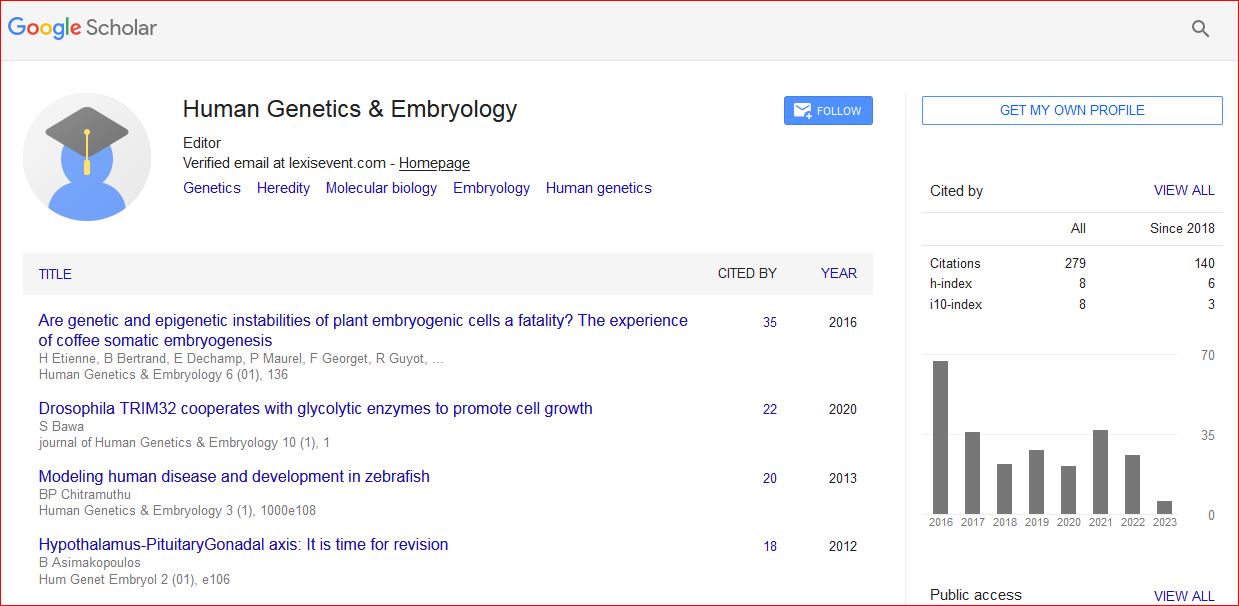
Human Genetics & Embryology received 309 citations as per Google Scholar report