Commentary - (2025) Volume 16, Issue 5
Received: 01-Sep-2025, Manuscript No. jch-26-178780;
Editor assigned: 03-Sep-2025, Pre QC No. P178780;
Reviewed: 17-Sep-2025, QC No. Q-178780;
Revised: 22-Sep-2025, Manuscript No. R-178780;
Published:
29-Sep-2025
, DOI: 10.37421/2157-7099.2025.16.812
Citation: Rodriguez, Maria. ”Gastrointestinal Histopathology: Essential for Diagnosis and Therapy.” J Cytol Histol 16 (2025):812.
Copyright: © 2025 Rodriguez M. This is an open-access article distributed under the terms of the Creative Commons Attribution License, which permits unrestricted use, distribution and reproduction in any medium, provided the original author and source are credited.
The intricate landscape of gastrointestinal diseases necessitates a rigorous diagnostic approach, with histopathological evaluation standing as a cornerstone in discerning the nature and extent of various lesions. This meticulous examination of tissue samples under a microscope is indispensable for differentiating benign conditions from malignant ones, thereby guiding appropriate therapeutic strategies [1].
The accurate classification of colorectal polyps, for instance, is paramount for effective patient management and risk stratification, distinguishing between adenomatous, serrated, and hyperplastic polyps based on their unique morphological characteristics [2].
In the context of gastric adenocarcinoma, precise histopathological staging is directly correlated with prognosis, and understanding the different histological subtypes and their molecular associations is vital for refining diagnoses and predicting treatment responses [3].
Furthermore, the histopathological assessment of inflammatory bowel disease (IBD) provides critical insights for diagnosis, disease activity evaluation, and distinguishing Crohn's disease from ulcerative colitis through characteristic histological findings [4].
Neuroendocrine tumors (NETs) of the gastrointestinal tract also rely heavily on histopathological grading, with mitotic counts and Ki-67 proliferation index being essential for prognosis and treatment guidance [5].
The evaluation of dysplasia in Barrett's esophagus through histopathology is crucial for identifying individuals at increased risk of esophageal adenocarcinoma, necessitating the careful differentiation of low-grade dysplasia, high-grade dysplasia, and intramucosal carcinoma [6].
In the case of gastrointestinal stromal tumors (GISTs), immunohistochemistry plays a pivotal role in their histopathological diagnosis, aiding in differentiation from other mesenchymal tumors and predicting treatment outcomes [7].
Premalignant lesions in the stomach, such as chronic gastritis, intestinal metaplasia, and dysplasia, are critically assessed histopathologically to stratify gastric cancer risk, with microscopic criteria informing diagnostic and surveillance protocols [8].
The integration of molecular pathology with traditional histopathology offers an enhanced approach to diagnosing gastrointestinal lesions, refining diagnoses, and predicting prognosis, particularly for colorectal and gastric cancers [9].
Finally, the histopathological diagnosis of small intestinal lesions, encompassing malabsorption disorders, polyps, and tumors, requires careful recognition of subtle histological changes for accurate diagnosis and management [10].
The foundation of diagnosing and characterizing gastrointestinal lesions lies in comprehensive histopathological evaluation, which enables the critical distinction between benign and malignant conditions, the determination of tumor grade and stage, and the identification of specific molecular markers crucial for therapeutic decision-making [1].
Precise histopathological classification of colorectal polyps is fundamental for patient management and risk stratification, with key morphological features guiding the differentiation of adenomatous, serrated, and hyperplastic polyps, thereby informing surveillance strategies for preventing colorectal cancer [2].
The histopathological features of gastric adenocarcinoma are essential for accurate staging and prognosis, with histological subtypes, molecular alterations, and immunohistochemistry playing significant roles in refining diagnosis and predicting treatment response, ultimately impacting surgical planning and adjuvant therapy recommendations [3].
Histopathological assessment of inflammatory bowel disease is crucial for diagnosis, evaluating disease activity, and differentiating between Crohn's disease and ulcerative colitis, with special stains and immunohistochemistry offering utility in challenging cases [4].
The histopathological grading of gastrointestinal neuroendocrine tumors (NETs) is essential for predicting prognosis and guiding treatment, relying on morphological criteria such as mitotic counts and Ki-67 proliferation index, alongside immunohistochemistry for confirming neuroendocrine differentiation [5].
The histopathological evaluation of dysplasia in Barrett's esophagus is critical for identifying patients at risk of esophageal adenocarcinoma, demanding precise differentiation of low-grade dysplasia, high-grade dysplasia, and intramucosal carcinoma by experienced pathologists [6].
Immunohistochemistry is vital in the histopathological diagnosis of gastrointestinal stromal tumors (GISTs), with markers like KIT (CD117) and DOG1 assisting in differentiation and predicting treatment outcomes [7].
The histopathological features of premalignant lesions in the stomach, including chronic gastritis, intestinal metaplasia, and dysplasia, are crucial for gastric cancer risk stratification, with microscopic criteria correlating with Helicobacter pylori infection and genetic factors to inform diagnostic and surveillance protocols [8].
The synergy of molecular pathology with histopathology provides a more precise diagnostic framework for gastrointestinal lesions, enhancing the identification of specific genetic mutations and protein expression profiles to predict prognosis and guide targeted therapies for cancers such as colorectal and gastric cancer [9].
Histopathological evaluation of small intestinal lesions, from malabsorption disorders to neoplasms, requires the recognition of subtle histological changes to accurately diagnose conditions like celiac disease and various small bowel tumors, ensuring appropriate management [10].
Histopathological evaluation is a critical diagnostic tool for gastrointestinal lesions, aiding in the differentiation of benign from malignant conditions, tumor staging, and guiding therapy. Specific applications include the classification of colorectal polyps for risk stratification, the assessment of gastric adenocarcinoma for prognosis and treatment, and the diagnosis of inflammatory bowel disease. Histopathology is also vital for grading gastrointestinal neuroendocrine tumors, evaluating dysplasia in Barrett's esophagus, diagnosing gastrointestinal stromal tumors using immunohistochemistry, and identifying premalignant lesions in the stomach. The integration of molecular pathology with histopathology offers enhanced diagnostic precision and prognostic prediction for gastrointestinal tumors. Furthermore, the histopathological diagnosis of small intestinal lesions requires careful recognition of subtle features for accurate management.
None
None
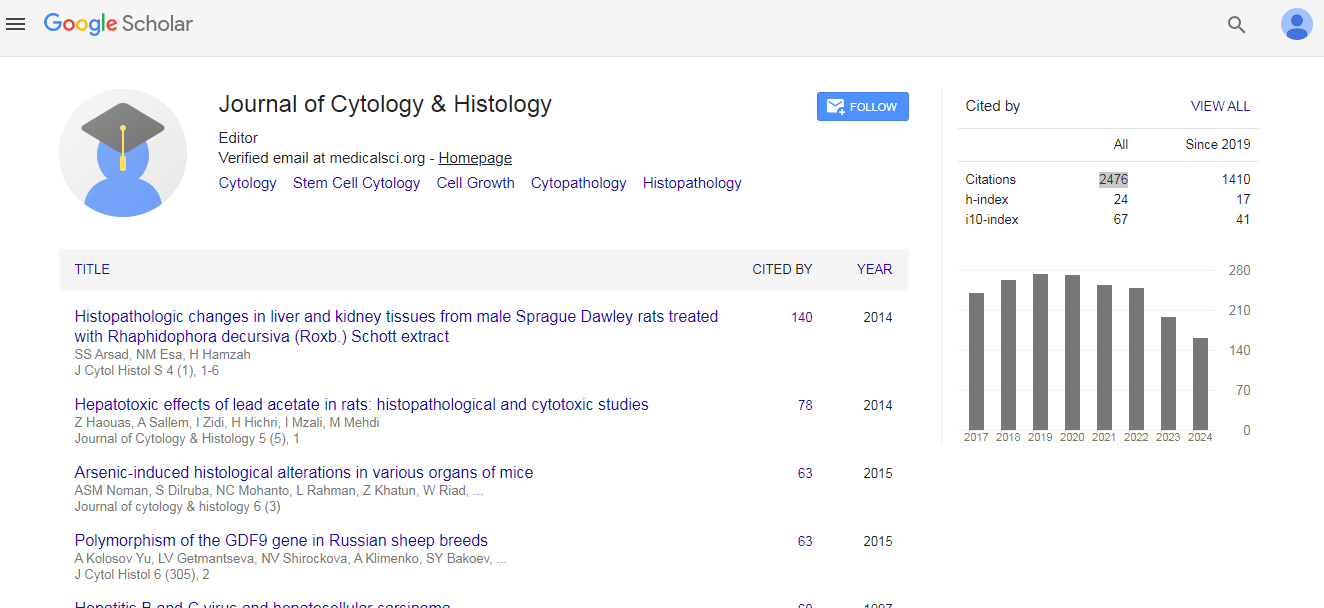
Journal of Cytology & Histology received 2476 citations as per Google Scholar report