Opinion - (2025) Volume 11, Issue 3
Received: 01-Jun-2025, Manuscript No. elj-25-173003;
Editor assigned: 03-Jun-2025, Pre QC No. P-173003;
Reviewed: 17-Jun-2025, QC No. Q-173003;
Revised: 23-Jun-2025, Manuscript No. R-173003;
Published:
30-Jun-2025
, DOI: 10.37421/2472-0895.2025.11.329
Citation: Chen, Lian. ”Functional Brain Mapping: Advancements and Applications.” Epilepsy J 11 (2025):329.
Copyright: © 2025 Chen L. This is an open-access article distributed under the terms of the Creative Commons Attribution License, which permits unrestricted use, distribution and reproduction in any medium, provided the original author and source are credited.
Resting-state functional connectivity (rsFC) analysis is a critical tool for understanding brain function in neurological disorders. This article reviews the fundamental principles of rsFC, discusses various analytical methods like seed-based correlation and independent component analysis, and highlights current challenges in clinical application, particularly regarding data acquisition, processing, and interpretation variability. It underscores the potential of rsFC in diagnosing and monitoring neurological conditions while calling for standardized approaches to improve its utility[1].
High-resolution functional brain mapping benefits significantly from advanced computational methods. This review explores techniques such as source localization, inverse problem solutions, and data-driven approaches that enhance the spatial and temporal precision of functional imaging data. The article emphasizes how sophisticated algorithms and computational frameworks enable deeper insights into brain activity at finer scales, paving the way for improved understanding of neurological processes and disorders[2].
Functional brain mapping plays a crucial role in presurgical planning for neurosurgical interventions. This systematic review synthesizes evidence on how techniques like fMRI, DTI, and MEG are used to delineate eloquent cortex, identify critical functional areas, and minimize postoperative deficits. It highlights the clinical utility of these mapping techniques in enhancing surgical safety and improving patient outcomes in complex brain surgeries, particularly for tumor resections and epilepsy[3].
Understanding dynamic functional brain networks (DFBNs) provides insights into the flexible and adaptive nature of brain activity, diverging from static connectivity models. This review discusses recent advancements in modeling DFBNs, methods for analyzing their temporal fluctuations, and their emerging clinical applications in conditions like psychiatric disorders and neurological diseases. It emphasizes how studying these dynamic properties can offer a more complete picture of brain function and dysfunction[4].
Precision functional mapping using intracranial electrophysiology (iEEG) offers unparalleled spatial and temporal resolution for understanding human brain function. This article explores how iEEG provides direct measurement of neuronal activity, enabling highly accurate localization of functional areas, critical for both basic neuroscience research and personalized neurosurgical interventions. It details the methodologies and challenges involved in translating these precise mappings into clinical practice[5].
Deep learning has revolutionized functional brain imaging by providing powerful tools for data analysis, feature extraction, and prediction. This review surveys the applications of deep learning across various functional neuroimaging modalities, including fMRI, EEG, and MEG. It discusses how these advanced algorithms can identify complex patterns, improve diagnostic accuracy, and contribute to a deeper understanding of brain disorders and cognitive processes[6].
Functional brain connectivity plays a significant role in understanding Autism Spectrum Disorder (ASD). This review summarizes recent findings on aberrant functional brain networks in individuals with ASD, discussing both under- and over-connectivity patterns observed across different brain regions and developmental stages. The article highlights how these insights contribute to better diagnostic markers and potential therapeutic targets for ASD[7].
Functional brain mapping of cognitive control in aging populations reveals age-related changes in brain networks responsible for executive functions. This systematic review explores alterations in prefrontal cortex activity and connectivity during tasks requiring attention, working memory, and inhibition. It sheds light on the neural mechanisms underlying cognitive decline in healthy aging and provides potential biomarkers for early detection of neurodegenerative diseases[8].
Multimodal functional brain imaging combines data from different neuroimaging techniques, such as fMRI, EEG, MEG, and DTI, to provide a more comprehensive view of brain structure and function. This article discusses recent advancements in integrating these diverse data streams, emphasizing how multimodal approaches overcome the limitations of single modalities by enhancing spatial, temporal, and anatomical precision. It highlights applications in understanding complex brain disorders and cognitive processes[9].
Real-time fMRI neurofeedback (rtfMRI-NF) offers a promising non-invasive therapeutic approach for mental disorders by allowing individuals to self-regulate specific brain regions or networks. This review outlines the recent progress in rtfMRI-NF protocols, including target selection, training paradigms, and efficacy across various psychiatric conditions like depression, anxiety, and addiction. It also addresses current challenges and future directions for optimizing rtfMRI-NF as a personalized intervention[10].
Resting-state functional connectivity (rsFC) analysis is a critical tool for understanding brain function in neurological disorders. This article reviews the fundamental principles of rsFC, discusses various analytical methods like seed-based correlation and independent component analysis, and highlights current challenges in clinical application, particularly regarding data acquisition, processing, and interpretation variability. It underscores the potential of rsFC in diagnosing and monitoring neurological conditions while calling for standardized approaches to improve its utility[1].
High-resolution functional brain mapping benefits significantly from advanced computational methods. This review explores techniques such as source localization, inverse problem solutions, and data-driven approaches that enhance the spatial and temporal precision of functional imaging data. The article emphasizes how sophisticated algorithms and computational frameworks enable deeper insights into brain activity at finer scales, paving the way for improved understanding of neurological processes and disorders[2].
Functional brain mapping plays a crucial role in presurgical planning for neurosurgical interventions. This systematic review synthesizes evidence on how techniques like fMRI, DTI, and MEG are used to delineate eloquent cortex, identify critical functional areas, and minimize postoperative deficits. It highlights the clinical utility of these mapping techniques in enhancing surgical safety and improving patient outcomes in complex brain surgeries, particularly for tumor resections and epilepsy[3].
Understanding dynamic functional brain networks (DFBNs) provides insights into the flexible and adaptive nature of brain activity, diverging from static connectivity models. This review discusses recent advancements in modeling DFBNs, methods for analyzing their temporal fluctuations, and their emerging clinical applications in conditions like psychiatric disorders and neurological diseases. It emphasizes how studying these dynamic properties can offer a more complete picture of brain function and dysfunction[4].
Precision functional mapping using intracranial electrophysiology (iEEG) offers unparalleled spatial and temporal resolution for understanding human brain function. This article explores how iEEG provides direct measurement of neuronal activity, enabling highly accurate localization of functional areas, critical for both basic neuroscience research and personalized neurosurgical interventions. It details the methodologies and challenges involved in translating these precise mappings into clinical practice[5].
Deep learning has revolutionized functional brain imaging by providing powerful tools for data analysis, feature extraction, and prediction. This review surveys the applications of deep learning across various functional neuroimaging modalities, including fMRI, EEG, and MEG. It discusses how these advanced algorithms can identify complex patterns, improve diagnostic accuracy, and contribute to a deeper understanding of brain disorders and cognitive processes[6].
Functional brain connectivity plays a significant role in understanding Autism Spectrum Disorder (ASD). This review summarizes recent findings on aberrant functional brain networks in individuals with ASD, discussing both under- and over-connectivity patterns observed across different brain regions and developmental stages. The article highlights how these insights contribute to better diagnostic markers and potential therapeutic targets for ASD[7].
Functional brain mapping of cognitive control in aging populations reveals age-related changes in brain networks responsible for executive functions. This systematic review explores alterations in prefrontal cortex activity and connectivity during tasks requiring attention, working memory, and inhibition. It sheds light on the neural mechanisms underlying cognitive decline in healthy aging and provides potential biomarkers for early detection of neurodegenerative diseases[8].
Multimodal functional brain imaging combines data from different neuroimaging techniques, such as fMRI, EEG, MEG, and DTI, to provide a more comprehensive view of brain structure and function. This article discusses recent advancements in integrating these diverse data streams, emphasizing how multimodal approaches overcome the limitations of single modalities by enhancing spatial, temporal, and anatomical precision. It highlights applications in understanding complex brain disorders and cognitive processes[9].
Real-time fMRI neurofeedback (rtfMRI-NF) offers a promising non-invasive therapeutic approach for mental disorders by allowing individuals to self-regulate specific brain regions or networks. This review outlines the recent progress in rtfMRI-NF protocols, including target selection, training paradigms, and efficacy across various psychiatric conditions like depression, anxiety, and addiction. It also addresses current challenges and future directions for optimizing rtfMRI-NF as a personalized intervention[10].
Functional brain mapping and connectivity analyses are pivotal for understanding brain function and dysfunction in neurological and psychiatric disorders. Resting-state functional connectivity (rsFC) analysis is a critical tool for investigating brain function in neurological disorders, despite challenges in data acquisition and interpretation variability. Advanced computational methods, including source localization and data-driven approaches, significantly improve the spatial and temporal precision of functional imaging, offering deeper insights into brain activity. Functional brain mapping also plays a vital role in neurosurgical planning, using methods such as fMRI, Diffusion Tensor Imaging (DTI), and Magnetoencephalography (MEG) to delineate critical functional areas and enhance surgical safety. Dynamic functional brain networks (DFBNs) offer a more complete understanding of brain activity by revealing its flexible and adaptive nature, with emerging clinical applications in conditions like psychiatric and neurological diseases. Precision functional mapping, particularly with intracranial electrophysiology (iEEG), provides unparalleled resolution for localizing functional areas, benefiting both basic neuroscience and personalized neurosurgical interventions. Deep learning algorithms have transformed functional brain imaging by enabling powerful data analysis, feature extraction, and prediction across various modalities including fMRI, Electroencephalography (EEG), and MEG. This helps in identifying complex patterns and improving diagnostic accuracy for brain disorders. Functional brain connectivity studies are also shedding light on conditions like Autism Spectrum Disorder (ASD), by identifying aberrant network patterns that could serve as diagnostic markers and therapeutic targets. Functional brain mapping of cognitive control in aging populations highlights age-related changes in brain networks, providing potential biomarkers for early detection of neurodegenerative diseases. Multimodal functional brain imaging, which integrates data from fMRI, EEG, MEG, and DTI, offers a more comprehensive view by combining the strengths of different techniques, enhancing spatial, temporal, and anatomical precision. Real-time fMRI neurofeedback (rtfMRI-NF) is an innovative therapeutic approach allowing individuals to self-regulate specific brain regions, showing promise for various mental disorders. These diverse advancements collectively push the boundaries of neuroscience, offering new diagnostic tools, therapeutic strategies, and a deeper understanding of the human brain across various states and conditions.
None
None
Indexed at, Google Scholar, Crossref
Indexed at, Google Scholar, Crossref
Indexed at, Google Scholar, Crossref
Indexed at, Google Scholar, Crossref
Indexed at, Google Scholar, Crossref
Indexed at, Google Scholar, Crossref
Indexed at, Google Scholar, Crossref
Indexed at, Google Scholar, Crossref
Indexed at, Google Scholar, Crossref
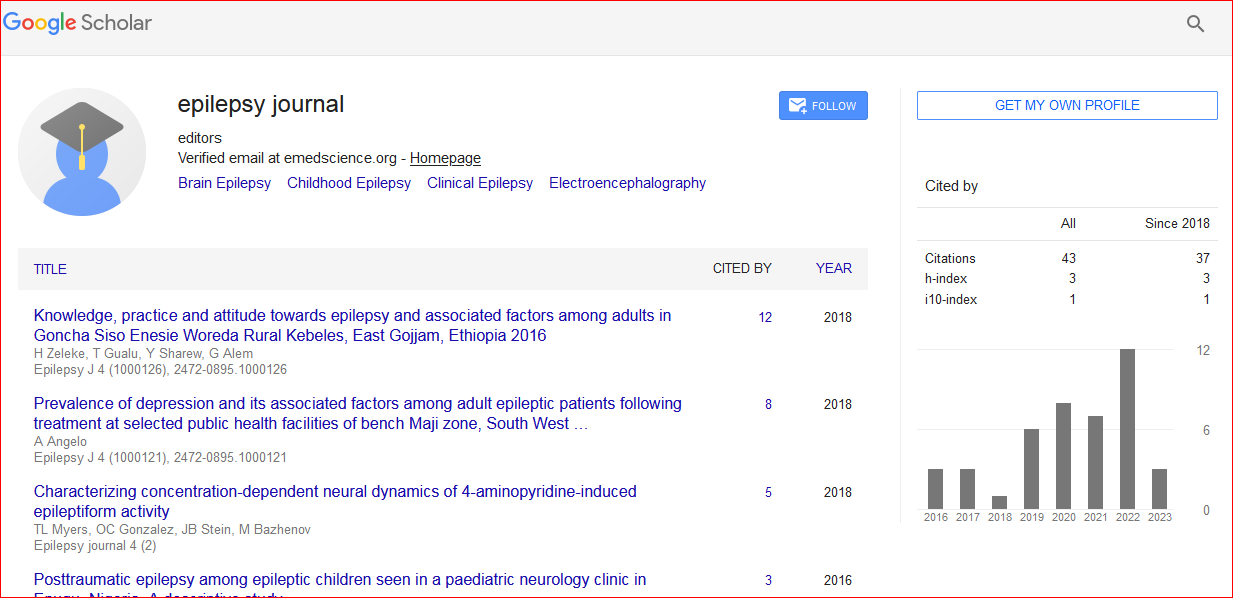
Epilepsy Journal received 41 citations as per Google Scholar report