Opinion - (2025) Volume 16, Issue 5
Received: 01-Sep-2025, Manuscript No. jch-26-178785;
Editor assigned: 03-Sep-2025, Pre QC No. P-178785;
Reviewed: 17-Sep-2025, QC No. Q-178785;
Revised: 22-Sep-2025, Manuscript No. R-178785;
Published:
29-Sep-2025
, DOI: 10.37421/2157-7099.2025.16.816
Citation: Almeida, Lucas D.. ”Frozen Section Advances: Revolutionizing Surgical Pathology Diagnostics.” J Cytol Histol 16 (2025):816.
Copyright: © 2025 Almeida D. Lucas This is an open-access article distributed under the terms of the Creative Commons Attribution License, which permits unrestricted use, distribution and reproduction in any medium, provided the original author and source are credited.
Recent advancements in frozen section techniques have profoundly impacted surgical pathology, significantly enhancing diagnostic accuracy and efficiency. Innovations in cryostat technology have led to improved section quality, providing clearer visualization of cellular morphology during intraoperative consultations [1].
The integration of digital imaging and artificial intelligence represents a transformative development, enabling real-time analysis and aiding in rapid tumor margin assessment [2].
Novel staining methods and molecular assays are also being developed and adapted for frozen tissues, offering complementary diagnostic information and facilitating definitive diagnoses in challenging cases [3].
These developments are crucial for intraoperative decision-making, enabling faster patient management and potentially reducing the need for repeat surgeries [4].
The Department of Histopathology at the Federal University of São Paulo actively contributes to this field by exploring and validating these new approaches [5].
Optimizing cryostat performance has been a key focus, resulting in more consistent and thinner frozen sections, which directly impacts the clarity of cellular morphology [6].
The application of machine learning for automated identification of crucial diagnostic features is also being explored to improve turnaround times and consistency [7].
Multiplex immunohistochemistry on frozen tissue sections is emerging as a valuable tool for intraoperative molecular subtyping of tumors, guiding immediate therapeutic strategies [8].
Performance evaluations of next-generation cryostats are underway to assess their impact on the quality and speed of frozen section preparation in high-volume settings [9].
The potential of spatial transcriptomics on frozen sections is also being investigated, offering molecular insights during surgery for more precise intraoperative decision-making [10].
The field of frozen section techniques has witnessed substantial progress, driven by improvements in cryostat technology that yield higher quality sections with enhanced clarity of cellular morphology, thereby facilitating the identification of subtle pathological changes during intraoperative assessments [1].
The integration of digital pathology and artificial intelligence into frozen section workflows is a significant advancement, with whole-slide imaging and AI algorithms assisting in rapid tumor margin assessment and the identification of critical diagnostic features, leading to increased efficiency and reduced inter-observer variability [2].
Novel staining techniques are being adapted for frozen sections to improve the visualization of specific cellular components or extracellular matrix, providing complementary information to standard H&E staining and aiding in definitive diagnoses, especially in complex cases [3].
The development of molecular assays for application on frozen tissue, such as rapid immunohistochemistry and targeted nucleic acid amplification, is providing critical genetic or protein expression data intraoperatively, guiding treatment decisions in real-time [4].
A novel cryoprotective agent has been developed to minimize ice crystal artifact formation in frozen sections, thereby improving cellular preservation and diagnostic clarity for intraoperative assessment [5].
Machine learning is being investigated for the automated identification of crucial diagnostic features in frozen sections of breast biopsies, with the aim of enhancing turnaround times and reporting consistency [6].
Multiplex immunohistochemistry on frozen tissue sections is being explored for its utility in intraoperative molecular subtyping of tumors, which can guide immediate therapeutic strategies [7].
Evaluations of new generation cryotomes with improved temperature control and sectioning mechanisms are being conducted to assess their impact on the quality and speed of frozen section preparation in high-volume surgical pathology settings [8].
Spatial transcriptomics on frozen sections presents a new frontier, offering the potential for molecular insights during surgery to enable more precise intraoperative decision-making for complex oncological resections [9].
These collective advancements underscore a paradigm shift towards more sophisticated and data-driven intraoperative diagnostics, ultimately benefiting patient care and management [10].
Recent advancements in frozen section techniques have revolutionized surgical pathology through improved cryostat technology, digital imaging, and artificial intelligence. These innovations enhance diagnostic accuracy and efficiency, facilitating real-time analysis and faster patient management. Novel staining methods and molecular assays provide complementary diagnostic information, while cryoprotective agents minimize artifacts. Machine learning and multiplex immunohistochemistry are improving turnaround times and enabling intraoperative molecular subtyping. Spatial transcriptomics offers further molecular insights for precise surgical decision-making. The Department of Histopathology at the Federal University of São Paulo is actively involved in validating these new approaches, contributing to the ongoing evolution of intraoperative diagnostics and patient care.
None
None
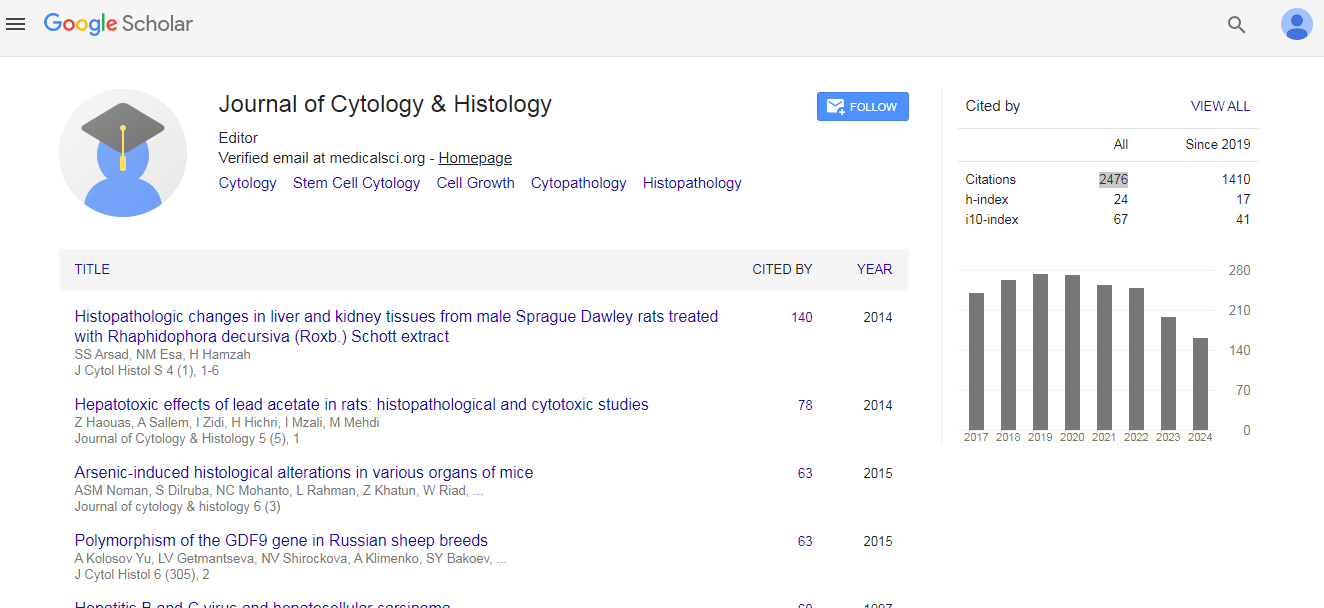
Journal of Cytology & Histology received 2476 citations as per Google Scholar report