Opinion - (2025) Volume 16, Issue 6
Received: 01-Nov-2025, Manuscript No. jpm-26-179471;
Editor assigned: 03-Nov-2025, Pre QC No. P-179471;
Reviewed: 17-Nov-2025, QC No. Q-179471;
Revised: 24-Nov-2025, Manuscript No. R-179471;
Published:
29-Nov-2025
, DOI: 10.37421/2090-0902.2025.16.563
Citation: Moretti, Lucas. ”Fractional Differential Equations: Modeling Complex Physics Phenomena.” J Phys Math 16 (2025):563.
Copyright: © 2025 Moretti L. This is an open-access article distributed under the terms of the Creative Commons Attribution License, which permits unrestricted use, distribution and reproduction in any medium, provided the original author and source are credited.
Fractional differential equations (FDEs) are emerging as powerful mathematical tools for modeling intricate phenomena across various scientific disciplines, offering a more sophisticated description than traditional integer-order equations. Their unique ability to capture long-range dependencies and memory effects makes them particularly adept at describing systems that exhibit anomalous diffusion, viscoelastic behavior, and wave propagation in complex media. This foundational understanding allows for deeper insights into the dynamics of these systems, moving beyond the limitations of classical models. The theoretical underpinnings and practical applications of FDEs in physical modeling are being extensively explored, revealing how fractional calculus provides a more nuanced perspective on system behavior [1].
The incorporation of fractional derivatives has significantly advanced the accuracy of modeling viscoelastic materials, extending capabilities beyond the constraints of standard linear solid models. This approach allows for a more precise description of the stress-strain behavior of polymers and other viscoelastic substances, encompassing both frequency-dependent and time-dependent responses. The inherent flexibility of fractional calculus enables a tighter fit to experimental data, thereby uncovering underlying material properties that might be obscured by simpler mathematical frameworks [2].
Wave propagation through complex media, such as porous geological formations or biological tissues, frequently displays dispersive and attenuative characteristics that are not adequately represented by conventional wave equations. Investigations into the application of fractional wave equations address these limitations. By utilizing fractional derivatives, these models can intrinsically describe wave attenuation and dispersion arising from the intricate microstructures of the medium, leading to more realistic simulations of phenomena like seismic wave and ultrasound propagation [3].
Anomalous diffusion, a phenomenon characterized by particle displacement variance that does not scale linearly with time, is observed ubiquitously in diverse physical systems. Comprehensive analyses demonstrate how FDEs, particularly the fractional Fokker-Planck equation, can precisely characterize various forms of anomalous diffusion, including subdiffusion and superdiffusion. The fractional order directly correlates with the anomalous diffusion exponent, establishing a potent framework for studying transport processes in disordered environments [4].
Fractional calculus offers a sophisticated methodology for modeling the dynamics of complex systems that exhibit memory effects and non-local influences. The application of FDEs in statistical physics is particularly noteworthy, especially for describing systems with long-range interactions and history-dependent behaviors. In these contexts, the fractional order serves as a parameter that quantifies the extent of non-locality or memory, thereby providing a more generalized modeling framework compared to traditional differential equations [5].
The practical implementation of FDEs in physical modeling necessitates robust numerical methods. This area of research focuses on reviewing and extending existing numerical techniques, such as finite difference and spectral methods, to efficiently and accurately solve various classes of FDEs. Addressing the inherent challenges posed by the non-local nature of fractional derivatives is paramount for establishing a solid foundation for computational investigations of fractional-order physical systems [6].
This paper delves into the application of fractional calculus to model heat transfer phenomena within materials characterized by complex microstructures or inherent memory effects. Traditional Fourier's law of heat conduction is extended through the use of fractional derivatives to account for non-local heat conduction. This adaptation is crucial for accurately describing materials that exhibit anomalous thermal transport, providing a more faithful representation of temperature distribution and evolution [7].
Electrochemical systems often exhibit complex dynamic behaviors attributable to surface effects, diffusion limitations, and charge transfer processes that possess memory characteristics. This research investigates the utility of fractional calculus in developing more precise models for electrochemical impedance spectroscopy (EIS) and other electrochemical techniques. Fractional-order models are particularly effective in capturing the fractal nature of electrode surfaces and the fractional-order kinetics governing electrochemical reactions [8].
The study of quantum systems influenced by memory effects represents an evolving frontier where fractional calculus provides innovative approaches. This work introduces the concept of fractional Schrödinger equations designed to describe quantum systems whose temporal evolution is contingent upon their past states. Such models are pertinent for understanding quantum transport in disordered systems and open quantum systems where decoherence processes inherently involve memory, offering a direct means to incorporate non-Markovian effects into quantum dynamics [9].
This research specifically examines the application of fractional calculus in modeling the behavior of chaotic systems that exhibit long-term memory. By incorporating fractional derivatives into the governing equations, the chaotic dynamics can be more accurately depicted, particularly in systems where the history of past states significantly influences the current trajectory. The study further investigates how variations in fractional orders impact key characteristics such as Lyapunov exponents and fractal dimensions, thereby yielding novel insights into the nature of fractional chaos [10].
Fractional differential equations (FDEs) are proving to be powerful tools for modeling complex phenomena in physics, offering a more nuanced description than their integer-order counterparts. Their ability to capture long-range dependencies and memory effects makes them particularly well-suited for systems exhibiting anomalous diffusion, viscoelasticity, and wave propagation in heterogeneous media. This work explores the theoretical underpinnings and practical applications of FDEs in physical modeling, highlighting how fractional calculus can provide deeper insights into the dynamics of these systems [1].
The incorporation of fractional derivatives significantly enhances the accuracy of modeling viscoelastic materials, moving beyond the limitations of standard linear solid models. This paper delves into the application of FDEs to describe the stress-strain behavior of polymers and other viscoelastic substances, considering the frequency-dependent and time-dependent responses. The flexibility of fractional calculus allows for fitting experimental data with greater precision, revealing underlying material properties that are often obscured by simpler models [2].
Wave propagation in complex media, such as porous rocks or biological tissues, often exhibits dispersive and attenuative characteristics that are not well captured by classical wave equations. This research investigates the use of fractional wave equations to model these phenomena. By employing fractional derivatives, the model can intrinsically describe the wave attenuation and dispersion due to the complex microstructure of the medium, leading to more realistic simulations of seismic waves and ultrasound propagation [3].
Anomalous diffusion, where particle displacement variance does not scale linearly with time, is a ubiquitous phenomenon in physical systems. This article presents an in-depth analysis of how FDEs, particularly the fractional Fokker-Planck equation, can precisely describe various forms of anomalous diffusion, including subdiffusion and superdiffusion. The fractional order directly corresponds to the anomalous diffusion exponent, offering a powerful framework for studying transport processes in disordered environments [4].
The fractional calculus offers a sophisticated approach to modeling the dynamics of complex systems that exhibit memory and non-local effects. This paper explores the application of FDEs in statistical physics, particularly in describing systems with long-range interactions and history-dependent behaviors. The fractional order acts as a parameter that quantifies the degree of non-locality or memory, providing a more generalized framework than traditional differential equations [5].
Numerical methods for solving FDEs are crucial for their practical application in physical modeling. This work reviews and extends existing numerical techniques, such as finite difference methods and spectral methods, to efficiently and accurately solve various types of FDEs. The challenges associated with the non-local nature of fractional derivatives are addressed, providing a foundation for computational investigations of fractional-order physical systems [6].
This paper examines the application of fractional calculus to model heat transfer in materials with complex microstructures or memory effects. Traditional Fourier's law is extended using fractional derivatives to describe non-local heat conduction, which is essential for materials exhibiting anomalous thermal transport. The fractional heat equation provides a more accurate representation of temperature distribution and evolution in such systems [7].
Electrochemical systems often display complex dynamic behaviors that can be attributed to surface effects, diffusion limitations, and charge transfer processes with memory. This research explores the utilization of fractional calculus to develop more accurate models for electrochemical impedance spectroscopy (EIS) and other electrochemical techniques. The fractional-order models can capture the fractal nature of electrode surfaces and the fractional-order kinetics of reactions [8].
The study of quantum systems with memory effects is an emerging area where fractional calculus offers novel approaches. This paper introduces fractional Schrödinger equations to describe quantum systems whose evolution depends on their past states. Such models are relevant for understanding quantum transport in disordered systems and open quantum systems where decoherence involves memory. The fractional approach provides a way to incorporate non-Markovian effects directly into the quantum dynamics [9].
This work focuses on the application of fractional calculus to model the behavior of chaotic systems exhibiting long-term memory. By introducing fractional derivatives into the governing equations, the chaotic dynamics can be better described, especially in systems where the memory of past states influences the present trajectory. The study explores how fractional orders affect the Lyapunov exponents and fractal dimensions, providing new insights into the nature of fractional chaos [10].
Fractional differential equations (FDEs) are increasingly utilized in physics to model complex systems exhibiting memory and long-range dependencies. They offer enhanced accuracy in describing anomalous diffusion, viscoelasticity, wave propagation in heterogeneous media, and heat transfer in materials with complex microstructures. FDEs also provide more precise models for electrochemical systems and quantum dynamics with memory effects, as well as chaotic systems. The development of efficient numerical methods is crucial for their application. Fractional calculus provides a generalized framework for understanding phenomena that traditional integer-order differential equations cannot adequately capture.
None
None
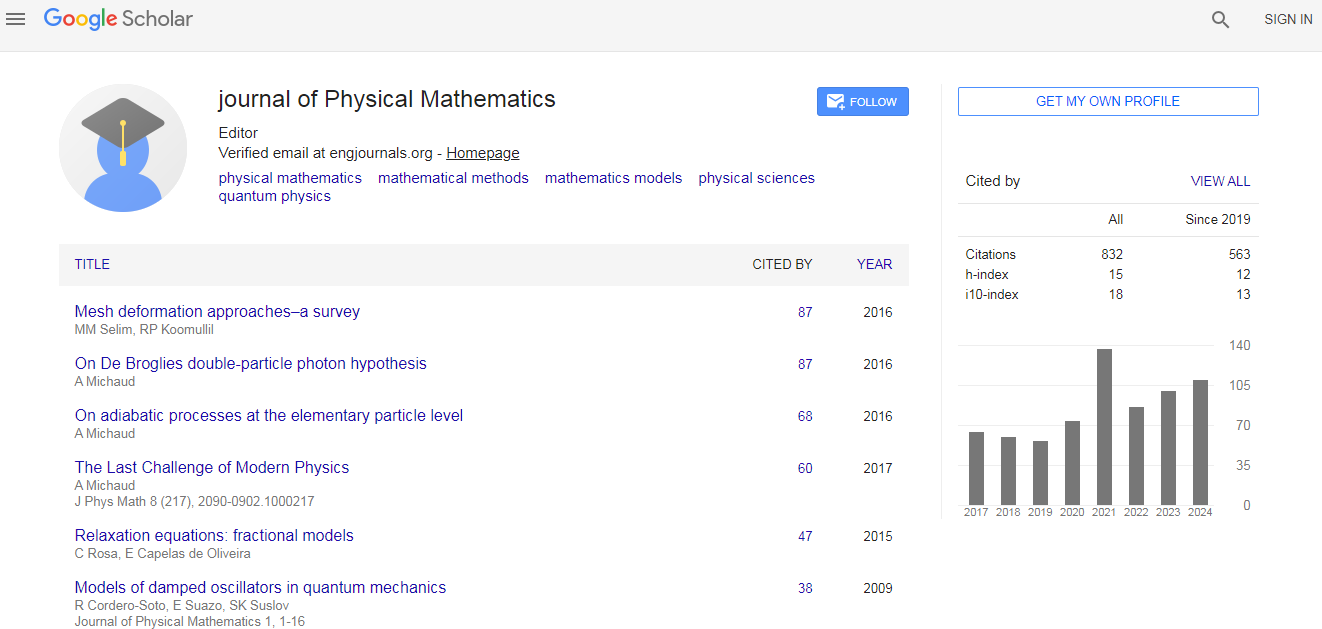
Physical Mathematics received 686 citations as per Google Scholar report