Opinion - (2025) Volume 16, Issue 4
Received: 01-Aug-2025, Manuscript No. jfr-26-184113;
Editor assigned: 04-Aug-2025, Pre QC No. P-184113;
Reviewed: 18-Aug-2025, QC No. Q-184113;
Revised: 22-Aug-2025, Manuscript No. R-184113;
Published:
29-Aug-2025
, DOI: 10.37421/2157-7145.2025.16.674
Citation: Popescu, Elena. ”Forensic Toxicology: Advancements
and Challenges in Detection.” J Forensic Res 16 (2025):674.
Copyright: © 2025 Popescu E. This is an open-access article distributed under the terms of the Creative Commons Attribution License, which permits unrestricted use,
distribution and reproduction in any medium, provided the original author and source are credited.
The field of forensic toxicology is continuously evolving, driven by the need for sophisticated methodologies to identify and quantify a wide array of substances in biological and environmental samples. Advanced analytical techniques are at the forefront of these developments, enabling more precise and rapid detection of toxic agents, which is paramount in forensic investigations. These advancements are crucial for establishing cause of death, understanding the circumstances of poisoning, and contributing to criminal justice proceedings. The integration of cutting-edge technologies allows toxicologists to tackle complex cases involving novel substances and intricate matrices, thereby enhancing the reliability and scope of forensic analysis.
Recent progress in forensic toxicology has been marked by significant strides in analytical instrumentation and methodology, aiming to overcome persistent challenges. This includes the development of more sensitive and specific assays for detecting both traditional and emerging toxicants. The ability to analyze complex biological samples, often in trace amounts, requires sophisticated sample preparation and highly advanced detection systems. The continuous pursuit of innovation in this domain is essential to keep pace with the ever-changing landscape of toxins and drugs of abuse encountered in forensic casework. The robust application of these techniques ensures that forensic investigations are grounded in sound scientific evidence. The detection and analysis of synthetic opioids represent a critical area of focus within forensic toxicology due to their escalating prevalence and profound public health impact. The chemical diversity and rapid emergence of new synthetic opioid analogs pose significant challenges for toxicology laboratories. Developing and validating analytical methods capable of identifying these novel compounds and their metabolites in biological specimens is a continuous effort. This requires constant vigilance and adaptation of forensic databases and analytical strategies to effectively address this evolving threat. The accurate identification of these substances is vital for law enforcement and public health initiatives. Forensic investigations involving pesticides require specialized analytical approaches due to the vast number of compounds and their varied toxicological profiles. Understanding the chemical classes of pesticides and their specific toxic effects is fundamental to interpreting analytical findings. Chromatographic and spectroscopic techniques play a vital role in their identification, particularly in post-mortem samples where degradation and metabolite formation can complicate analysis. Emphasizing the study of these degradation pathways and the identification of metabolites is crucial for a comprehensive forensic assessment. The meticulous analysis of pesticide-related cases contributes to a better understanding of poisoning incidents. The application of high-resolution mass spectrometry (HRMS) has revolutionized the comprehensive screening and identification of various drugs, including anxiolytics, in biological fluids. HRMS offers unparalleled accuracy and sensitivity, enabling the precise determination of a broad spectrum of benzodiazepines and their related compounds. This capability is particularly indispensable in forensic investigations, especially in cases involving drug-facilitated crimes where accurate identification of the administered substances is critical for establishing the sequence of events. The precision offered by HRMS significantly enhances the evidential value of toxicological findings. The phenomenon of post-mortem redistribution of drugs and toxins presents a significant challenge in forensic toxicology, influencing the interpretation of analytical results. This redistribution is influenced by various physiological and environmental factors, including the chemical properties of the substance, the pH of the tissues, and the time elapsed since death. Forensic toxicologists must understand these factors to accurately interpret toxicological findings and account for potential variations in drug concentrations. The development and implementation of standardized protocols are essential to mitigate and manage these redistribution effects, ensuring the reliability of post-mortem toxicological data. The development of highly sensitive and specific analytical methods is crucial for the forensic detection of potent toxins, such as ricin, which are relevant in cases of bioterrorism and deliberate poisoning. Liquid chromatography-tandem mass spectrometry (LC-MS/MS) has emerged as a powerful tool for the quantitative analysis of trace amounts of these toxins in forensic samples. The inherent challenges in ricin detection, including its extremely low toxicity threshold, necessitate assays with exceptional sensitivity and specificity. Validated methods like the one discussed are invaluable for investigating suspected bioterrorism incidents and ensuring public safety. Forensic analysis of heavy metal poisoning demands robust analytical techniques capable of detecting and quantifying these elements in various biological matrices. Common heavy metal toxicants, such as lead, mercury, and arsenic, exert significant toxic effects, and their identification is critical in poisoning investigations. Techniques like atomic absorption spectroscopy (AAS) and inductively coupled plasma mass spectrometry (ICP-MS) are indispensable for this purpose, providing the sensitivity and specificity required for accurate analysis. A comprehensive review of these analytical methods aids in understanding and addressing heavy metal-related fatalities. The forensic investigation of novel psychoactive substances (NPS) has become increasingly complex due to the continuous emergence of new compounds. Oral fluid analysis, utilizing techniques like liquid chromatography-tandem mass spectrometry (LC-MS/MS), offers a valuable alternative or complementary matrix to blood for both post-mortem and antemortem investigations. Its ease of collection and correlation with blood concentrations make it a practical option for screening and confirmatory testing. Method validation and application in real forensic cases underscore the utility of this approach in identifying NPS. Volatile organic compounds (VOCs) can play a significant role in poisoning cases, and their forensic toxicology requires specialized analytical approaches. Understanding the sources, toxicological effects, and analytical methods for VOC detection is crucial. Headspace gas chromatography-mass spectrometry (HS-GC-MS) is a primary technique employed for their analysis in biological samples. Interpreting VOC results necessitates a thorough understanding of exposure pathways, considering potential environmental and occupational sources, to accurately assess their contribution to a poisoning event. This detailed analysis is vital for comprehensive forensic evaluation.The field of forensic toxicology is characterized by its reliance on advanced analytical methodologies to accurately detect and quantify a diverse range of substances in various biological and environmental samples. The rapid and precise identification of toxic agents is a cornerstone of effective forensic investigations, with modern analytical techniques such as mass spectrometry and chromatography playing pivotal roles. These methods are essential for analyzing complex matrices, including biological specimens, and for the ongoing development of new biomarkers and detection strategies to address emerging threats. The continuous refinement of analytical capabilities is crucial for the integrity and advancement of forensic science.
Forensic science is continually seeking to enhance its analytical capabilities to meet the evolving challenges posed by the ever-increasing number of chemical substances encountered. This includes the development of sensitive and specific detection methods for both traditional and novel compounds. The ability to analyze complex biological samples, often containing trace amounts of target analytes, necessitates sophisticated sample preparation techniques and highly advanced analytical instrumentation. The dynamic nature of toxicology demands ongoing research and development to ensure that forensic laboratories remain equipped to handle the most challenging cases, thereby supporting accurate and reliable scientific evidence. A significant area of concern within forensic toxicology is the rise of synthetic opioids. These substances present unique challenges due to their increasing prevalence and the constant introduction of new analogs. Forensic laboratories are tasked with developing and validating analytical methods to detect these novel compounds and their metabolites in biological samples. This necessitates continuous monitoring of drug trends and the systematic updating of forensic databases and analytical protocols. The effective identification of these substances is critical for both public health and criminal justice purposes. In cases involving pesticide poisoning, forensic toxicologists face the challenge of analyzing a wide array of compounds with diverse toxicological profiles. Various classes of pesticides require specific analytical approaches for their identification in biological samples, particularly post-mortem specimens. Chromatographic and spectroscopic techniques are the primary tools employed in this endeavor. Furthermore, understanding the degradation pathways and the formation of metabolites is essential for a comprehensive interpretation of analytical findings and for reconstructing the events of a poisoning case. The utility of high-resolution mass spectrometry (HRMS) in forensic toxicology is increasingly recognized for its comprehensive screening and identification capabilities, particularly for anxiolytic drugs and their metabolites. HRMS provides exceptional accuracy and sensitivity, allowing for the precise quantification of a wide range of benzodiazepines and related compounds in biological fluids. This advanced analytical technique is invaluable in forensic investigations, especially in cases of drug-facilitated crimes, where accurate identification of the drug is paramount for establishing the circumstances and culpability. Post-mortem redistribution of drugs and toxins is a well-documented phenomenon that can significantly impact the interpretation of toxicological results. Factors such as the chemical properties of the substance, tissue pH, and the post-mortem interval influence the extent of this redistribution. Forensic toxicologists must possess a thorough understanding of these influencing factors to accurately interpret toxicological findings and account for potential variations in drug concentrations observed in different biological samples. Standardized protocols are crucial for minimizing and addressing these effects. The forensic detection of potent toxins, such as ricin, which can be relevant in cases of bioterrorism, requires highly sensitive and specific analytical methods. The development and validation of such methods, often employing techniques like liquid chromatography-tandem mass spectrometry (LC-MS/MS), are critical. Ricin's low toxicity threshold presents a significant analytical challenge, demanding assays with exceptional sensitivity and specificity. Validated methods are essential tools for investigating suspected incidents and ensuring public safety through timely detection. Forensic investigations of heavy metal poisoning rely on robust analytical techniques for accurate detection and quantification. Common heavy metal toxicants and their mechanisms of action are well-studied, but their identification in diverse biological matrices requires specialized methods. Atomic absorption spectroscopy (AAS) and inductively coupled plasma mass spectrometry (ICP-MS) are the primary analytical tools used in this area, offering the necessary sensitivity and selectivity to identify these elements. A comprehensive understanding of these techniques is vital for analyzing poisoning cases. Novel psychoactive substances (NPS) pose a continuous challenge in forensic toxicology due to their rapid evolution. The analysis of oral fluid using liquid chromatography-tandem mass spectrometry (LC-MS/MS) offers a practical approach for both antemortem and post-mortem investigations. Oral fluid is easily collected and often correlates well with blood concentrations, making it a valuable matrix for screening and confirmatory testing. Method validation and its application in real forensic cases highlight the significance of this technique for identifying NPS. The forensic toxicology of volatile organic compounds (VOCs) is important in understanding poisoning cases. These compounds can originate from various sources, and their toxicological effects necessitate specific analytical methods for their detection and quantification in biological samples. Headspace gas chromatography-mass spectrometry (HS-GC-MS) is commonly employed for VOC analysis. Accurate interpretation of results requires careful consideration of potential exposure pathways, including environmental and occupational exposures, to determine their relevance in a forensic context.This collection of research highlights advancements and challenges in forensic toxicology, focusing on the detection and analysis of various toxic substances. Key areas include the application of sophisticated analytical techniques like mass spectrometry and chromatography for identifying poisons and toxins, with specific attention to emerging synthetic opioids and plant-derived toxins. The papers also address challenges such as the post-mortem redistribution of drugs, the forensic analysis of pesticides and heavy metals, and the utility of methods like HRMS and LC-MS/MS for detecting anxiolytics and novel psychoactive substances in biological fluids and oral fluid. The importance of developing sensitive and specific assays for potent toxins and understanding exposure pathways for volatile organic compounds is also emphasized, underscoring the continuous evolution of forensic toxicology to meet contemporary challenges.
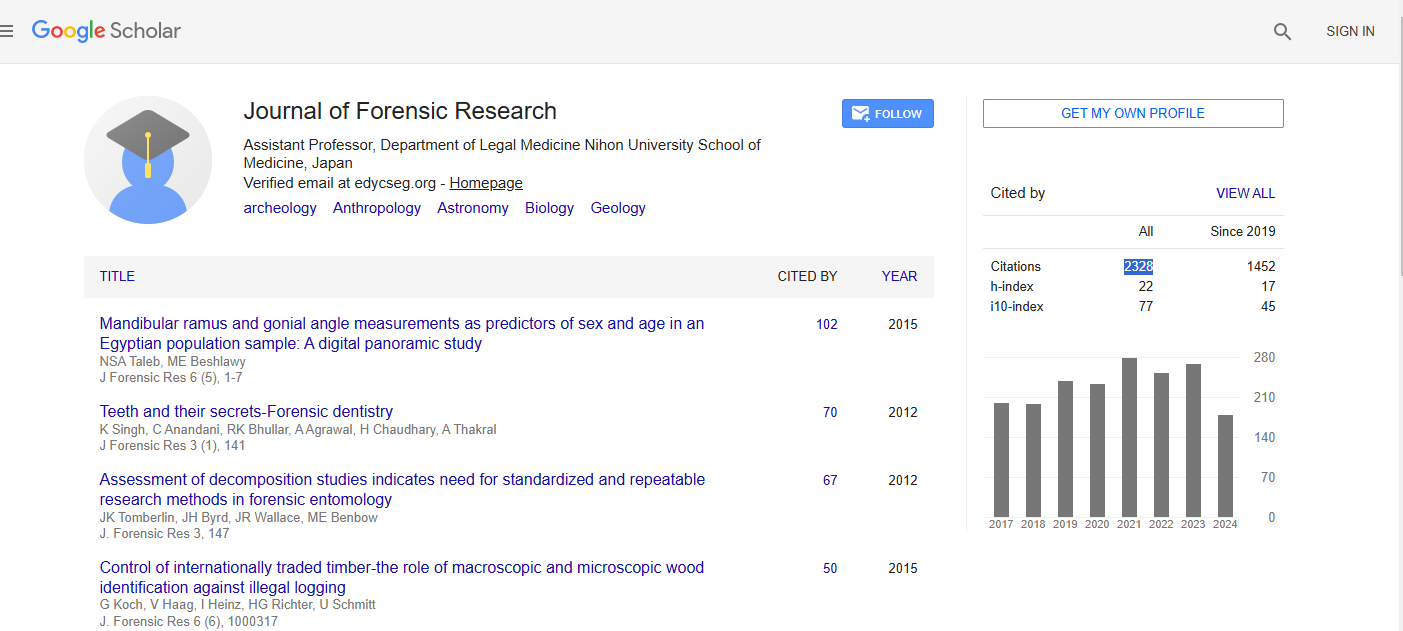
Journal of Forensic Research received 2328 citations as per Google Scholar report